ACWR in Football: How to Use It Safely and Effectively (Coach’s Guide)
This guide explains ACWR (Acute:Chronic Workload Ratio) in simple terms, shows how to calculate it with a 7-day acute and 21-day chronic window (the method Fractall uses), and how to apply it safely and effectively in football, especially in small and medium clubs.
ACWR Explained: A Simple Definition for Coaches
ACWR stands for Acute:Chronic Workload Ratio.
At Fractall, we use:
- Acute workload (7 days) = total training + match load from the last 7 days
- Chronic workload (21 days) = the average load from the previous 21 days (the last 3 weeks)
The formula is:
ACWR = Acute Workload (7 days) ÷ Chronic Workload (21-day average)
Think of it like this:
- Acute = “What has the player done in the last week?”
- Chronic = “What has the player been conditioned to handle over the last three weeks?”
If the 7-day load is much higher than the 21-day average, ACWR goes up and may indicate increased risk or an aggressive progression in training load.
Coach Takeaway:
ACWR compares this week’s load with the player’s 3-week “fitness base”. It does not predict injuries, but it helps you spot big jumps that deserve attention.
Why ACWR Matters in Football
Football is full of variables:
- Fixture congestion and cup runs
- Players jumping from bench roles to 90-minute starters
- Travel, school/work, and lifestyle stress
- Changing tactical demands and positions
Research in team sports has consistently found that rapid spikes in training and match load are linked to greater injury risk, while well-managed chronic load can be protective. International consensus statements from organisations linked to FIFA and the IOC underline the importance of tracking load and athlete well-being over time.
ACWR helps you:
- Flag sudden increases in load across 7 days compared with the previous 21 days
- Plan gradual progressions in pre-season and in-season
- Manage return-to-play after injury
- Monitor players taking on new roles or more minutes
Coach Takeaway:
ACWR is a load management compass. It tells you whether you’re staying close to what players are conditioned for, or jumping too far, too fast.
How We Calculate ACWR with 7-Day Acute and 21-Day Chronic
To keep things Accessible, we’ll use internal training load based on session-RPE, which any club can implement without GPS.
If you need the basics on RPE and training load, start here:
👉 RPE Basics for Coaches: How to Use Session-RPE to Monitor Training Load
Step 1 – Define Your Load Metric
We use:
Session Load = RPE × Session Duration (minutes)
Then we sum across sessions to get:
Daily Load = Sum of those session loads on that day
And from there:
- Acute Load (7 days) = sum of the last 7 days of load
- Chronic Load (21 days) = average of the previous 21 days of load
Step 2 – Collect a Few Weeks of Data
For ACWR to be meaningful, you need a minimum history:
- At least 3 full weeks (21 days) of consistent data to establish the first chronic value
- After that, you can calculate ACWR daily or weekly, using rolling 7-day and 21-day windows
Step 3 – Calculate the Acute Load (7 Days)
For any given day (or “current week”), sum the last 7 days:
Acute Load (7d) = Load(day-6) + … + Load(day-1) + Load(day)
Example (simplified weekly view):
- Mon: 300 AU
- Tue: 400 AU
- Wed: 0 AU (rest)
- Thu: 450 AU
- Fri: 250 AU
- Sat: 0 AU (matchday-1)
- Sun: 700 AU (match)
Acute (7 days) = 300 + 400 + 0 + 450 + 250 + 0 + 700 = 2,100 AU
Step 4 – Calculate the Chronic Load (21 Days)
Now take the previous 21 days before (and including) the current day and compute the average:
Chronic Load (21d) = (Sum of last 21 days of load) ÷ 21
To make it simple for coaches, you can think of this as the average of the last 3 “weeks” of load, but we keep it in days so that ACWR can be updated any day, not only on a fixed weekly cycle.
Example (using weekly totals for illustration):
| Period | Weekly Total (AU) |
|---|---|
| Week −3 | 1800 |
| Week −2 | 2000 |
| Week −1 | 1900 |
| Current 7 days | 2100 |
Here, the chronic load for the current 7-day period is based on the previous 21 days:
Chronic = (1800 + 2000 + 1900) ÷ 21 days × 7 days (to put it on a weekly-equivalent scale)
= (5700 ÷ 21) × 7 ≈ 271 × 7 ≈ 1,897 AU
You don’t need to do this scaling step if your system works natively in daily values – but in Fractall we do the math in the background so you can read it in simple weekly-equivalent numbers.
Step 5 – Calculate ACWR (7d / 21d)
Using the example:
- Acute (7 days) = 2,100 AU
- Chronic (21-day average, scaled to weekly equivalent) ≈ 1,897 AU
ACWR = 2,100 ÷ 1,897 ≈ 1.11
Interpretation:
- ≈1.0 → Current 7-day load is very similar to the recent 21-day “fitness base”.
- Higher than 1.2–1.3 → You are pushing clearly above recent norms (spike).
- Lower than 0.8 → You are well below recent norms (deload, taper, or under-training).
Coach Takeaway:
With a 7-day acute and 21-day chronic window, ACWR tells you if the last week is in line with the last three weeks, which is a practical time frame for football planning.
Football Example: ACWR Across a Match Week (7/21 Model)
Let’s use a typical microcycle for a player who starts the match. We’ll use session-RPE for football training load.
Step 1 – Calculate 7-Day Acute Load
| Day | Type | Duration | RPE | Session Load (AU) |
|---|---|---|---|---|
| Mon | MD-4 | 75 min | 6 | 450 |
| Tue | MD-3 | 80 min | 7 | 560 |
| Wed | Off | – | – | 0 |
| Thu | MD-2 | 70 min | 6 | 420 |
| Fri | MD-1 | 45 min | 4 | 180 |
| Sat | Off | – | – | 0 |
| Sun | Match | 95 min | 8 | 760 |
| 2,370 AU |
Acute Load (7 days) = 2,370 AU
Step 2 – Use the Previous 21 Days for Chronic Load
Assume the previous 21 days looked like this at the weekly-equivalent level:
| Past week (7-day blocks) | Weekly Total (AU) |
|---|---|
| Week −3 | 2,100 |
| Week −2 | 2,250 |
| Week −1 | 2,180 |
These three 7-day blocks represent the previous 21 days.
To put chronic on the same scale as acute (per 7 days), we can simply average the three weekly totals:
Chronic (21-day average, per 7 days) = (2,100 + 2,250 + 2,180) ÷ 3
= 6,530 ÷ 3 ≈ 2,177 AU
Step 3 – Compute ACWR
ACWR = Acute (7d) ÷ Chronic (21d avg per 7d)
ACWR = 2,370 ÷ 2,177 ≈ 1.09
Interpretation:
- 1.09 is slightly above the player’s recent 21-day “fitness base” → a normal, slightly progressive week.
- If next week jumped to 3,000 AU while chronic was still around 2,200 AU, ACWR would move towards 1.35+, indicating a noticeable spike.
Coach Takeaway:
The 7/21 model lets you see, for each player, whether this week’s load is in line with the last three weeks, not just with a single previous week.
Common Mistakes and Limitations When Using ACWR
Scientific papers have both supported and criticised ACWR. The key is to understand what it can do and what it cannot do.
Mistake 1 – Treating ACWR as an Injury Predictor
ACWR is often misunderstood as “high ratio = injury, low ratio = safe”. In reality:
- Injuries are multifactorial: strength, previous injury, sleep, stress, surfaces, tactical context, and more.
- ACWR only tells you about load exposure relative to recent conditioning.
Better approach:
Use ACWR as a risk flag, not as a yes/no decision-maker. When ACWR is high and wellness is poor and history is problematic, then the risk picture is stronger.
Coach Takeaway:
ACWR is a warning light, not a crystal ball.
Mistake 2 – Using Hard Thresholds Without Context
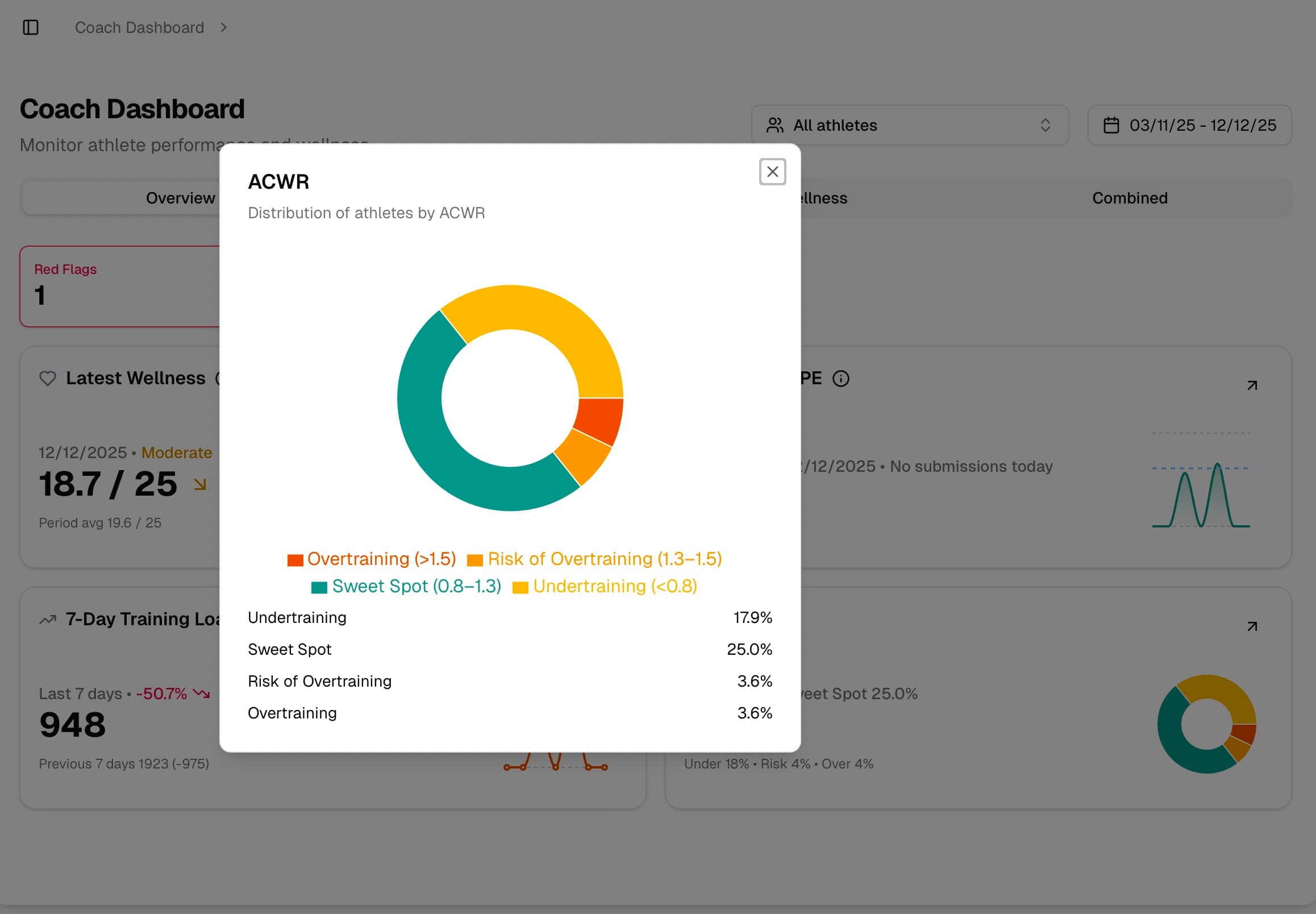
Some early work proposed “safe zones” (e.g., 0.8–1.3) and “danger zones” (>1.5), but later reviews have highlighted:
- Ratios are sensitive to both the acute and chronic parts.
- No single threshold works for all squads, levels, or sports.
- Interpretation must be contextual, not rigid.
Better approach:
- Use bands (e.g., around 1.0 = “similar”, clearly >1.2–1.3 = “spike”) as soft guides.
- Combine them with player history, wellness, and match exposure.
Mistake 3 – Poor Data Quality (RPE, Duration, Missing Days)
ACWR is only as good as the training load you feed into it.
Common issues:
- RPE not collected regularly
- Session durations not accurate
- Missing data on intense days
- Players not understanding the RPE scale
Better approach:
- Educate players on RPE and why it matters.
- Make the questionnaire fast and routine (e.g., on their phone after training).
- Use simple, consistent workflows – or a platform that removes friction.
Mistake 4 – Ignoring Wellness and Pain
You can have a “good” ACWR around 1.0 but still see:
- Poor sleep
- High fatigue
- Low mood and high stress
- Persistent muscle or joint pain
Consensus statements strongly recommend combining load monitoring with athlete well-being and health monitoring.
Better approach:
- Track wellness (sleep, fatigue, soreness, stress, mood).
- Track pain locations and trends.
- Put ACWR values beside those indicators, not above them.
For more on this, see:
- 👉 Wellness Monitoring 101: Sleep, Fatigue, Soreness, Stress, and Mood Explained
- 👉 Early Warning Signs of Overload and Injury Risk in Team Sports
Coach Takeaway:
ACWR is most powerful when it confirms what you already suspect based on wellness, pain, and performance – or when it makes you ask better questions.
How to Use ACWR Safely with a 7/21 Model
Here’s a practical framework tailored to the 7-day acute / 21-day chronic method used in Fractall.
1. Build the Foundation: RPE + Session Load
Before ratios:
- Collect RPE + duration for each key session and match.
- Calculate session load (RPE × minutes).
- Get reliable daily and weekly load numbers.
2. Implement the 7/21 ACWR in Simple Steps
- Acute (7d): sum of the last 7 days of internal training load.
- Chronic (21d): average of the last 21 days of internal training load (often expressed as a 7-day equivalent for easier reading).
Update:
- Daily (rolling 7/21 windows), or
- Once per week (e.g., every Monday, looking back at the previous 7 and 21 days)
3. Look for Meaningful Spikes and Drops
Focus on:
- ACWR clearly above ~1.2–1.3, especially when chronic load has been low.
- Sudden jumps (e.g., 0.9 → 1.35) after holidays, breaks, or injuries.
- ACWR <0.8 for extended periods, indicating under-loading relative to past levels.
When you see a concerning spike:
- Slightly reduce volume or intensity in 1–2 upcoming sessions.
- Add more recovery strategies (e.g., sleep quality, nutrition, active recovery).
- Monitor wellness more closely.
4. Use ACWR for Return-to-Play Plans
For players returning from injury:
- Start with lower 7-day acute load and build gradually.
- Monitor how the 7-day acute compares to the 21-day chronic; avoid huge leaps.
- Combine with: strength testing, movement screens, and medical sign-off.
Coach Takeaway:
With a 7/21 model, ACWR becomes a simple, continuous signal: “Are we building up in a controlled way, or jumping too fast compared with the last three weeks?”
Expert Tips on Thresholds, Spikes, and Trends
Tip 1 – Use Bands, Not Lines in the Sand
For practical coaching with 7/21 ACWR:
- Around 0.8–1.2 → often a stable or slightly progressive range
- Around 1.2–1.4 → a spike zone where extra attention is needed
- Above 1.4–1.5 → a large spike, especially concerning if chronic load is low or wellness is poor
These are guidelines, not rules. Your squad, level, and context matter.
Tip 2 – Flag High-Risk Profiles
Be more conservative with:
- Players with repeated soft-tissue injuries
- Youth players in growth spurts
- Players with low chronic load (e.g., late arrivals, long layoffs)
- Players with high tactical demands (fullbacks, wingers) facing schedule congestion
Tip 3 – Stick to One Method
There are many ways to compute ACWR (rolling averages, exponentially weighted models, different windows). Pick one method – in this case, 7-day acute and 21-day chronic – and apply it consistently so that:
- Coaches and players understand what the numbers mean.
- Trends over time are reliable.
Tip 4 – Youth Teams: Go Slower
For youth squads:
- Use ACWR to avoid extremes, not to micromanage.
- Combine with strong emphasis on sleep, growth, technique, and movement quality.
- Be especially cautious with spikes around tournaments, exams, and multi-team participation.
Coach Takeaway:
The goal is not to chase the “perfect ACWR”, but to reduce unnecessary risk from sudden, unplanned load spikes, especially in vulnerable players.
How Fractall Makes 7/21 ACWR Effortless
To use a 7/21 ACWR model with a full squad, you need to:
- Collect RPE and wellness data consistently
- Compute daily load, 7-day acute, 21-day chronic load, and ACWR
- Visualise spikes, trends, and individual differences clearly
Doing this manually becomes a spreadsheet job that eats up hours every week.
Fractall is built to solve exactly that for small and medium clubs:
- Accessible: simple flows for players and coaches, no data-science degree required
- Insightful: clear dashboards focused on decisions, not complexity
- Accurate: consistent calculations of training load and ACWR using the 7-day / 21-day model
- Optimized: automation that lets you focus on coaching instead of chasing numbers
With Fractall you can:
- Collect RPE, wellness, and pain data quickly through athlete-friendly interfaces
- Automatically calculate daily load, 7-day acute load, 21-day chronic load, and ACWR
- See ACWR alongside wellness, pain maps, monotony, and strain, giving you a real-time snapshot of load and risk for each player
👉 Generate ACWR automatically - no spreadsheets needed. Try Fractall free.
FAQs: ACWR Questions from Coaches
1. What’s a safe ACWR range with a 7/21 model?
There is no universal “safe” number, but in practice, many coaches treat:
- ~0.8–1.2 as a normal or slightly progressive zone
- ~1.2–1.4 as a spike zone where more attention is needed
- >1.4–1.5 as a large spike, especially concerning in players with low chronic load, poor wellness, or injury history
Use these ranges as conversation starters, not strict rules.
2. Should youth teams use ACWR?
Yes, but gently.
- ACWR can help avoid sudden jumps in training + match load.
- For youth, thresholds should be softer and interpreted with maturation and total sport exposure in mind.
- The priority is education and protection, not numbers for their own sake.
3. What’s the difference between a 7/21 model and a “4-week model”?
Traditionally, many ACWR implementations used:
- 1-week acute
- 3–4 week (21–28 day) chronic
Fractall’s 7/21 model fits this logic but expresses it clearly in days:
- Acute = last 7 days
- Chronic = last 21 days (three weeks)
This allows you to compute ACWR any day, not just once per week, and keeps the concept aligned with football microcycles.
4. Do I need GPS data to use 7/21 ACWR?
No. The 7/21 model works perfectly with internal load based on RPE × duration:
- Easy to implement in small and medium clubs
- Works across different sports and levels
- Can later be combined with external load (GPS, tracking) as a second layer
If you’re starting from zero, begin with internal load, then build up.
Summary: Coach-Friendly Recap
- ACWR explained: it compares 7-day acute load with a 21-day chronic average to show how much your latest week differs from the last three weeks.
- ACWR helps you spot spikes and drops in training load that may influence injury risk and performance, especially when combined with wellness and pain data.
- For small and medium clubs, the 7/21 model using internal load (RPE × duration) is simple, realistic, and effective.
- ACWR must not be used as a stand-alone injury predictor; it is a decision-support tool that should be interpreted with context.
- Tools like Fractall automate the 7/21 ACWR calculation, integrate it with wellness and pain, and free coaches to focus on planning and on-field work.
Coach Takeaway:
You do not need GPS or a performance analyst to benefit from ACWR. With a 7-day acute / 21-day chronic approach, simple RPE data and a consistent routine allow you to control how fast you progress load, reduce unnecessary spikes, and give players a better chance to stay healthy and perform.
👉 Generate ACWR automatically - no spreadsheets needed. Try Fractall free.
References
- Blanch P, Gabbett TJ. Has the athlete trained enough to return to play safely? The acute:chronic workload ratio permits clinicians to quantify a player’s training load. Br J Sports Med. 2016. PubMed
- Fuller CW et al. Consensus statement on injury definitions and data collection procedures in studies of football (soccer) injuries. Br J Sports Med. 2006. PMC+1
- Gabbett TJ. The training–injury prevention paradox: should athletes be training smarter and harder? Br J Sports Med. 2016. British Journal of Sports Medicine
- Hulin BT et al. The acute:chronic workload ratio predicts injury: high chronic workload may decrease injury risk in elite rugby league players. Br J Sports Med. 2016. PubMed+1
- IOC Medical Commission. How much is too much? International Olympic Committee consensus statements on load in sport and risk of injury/illness. Br J Sports Med. 2016. repository.up.ac.za+3British Journal of Sports Medicine+3ResearchGate+3
- Impellizzeri FM et al. Acute:Chronic Workload Ratio: Conceptual Issues and Fundamental Pitfalls from a Statistician’s and Clinician’s Perspective. Int J Sports Physiol Perform. 2020. Human Kinetics Journals
- Maupin D et al. The relationship between acute:chronic workload ratios and injury risk in team sports: a systematic review. Open Access J Sports Med. 2020. Dove Medical Press
- Rico-González M et al. Acute:chronic workload ratio and training monotony: limitations as injury risk predictors in team sports. 2022. IPSantarem Repository
- Soligard T et al. How much is too much? Part 1: International Olympic Committee consensus statement on load in sport and risk of injury. Br J Sports Med. 2016. British Journal of Sports Medicine+2klokeavskade.no+2
- Zouhal H et al. Editorial: Acute:Chronic Workload Ratio: Is There Scientific Evidence? Front Sports Act Living. 2021.