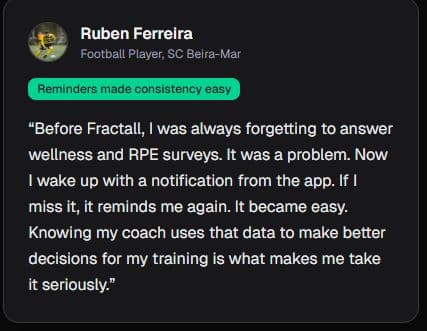
Athlete compliance is the foundation of every performance monitoring system. A coach's analysis is only as good as the data behind it — and that data depends entirely on whether athletes submit it consistently, honestly, and on time.
This is the compliance problem. You can have access to ACWR dashboards, wellness scoring, and AI-generated reports. If athletes aren't engaging with the process, every insight you draw is built on incomplete information.
In this article, you'll learn what athlete compliance means in monitoring practice, why it breaks down, and what you can do today to build a system athletes actually trust and use.
What is Athlete Compliance in Performance Monitoring?
Athlete compliance refers to how consistently and accurately athletes submit wellness, RPE, and training load data through a monitoring system.
It's not just whether they complete the survey. It's whether the data they provide reflects reality. An athlete who scores 7/10 on fatigue every day regardless of how they feel isn't complying — they're generating noise. True compliance means consistent, honest, and timely submissions that coaches can actually build decisions on.
Why Does Athlete Compliance Matter for Coaches?
A wellness survey that 40% of your squad completes inconsistently tells you almost nothing useful. Consider what's lost: if several of your starting players don't submit RPE after Tuesday's session, your ACWR calculation for those players is compromised. If athletes routinely underreport fatigue to avoid being rested, your readiness data is systematically skewed.
As Foster et al. (2001) demonstrated in validating session-RPE as a training load metric, the method depends on athletes accurately perceiving and reporting their exertion after each session. The validity of the metric is inseparable from the quality of reporting.
In practice, the difference between 60% and 90% compliance can be the difference between actionable intelligence and educated guesswork. Explore how Fractall structures this process to understand what consistent compliance looks like in a real monitoring workflow.
Coach Takeaway: Monitoring systems don't fail because of bad algorithms. They fail because athletes don't engage with them. Compliance is a design problem before it's a coaching problem.
How to Improve Athlete Compliance Step by Step
1. Reduce friction at the point of submission
The single biggest driver of non-compliance is friction. If submitting RPE takes more than 30 seconds, response rates drop. If athletes need to log into a separate app they rarely use, they forget.
Design the collection method around where athletes already are — not where you want them to be.
2. Set clear expectations at onboarding
Athletes who don't understand why they're submitting data are less likely to do it consistently. Take 10 minutes during pre-season to explain what RPE and wellness data is used for, how it influences training decisions, and what happens when it's missing.
When athletes know their input changes something, they take it more seriously.
3. Use automated reminders — timed to your training schedule
Reminders that arrive at the wrong moment create friction, not compliance. A wellness survey notification before morning training works. The same notification at 11pm does not.
Build your reminder schedule around your training timetable, not a generic clock.
4. Close the feedback loop visibly
Show athletes what their data looks like. Give them visibility into their own wellness trends and load history. This transforms data submission from an admin task into something they value.
When athletes see that their input influences decisions, compliance becomes intrinsic — not enforced.
5. Track compliance as a metric
Treat compliance rate like any other performance indicator. Monitor it weekly. Identify which athletes or positions are consistently under-reporting. Investigate before assuming the data is accurate.
A squad with 85% average compliance often masks individual players at 50%. That gap is worth knowing.
Real Examples from Sport
At the semi-professional level, compliance challenges aren't abstract. They show up every week.
Consider a football club managing a 25-player squad through a 10-week pre-season block. The S&C coach sets up a daily wellness survey and post-session RPE system. In week one, compliance is 85%. By week four, without active management, it drops to 58%.
Why? Athletes habituate. The novelty wears off. No one reinforced why it matters. The process started to feel like administrative overhead.
The fix isn't a new tool. It's structure: consistent reminders, visible feedback, and a brief moment each week where the coach references the data in squad communication. "Based on what we're seeing in the wellness scores, we're adjusting Friday's session intensity." That one sentence changes athlete behaviour more than any feature update.
In youth academy environments, as documented in Bourdon et al. (2017) in their athlete monitoring framework for elite development players, compliance is higher when young athletes perceive monitoring as part of the professional environment — not as surveillance or extra work. The framing matters as much as the tool.
Coach Takeaway: Compliance doesn't maintain itself. It requires a system: regular reminders, visible use of data, and a brief recurring signal that the information athletes submit is being heard.
Common Mistakes Coaches Make
Choosing the wrong submission channel. Asking athletes to use a dedicated app they don't already have installed adds a login barrier that compounds over time. Meeting athletes where they already are consistently outperforms isolated monitoring apps in long-term compliance rates.
Not closing the feedback loop. Collecting data and never visibly acting on it is the fastest way to kill compliance. Athletes stop providing honest input when they can't see how it influences anything.
Sending reminders at generic times. An 8am reminder doesn't work for every squad. Reminders calibrated to your actual training schedule have meaningfully higher response rates than generic daily notifications.
Treating compliance as binary. A player who submits every day but gives the same score regardless of their state is not truly complying. Monitor variance in responses — not just submission rate.
Over-surveying. Asking athletes to complete a 15-question form every day creates fatigue and resentment. The most effective wellness surveys are 4–6 items: fatigue, sleep quality, muscle soreness, stress, and mood. Short enough to be sustainable. Long enough to be meaningful.
Coach Takeaway: Most compliance problems are experience problems. Before adding a new reminder or incentive, audit the submission process from the athlete's perspective.
How to Implement This Today
- [ ] Calculate your current compliance rate — what percentage of athletes submit at least 4 days per week?
- [ ] Map the submission journey from the athlete's perspective — count every tap, click, and login step required
- [ ] Schedule one squad communication in the next two weeks where you explicitly reference wellness or RPE data in a training decision
- [ ] Review your reminder timing against your training schedule — adjust to match athlete routines
- [ ] Reduce your survey to 4–6 items if it currently exceeds that
- [ ] Check response variance — identify athletes who may be submitting consistently but with suspiciously low variation in their scores
How Fractall Helps
At Fractall, athlete compliance was a design constraint from the beginning — not an afterthought.
The data collection experience is built to be as close to invisible as possible for athletes. Notifications arrive at times calibrated to training schedules. The submission flow is minimal, designed to take under 30 seconds. No separate login required — athletes respond where they already are, through channels they already use.
When the experience is intuitive, compliance becomes consistent. And when compliance is consistent, the data coaches see in their dashboard reflects what's actually happening across the squad — not a partial picture shaped by who remembered to submit.
Start a free trial at Fractall to see how your athletes respond to a monitoring system built around their routine. Pricing starts from €14.95/month, with a free trial for your first team and no hardware required.
Frequently Asked Questions
What is a good athlete compliance rate for wellness monitoring? A compliance rate of 80% or above — meaning at least 80% of athletes submitting data at least 4 days per week — is a reliable threshold for generating useful squad-level insights. Below 70%, the data becomes difficult to interpret with confidence, as missing responses often cluster around specific athletes whose state you most need to understand.
Why do athletes stop filling in RPE surveys? The most common reasons are surveys that take too long, reminders that arrive at inconvenient times, and a lack of visible feedback — athletes don't see how their input changes anything. Reducing submission time to under 30 seconds and closing the feedback loop by explicitly referencing the data in coaching decisions are the two most effective interventions.
Does the submission channel affect compliance rates? Yes, significantly. Channels that require a separate app login consistently show lower long-term compliance than methods integrated into platforms athletes already use daily. Reducing the number of steps required to submit data is the most reliable structural intervention for maintaining compliance across a full season.
How many questions should a daily wellness survey include? Four to six questions is the established practical standard in performance monitoring. The core markers — fatigue, sleep quality, muscle soreness, stress, and mood — cover the most meaningful dimensions of readiness without creating survey fatigue. Adding items beyond six should only happen when there is a specific clinical or performance reason to do so.
Can you monitor compliance itself as a performance metric? Yes — and you should. Compliance rate, tracked weekly per player and position group, is a leading indicator of data quality. A sudden drop in compliance from a specific athlete is often worth investigating directly. It can signal disengagement, an undisclosed physical complaint, or a friction point in the submission process.
What is the relationship between athlete compliance and ACWR accuracy? ACWR (Acute:Chronic Workload Ratio) is calculated from session-RPE data submitted after each training session. If an athlete submits inconsistently — or submits inaccurate values — their ACWR will be unreliable. High compliance is a prerequisite for ACWR to function as a valid decision-support tool, as Foster et al. (2001) established in their original validation of the session-RPE method.
Coach Checklist
- Compliance rate should be tracked weekly — target 80%+ across your squad
- Friction is the primary driver of non-compliance — simplify the submission experience before adding reminders
- Feedback loops matter: athletes engage more consistently when they see their data reflected in coaching decisions
- Survey length should be 4–6 items maximum for sustainable daily use
- Reminder timing must align with athlete routines, not generic schedules
- Response variance is as important to monitor as submission rate — flat scores signal disengagement, not wellness
Monitoring only creates value when it supports action — and action starts with data you can trust.