The Real Reason Your Wellness Data Disappears After Week Two
Most coaches spend hours setting up a wellness or RPE monitoring system. They design the questions, share the link, brief the squad — and in week one, compliance is great.
By week three, it's 40%. By week six, it's a handful of athletes who actually remember. The rest? Gone.
The problem is rarely motivation. It is almost always friction.
What Is Athlete Compliance in Monitoring?
Athlete compliance refers to how consistently athletes submit their wellness and RPE data — after sessions, on rest days, or at set check-in points throughout the week.
In sports science, compliance is the backbone of any load monitoring system. Without consistent data, you cannot calculate ACWR reliably, you cannot spot fatigue trends early, and your ability to make evidence-based decisions before training breaks down.
Simply put: a monitoring system is only as good as the data going into it. And data only comes in if athletes actually submit it.
Why Athlete Compliance Matters More Than the Metric Itself
Many coaches focus heavily on which metrics to track — RPE, sleep quality, mood, muscle soreness, stress. That debate matters. But it matters far less than whether those metrics are being collected consistently.
Here is why:
- Incomplete data creates false patterns. If your most fatigued athletes are the ones who stop submitting, your average wellness score looks artificially healthy.
- Gaps break ACWR calculations. Acute:Chronic Workload Ratio depends on a rolling data window. Missing days distort the ratio and create blind spots.
- Coaches lose trust in the system. When data is sparse, coaches default back to gut feel — and the tool gets abandoned entirely.
- Athletes feel unheard. If no one acts on their responses, they stop seeing the point of submitting.
Coach Takeaway: Compliance is not a motivational problem. It is a design problem. If your tool creates friction, athletes will quietly stop using it — and you will not always notice until the damage is done.
The Four Friction Points That Kill Compliance
Understanding why athletes drop off is the first step to fixing it. There are four common friction points in most monitoring workflows:
1. Browser-Based Access
Athletes receive a link, open a browser, log in, get asked for a password they forgot, and give up. Every extra tap is a dropout risk. On mobile, browser-based forms are slow, often poorly formatted, and create a disconnected experience from the rest of an athlete's phone.
2. Delayed or No Notifications
Athletes do not check their email at 7am before a session. Without a timely reminder — ideally a push notification at a predictable time — the check-in simply does not happen. Coaches end up chasing athletes individually, which is unsustainable at scale.
3. Slow or Clunky Interfaces
If a wellness check-in takes longer than 60 seconds and feels like filling out a tax form, athletes will avoid it. The experience needs to feel fast, native, and worth their time.
4. No Feedback Loop for Athletes
Athletes are more likely to comply when they see value for themselves — not just for the coach. If they submit data but never see their own trends, fatigue patterns, or readiness scores, the habit does not stick.
| Friction Point | Impact on Compliance | Fix |
|---|---|---|
| Browser login required | High dropout | Native app with saved session |
| No push notifications | Missed submissions | Automated reminders |
| Slow, poor UX | Abandonment | Streamlined, fast interface |
| No athlete feedback | No habit formation | Athlete-facing dashboard |
Real Examples: What Low Compliance Looks Like in Practice
Scenario 1 — Youth Football Academy A U17 academy squad uses a Google Form shared via WhatsApp every morning. Response rate in week one: 85%. By week five: 30%. The coach cannot identify which players are accumulating fatigue because only the most engaged athletes are submitting. Two players develop overuse complaints that could have been flagged earlier.
Scenario 2 — Amateur Rugby Club A strength and conditioning coach rolls out an RPE logging system using a browser-based app. Players complain the link does not always work on mobile. The coach spends 20 minutes before every session chasing submissions. The system is abandoned by month two.
Scenario 3 — Semi-Professional Basketball Team The club switches to a native mobile app with push notifications. Compliance goes from 55% to 88% within three weeks — without any change to the questions asked. The only thing that changed was the experience.
Coach Takeaway: The data you collect is a direct reflection of the experience you offer. Remove the steps, increase the returns.
Common Mistakes Coaches Make Around Compliance
- Blaming athletes for not submitting, rather than auditing the tool experience
- Over-designing questionnaires with 12+ questions that take too long to complete
- Using the same link every time without building a habit around a consistent notification
- Never sharing results with athletes, removing their incentive to participate
- Switching tools too often, breaking whatever routine athletes had started to build
- Launching without a briefing — athletes need to understand why the data matters to them, not just to the coach
How to Improve Athlete Compliance Starting This Week
You do not need a new system to improve compliance. You need to reduce friction in the one you already use. Here is a practical framework:
Step 1 — Audit your current submission process Open your own form or app on a mobile phone. Count every tap required from opening to submitting. Anything above five steps is too much.
Step 2 — Set a consistent notification time Athletes build habits around predictable triggers. Choose one fixed time — 30 minutes before training, or immediately after — and send reminders at that time every day.
Step 3 — Shorten your questionnaire Five well-chosen questions completed by 90% of your squad is far more valuable than twelve questions completed by 40%. Prioritise: sleep quality, fatigue, muscle soreness, mood, and motivation.
Step 4 — Close the loop with athletes Share anonymised team trends in the weekly debrief. Show athletes their personal readiness score. When players see the data being used — including for their own benefit — compliance rises.
Step 5 — Use a native mobile app where possible Browser-based tools add unnecessary steps. A native app with push notifications, saved authentication, and a fast interface removes the main barriers that kill consistency.
Coach Takeaway: Compliance is a habit, and habits are built through ease, consistency, and perceived value. Engineering all three into your workflow will do more for your data quality than any new metric.
How Fractall Approaches Athlete Compliance
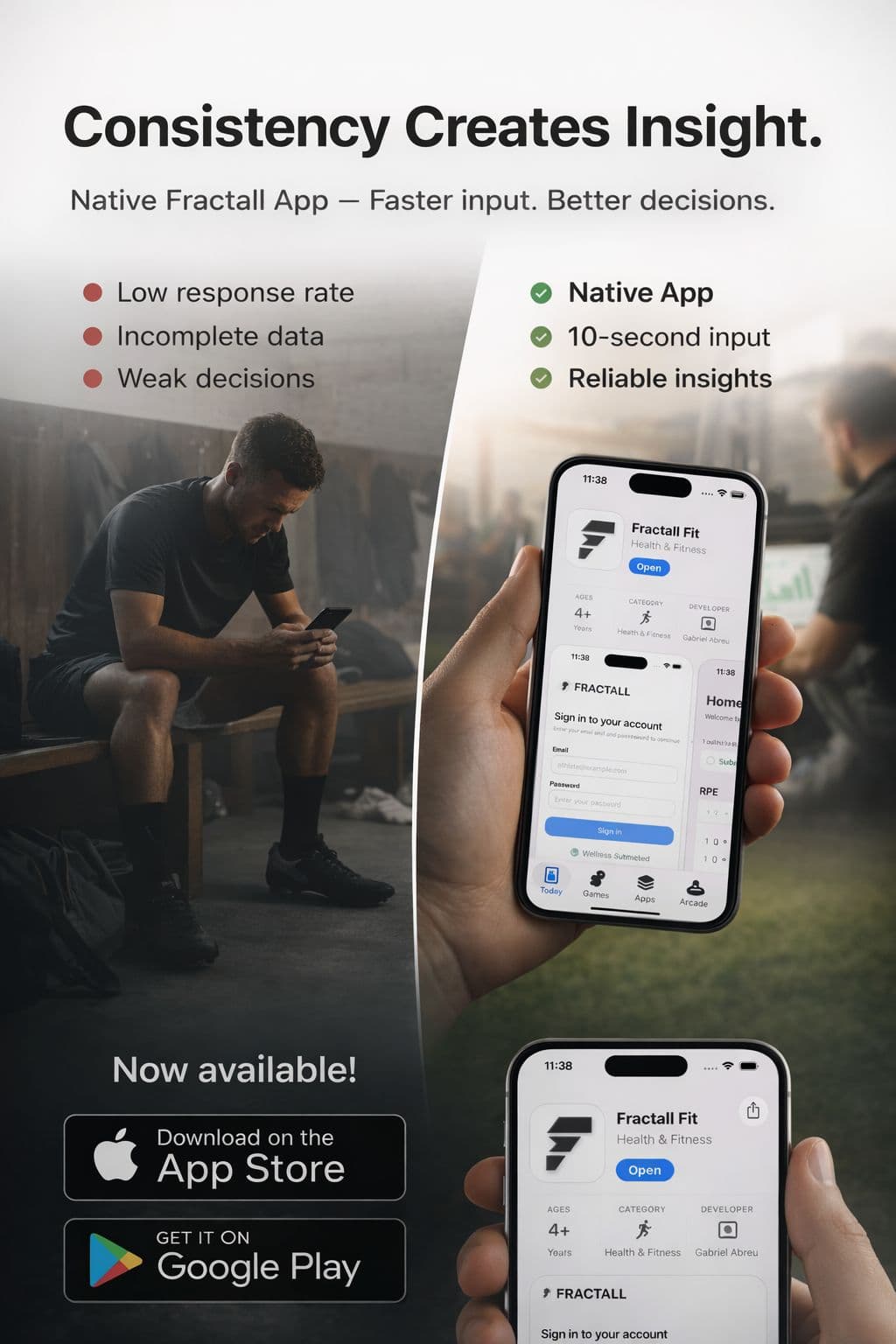
Fractall recently launched its native mobile app for athletes, built specifically to remove the friction points described above. Athletes receive push notifications, log in once, and complete check-ins in under 30 seconds — no browser, no broken links, no chasing.
The early feedback from pilot clubs showed clear improvements in response consistency within the first two weeks. An athlete dashboard is also coming, so players can see their own trends and understand how they are adapting over time.
If compliance has been a persistent challenge in your squad, it is worth exploring whether your current tool is making it harder than it needs to be. Try Fractall free and see how quickly response rates improve.
FAQ: Athlete Compliance and Wellness Monitoring
Why do athletes stop submitting wellness data after a few weeks? Most dropout is caused by friction — slow tools, browser logins, forgotten links, or inconsistent reminders. Athletes do not usually lack motivation; they lack a seamless habit. Reducing the number of steps in the submission process is the most effective fix.
What is a good athlete compliance rate for wellness monitoring? A compliance rate above 80% is considered strong for most teams. Below 60%, your data becomes unreliable for trend analysis. Anything below 40% means decisions are being made on incomplete context.
How many questions should a wellness check-in include? Five to seven questions is the optimal range for daily check-ins. Covering sleep, fatigue, soreness, mood, and motivation gives a comprehensive picture without creating survey fatigue. Shorter is better if compliance is already an issue.
Does WhatsApp improve athlete compliance compared to email? Yes, significantly. Athletes are far more likely to respond to a WhatsApp message than an email, because the platform is already embedded in their daily routine. Platforms that send reminders through familiar channels reduce friction at the notification stage.
What is the difference between RPE compliance and wellness compliance? RPE (Rating of Perceived Exertion) is typically submitted immediately after a session, while wellness check-ins are usually collected before training or on rest days. Both require consistent submission habits. Post-session RPE often has higher compliance because athletes are already in a training context; wellness surveys require more deliberate habit-building.
Can athlete compliance be improved without changing the monitoring tool? Yes — by improving the process around it. Fixed notification times, shorter questionnaires, coaching staff modelling the behaviour, and sharing results with athletes can all lift compliance meaningfully, even within an existing system.
Summary: Coach Checklist for Better Athlete Compliance
- [ ] Audit your current tool on mobile — count every tap from open to submit
- [ ] Reduce your wellness questionnaire to 5–7 focused questions
- [ ] Set one fixed daily notification time and stick to it
- [ ] Use a native mobile app or WhatsApp-based tool to remove browser friction
- [ ] Never require athletes to log in more than once per device
- [ ] Share team wellness trends at least once per week in a debrief
- [ ] Give athletes visibility of their own readiness and fatigue data
- [ ] Brief your squad on why the data matters — for them, not just the coaching staff
- [ ] Review compliance rates weekly and act if they drop below 70%
- [ ] Celebrate consistent submitters — make compliance part of the team culture
Better compliance does not require better athletes. It requires a better experience.