Most coaches know they should be tracking athlete wellness. Fewer do it consistently — and even fewer act on what the data shows.
Athlete wellness monitoring is the systematic collection of subjective markers — fatigue, sleep quality, muscle soreness, stress, and mood — from athletes before or after training sessions. When done well, it gives coaches and performance staff a clear picture of how athletes are recovering, adapting, and preparing for the next session.
This guide explains what wellness monitoring is, why it matters, how to implement it practically, and how to customise your view of the data so it supports the way you actually coach.
What is Athlete Wellness Monitoring?
Athlete wellness monitoring is the daily or session-based collection of subjective wellbeing data from your squad. Athletes self-report how they feel across a set of markers — typically:
- Fatigue — how tired do you feel today?
- Sleep quality — how well did you sleep last night?
- Muscle soreness — how sore are your muscles?
- Stress — how stressed are you feeling?
- Mood — how would you rate your current mood?
Each marker is rated on a simple numerical scale, usually 1–5 or 1–7. The scores are aggregated to create a daily readiness indicator — a fast signal of how prepared an athlete is to train or compete.
Unlike GPS or heart rate variability devices, wellness monitoring requires no hardware. Athletes complete a short questionnaire, and coaches receive the data in seconds.
Why Does Wellness Monitoring Matter for Coaches?
Training load tells you how hard athletes worked. Wellness tells you how well they are recovering.
Both are necessary. Neither is sufficient alone.
When a midfielder scores 2/5 on sleep quality three days in a row, that context changes the decision about their training intensity on day four. Without the wellness data, the coach sees only load numbers — and misses the warning pattern underneath.
Research supports this relationship. Gabbett (2016) identified sustained drops in self-reported wellness — particularly sleep quality and elevated soreness scores — as associated with increased injury risk in team sport athletes. The IOC Consensus Statement on load management also identifies subjective wellness as a core component of any evidence-based athlete monitoring system.
Coach Takeaway: Wellness monitoring does not predict injuries. It supports earlier, better-informed decisions about training intensity and recovery allocation.
Three practical outcomes coaches see from consistent wellness monitoring:
- Earlier detection of accumulated fatigue — before it becomes a performance drop
- Context for unexplained underperformance — a player who looks flat in training may be showing it in their wellness scores too
- Better recovery management — knowing which athletes are genuinely fresh before a match-day session
How to Monitor Athlete Wellness Step by Step
Step 1: Choose your wellness markers
Start with five core markers: fatigue, sleep quality, muscle soreness, stress, and mood. These have strong support in the sports science literature and are simple enough for athletes to self-report reliably.
If your squad includes female athletes, consider adding a menstrual cycle tracking option. Research has identified correlations between cycle phase and perceived exertion, recovery rate, and wellness scores — making it a valuable additional data point for performance staff.
Step 2: Define your scale
A 1–5 scale is sufficient for most club environments. Keep it consistent across the season. Changing scales mid-season breaks your longitudinal data and makes trend analysis meaningless.
Use anchored language:
| Score | Meaning |
|---|---|
| 1 | Very poor / Extremely fatigued |
| 2 | Poor |
| 3 | Moderate |
| 4 | Good |
| 5 | Very good / Fully recovered |
Step 3: Set your collection window
Collect wellness data before training, not after. Pre-session data reflects current readiness. Post-session data reflects fatigue — which is useful for load tracking but serves a different purpose.
Aim for a consistent window: ideally 60–90 minutes before the session starts.
Step 4: Establish your monitoring timeframe
A single day's wellness score is useful for immediate decisions. A four-week trend is far more valuable for understanding patterns.
When you view an athlete's wellness data over four weeks, patterns emerge that a single snapshot cannot reveal:
- Is sleep quality declining as the competitive phase intensifies?
- Is soreness recovering between sessions or accumulating week on week?
- Is there a repeating weekly pattern — lower scores on Wednesdays after Tuesday high-intensity sessions?
One report gives information. A pattern gives understanding.
Step 5: Customise your view by athlete and timeframe
Not every athlete responds to load the same way. A senior player with a high chronic load capacity may function normally at a wellness score that would flag a younger squad member. Adjust your monitoring view to reflect individual baselines, not squad averages.
Real Examples from Sport
Youth football academy A U19 coach in a national-level academy uses weekly wellness summaries to identify which players enter a Thursday high-intensity session with unresolved soreness from Tuesday. Players below a defined threshold are moved to a modified session. Tracking this pattern over a full competitive season made recovery adjustments proactive rather than reactive.
Senior semi-professional football An S&C coach managing a squad of 24 players uses a four-week rolling wellness view during December fixture congestion. Three players showed sustained declines in sleep scores across weeks 48–50 of the season. Their loads were adjusted proactively — before performance dropped or fitness staff needed to intervene.
Multi-sport club A performance department managing football and basketball squads simultaneously uses individual wellness baselines rather than universal thresholds. A basketball centre and a football winger have different normal ranges. Monitoring each athlete against their own baseline — rather than a shared squad average — makes the data more actionable for both coaching teams.
Common Mistakes Coaches Make with Wellness Monitoring
1. Using one timeframe for everyone Squad-level averages hide individual patterns. An athlete who consistently scores 3/5 may be performing at their normal; one who usually scores 5 and drops to 3 is showing a real signal. Context changes the decision.
2. Collecting data but not acting on it Monitoring creates value only when it supports a decision. If wellness data never changes a training prescription, recovery protocol, or selection conversation, coaches stop trusting it — and athletes stop reporting honestly.
3. Only reviewing aggregate scores The composite wellness score is useful for a quick squad overview. But the individual markers tell richer stories. Sleep quality declining while soreness stays constant is a different signal than both declining simultaneously.
4. Not reviewing trends across weeks Daily scores fluctuate naturally. Trends across three to four weeks reveal the real picture. Coaches who review only yesterday's data miss the accumulation patterns that matter most.
5. Not adjusting expectations for the training phase Wellness scores during a pre-season block will look different from in-season recovery weeks. Comparing across phases without context is misleading. Define what "normal" looks like for each phase of your periodisation plan.
Coach Takeaway: The biggest risk in athlete wellness monitoring is collecting data that never changes a decision. Monitoring only creates value when it supports action.
How to Implement Athlete Wellness Monitoring Today
A practical starting checklist for coaches:
- Select 5 core wellness markers — fatigue, sleep, soreness, stress, mood
- Choose a consistent 1–5 scale with clear verbal anchors
- Set a fixed collection window — 60–90 minutes before training
- Define your review timeframe — daily view for acute decisions, four-week view for trend analysis
- Establish individual baselines for each athlete within the first two to three weeks
- Build a decision protocol — what does a low score trigger? Who reviews it? What changes?
- Review compliance weekly — if athletes are not completing surveys, find out why
The most common compliance barrier is friction. If athletes must download a new app, create an account, and navigate a dashboard to submit five numbers, completion rates drop quickly. Meeting athletes where they already are — a familiar platform, a mobile-optimised form — consistently produces higher compliance over a full season.
Better compliance = better context. Better context = better decisions before training.
How Fractall Helps with Athlete Wellness Monitoring
Fractall was built around the reality that coaches work differently. A head coach preparing for a Saturday match needs a different view than an S&C coach planning the next microcycle. Both need accurate data. Neither has time to dig through spreadsheets.
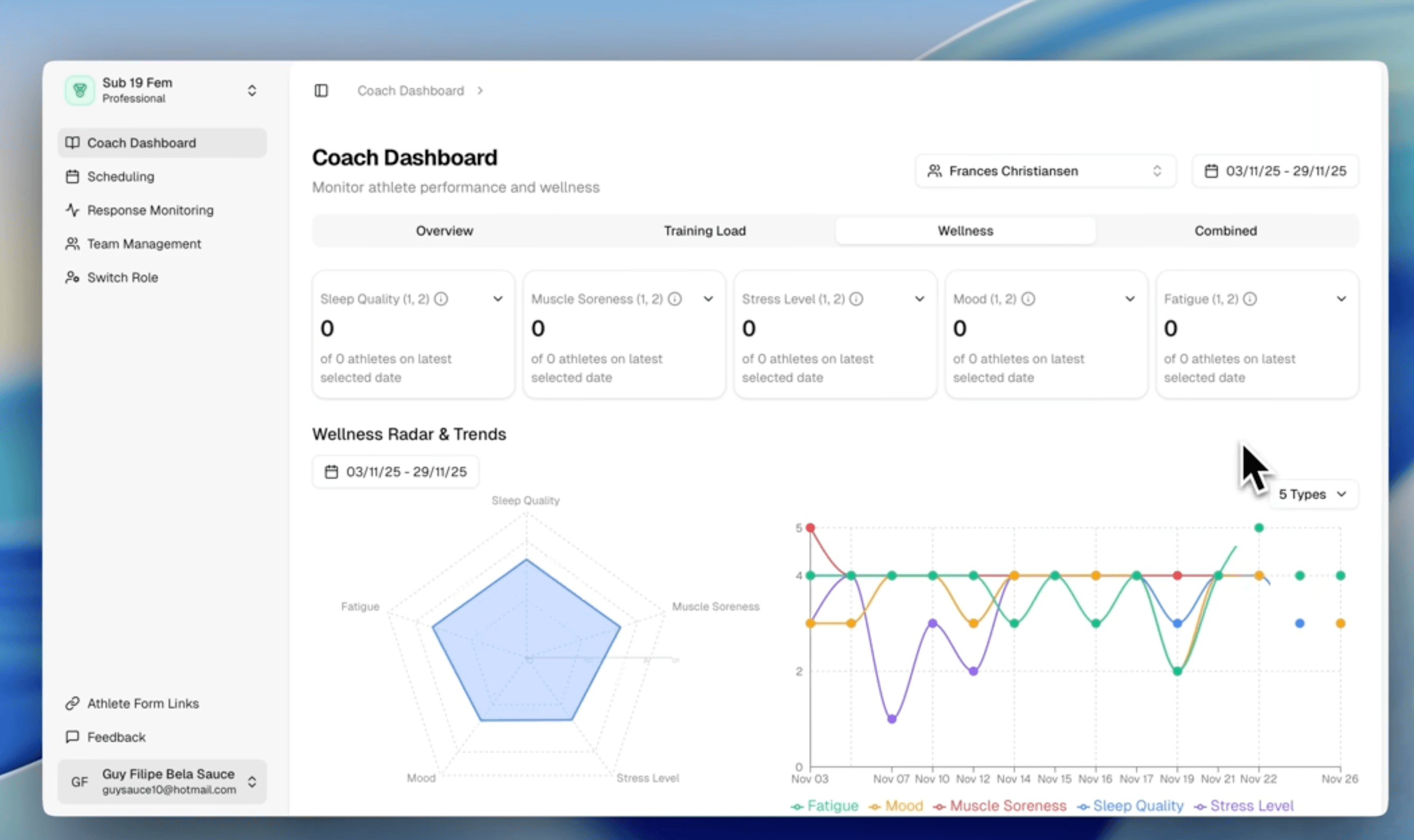
On Fractall's platform, wellness monitoring views are fully customisable. Coaches configure the timeframe — switching between a single-session view and a four-week rolling summary — to match the decision they need to make. A performance staff member reviewing chronic trends sees four weeks of individual athlete data. A head coach before a training session sees today's readiness at squad level, in under five minutes.
Athletes submit data via a simple mobile interface. No new app to download. No dashboard to navigate. Submission takes under 60 seconds.
The result: coaches see clean, structured wellness trends — by athlete, by marker, by timeframe — without manual reporting or data entry. Explore how Fractall's wellness tracking works, or start a free trial to see what your squad's data looks like in practice.
Frequently Asked Questions
What wellness markers should coaches track for athletes?
The five core wellness markers most supported in sports science research are fatigue, sleep quality, muscle soreness, stress, and mood. These can be self-reported on a 1–5 scale before each training session. For female athletes, menstrual cycle tracking adds an additional layer of context linked to performance readiness. Start with these five and expand only once your collection process is consistent and athlete compliance is established.
How often should athlete wellness be monitored?
Daily monitoring — before each training session — gives the most complete picture of individual readiness. If daily collection is not feasible, a minimum of three to four times per week is sufficient to detect meaningful trends. Monitoring less than three times per week makes it difficult to distinguish normal daily variation from a genuine warning signal.
What is a normal wellness score for an athlete?
There is no universal "normal." Each athlete has their own baseline. An athlete who regularly scores 4/5 across all markers is showing a different signal at 2/5 than one whose typical score is 3/5. The value comes from tracking individuals against their own historical average — not against squad norms or published standards. Establishing this baseline takes approximately two to three weeks of consistent monitoring.
How do I get athletes to complete wellness surveys consistently?
The most effective strategies for improving compliance are: reducing the friction of submission (fewer steps, a familiar platform), showing athletes that their data influences coaching decisions, and keeping the survey short — five markers, under 60 seconds. Coaches who share wellness trends back with athletes see significantly higher long-term compliance. When athletes understand that their input changes something, they report more consistently and more honestly.
How is wellness monitoring different from load monitoring?
Load monitoring tracks how much work athletes do — quantified through session-RPE, GPS distance, or training volume. Wellness monitoring tracks how athletes are responding to that work — their subjective recovery state. As Foster et al. (2001) demonstrated, combining internal load data with self-reported wellness creates a far more complete picture of athlete status than either measure alone. The two systems are complementary. Neither replaces the other.
Can wellness monitoring replace GPS or wearable technology?
No — and it should not try to. Wellness monitoring captures the athlete's subjective experience of load and recovery. GPS and heart rate data capture external and internal load through objective measurement. The two are complementary. In clubs without GPS infrastructure, wellness data combined with session-RPE provides a strong evidence base for decision-making without hardware investment. This approach is consistent with FIFA's athlete monitoring guidelines for clubs at all levels of the game.
Key Takeaways
- Athlete wellness monitoring tracks subjective markers — fatigue, sleep, soreness, stress, mood — to support daily coaching decisions
- A single score is useful; a four-week trend reveals the patterns that matter most
- Monitor athletes against their individual baselines, not squad averages or published norms
- Compliance depends on reducing friction — simpler submission processes produce more complete, honest data
- Customisable views — by timeframe, by athlete, by marker — make wellness data work for the way you actually coach
- Wellness data only creates value when it influences a coaching decision