ACWR in Football: How to Use It Safely and Effectively
A coach-friendly guide to using 7-day acute and 21-day chronic workload ratios to manage football training load without turning ACWR into an injury prediction shortcut.
ACWR explained
Compare this week with what the player is prepared to handle
ACWR stands for acute:chronic workload ratio. In Fractall, the practical version compares the last 7 days of load with the player's recent 21-day load base.
Acute workload
The total training and match load from the last 7 days.
Example: If a player records 2,100 AU across the last week, their acute load is 2,100 AU.
Chronic workload
The player's recent workload base, calculated from the previous 21 days and commonly read as a weekly-equivalent value.
Example: Three recent weekly totals of 1,800, 2,000, and 1,900 AU produce a weekly-equivalent chronic load near 1,900 AU.
7d
Acute window
The latest training and match load period.
21d
Chronic window
The recent base used to judge whether the latest week is a spike.
Calculation
Calculate 7-day acute and 21-day chronic load from session RPE
Small and medium clubs do not need GPS to start. A consistent session-RPE workflow can create a useful internal-load signal.
- 1
Define session load
Multiply the athlete's RPE by the session duration in minutes. A 75-minute session at RPE 6 equals 450 AU.
- 2
Sum the last 7 days
Add training and match load across the latest rolling week to get acute load.
- 3
Build the 21-day base
Average the previous 21 days of load, then read it on the same weekly scale as the acute value.
- 4
Divide acute by chronic
If acute is 2,100 AU and chronic is about 1,897 AU, ACWR is about 1.11.
| ACWR signal | Typical meaning | Coach response |
|---|---|---|
| Around 0.8 to 1.2 | Current load is broadly close to the recent base. | Continue monitoring and review other athlete signals. |
| Around 1.2 to 1.4 | The latest week is moving clearly above recent norms. | Check wellness, soreness, role change, and upcoming sessions. |
| Above 1.4 to 1.5 | A large spike, especially if chronic load is low. | Consider reducing volume, adding recovery, or reviewing exposure. |
Estimate session-RPE load
Use the inputs to see how quickly simple football sessions create weekly load.
Estimated weekly load
1800
Football example
A normal match week can produce a healthy small progression
ACWR becomes useful when it is attached to the football calendar: starters, bench players, return-to-play athletes, fixture congestion, and role changes.
| Day | Football context | Session load |
|---|---|---|
| Monday | MD-4 training, 75 min at RPE 6 | 450 AU |
| Tuesday | MD-3 training, 80 min at RPE 7 | 560 AU |
| Wednesday | Off day | 0 AU |
| Thursday | MD-2 training, 70 min at RPE 6 | 420 AU |
| Friday | MD-1 taper, 45 min at RPE 4 | 180 AU |
| Saturday | Off or travel day | 0 AU |
| Sunday | Match, 95 min at RPE 8 | 760 AU |
2,370 AU
Example 7-day acute load
The sum of the training week and match exposure.
1.09
Example ACWR
If the previous 21-day weekly-equivalent chronic load is about 2,177 AU.
What the number says
Limitations
Use ACWR as a warning light, not a verdict
The biggest mistake is treating one ratio as a complete answer. ACWR is strongest when it sits beside wellness, pain, availability, and coaching context.
Common ACWR mistakes
- Treating a high ratio as an injury prediction.
- Using hard thresholds without player context.
- Ignoring missing RPE, inaccurate durations, or poor survey habits.
- Reading ACWR without sleep, fatigue, soreness, stress, mood, or pain data.
- Comparing players as if they have identical roles, histories, and match demands.
When ACWR rises quickly
Review whether the player has taken on more minutes, returned from absence, changed tactical role, or trained through fixture congestion.
A safer ACWR review rhythm
Scan the ACWR band to find spikes, drops, and sudden trend changes.
Open the athlete context: wellness, pain, match minutes, and recent role.
Decide whether to monitor, adjust load, ask the athlete, or involve medical staff.
Fractall workflow
Fractall removes the spreadsheet work behind 7/21 ACWR
The value of ACWR depends on consistency. Fractall helps clubs collect the inputs, calculate the ratios, and read load alongside athlete context.
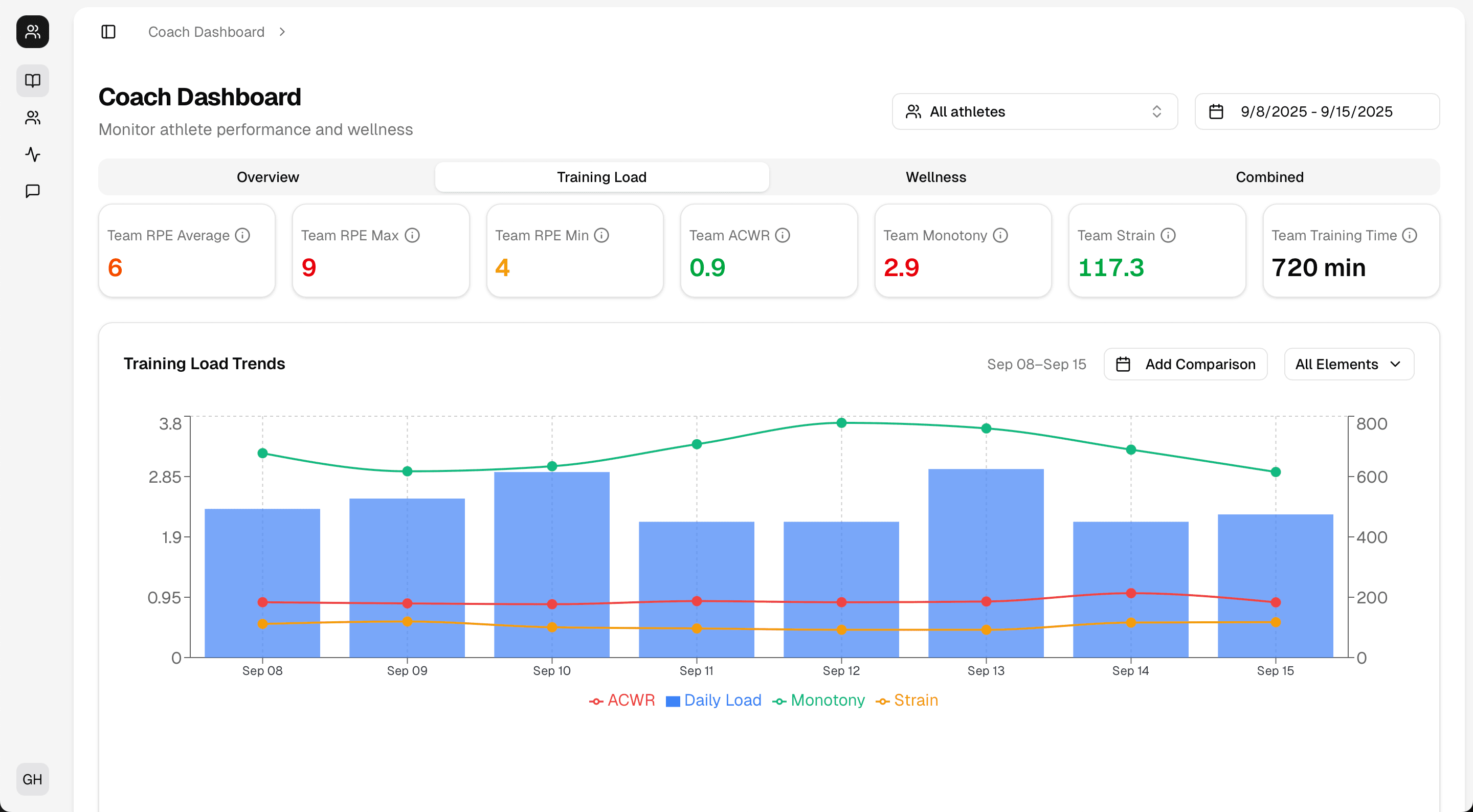
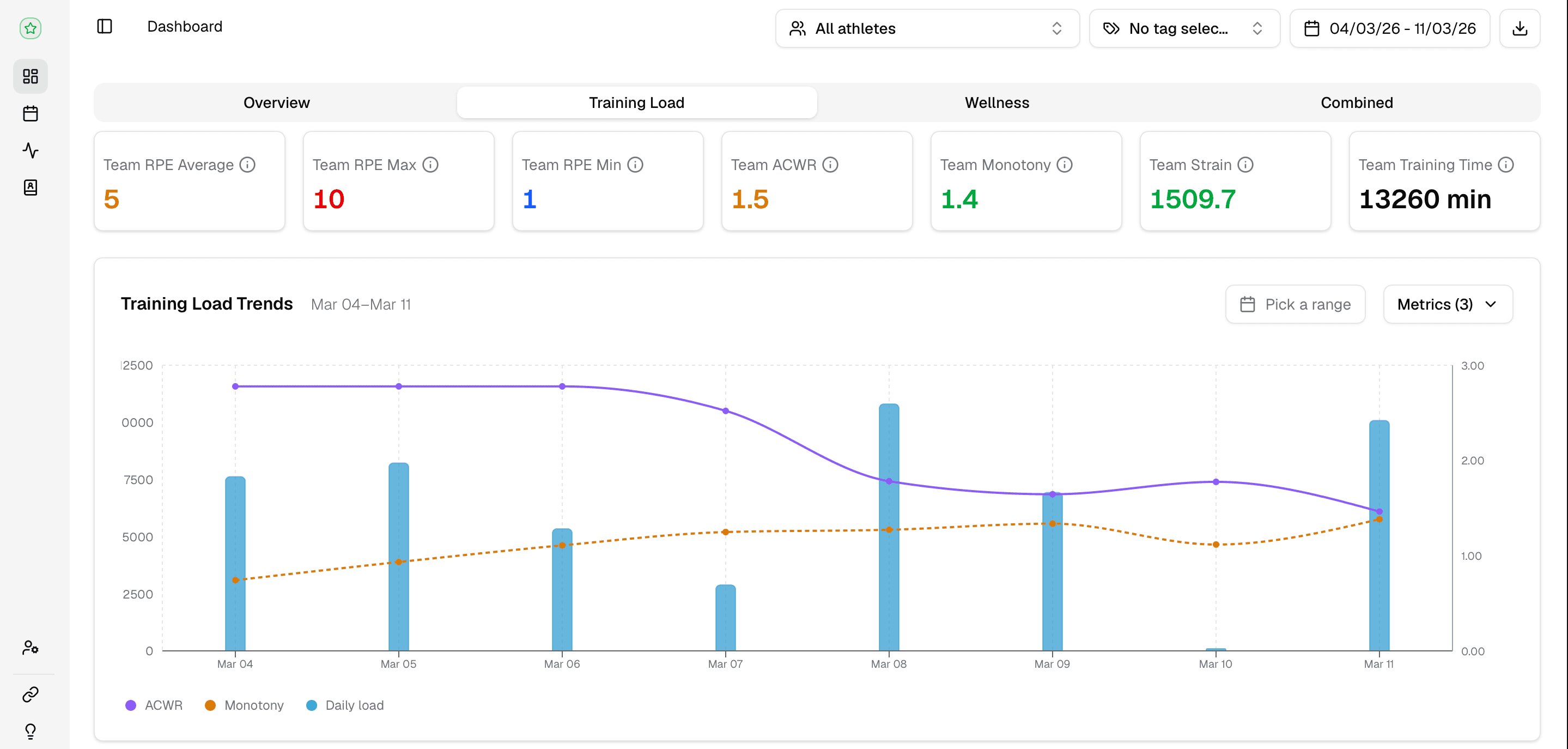
1. Training load history
Use recent load trends to understand whether the current week is close to the player's normal base.
2. Athlete-level review
Move from squad-level patterns to the players who need a closer conversation.
3. Decision context
Read ACWR beside wellness, pain, monotony, and strain instead of treating one number as the whole answer.
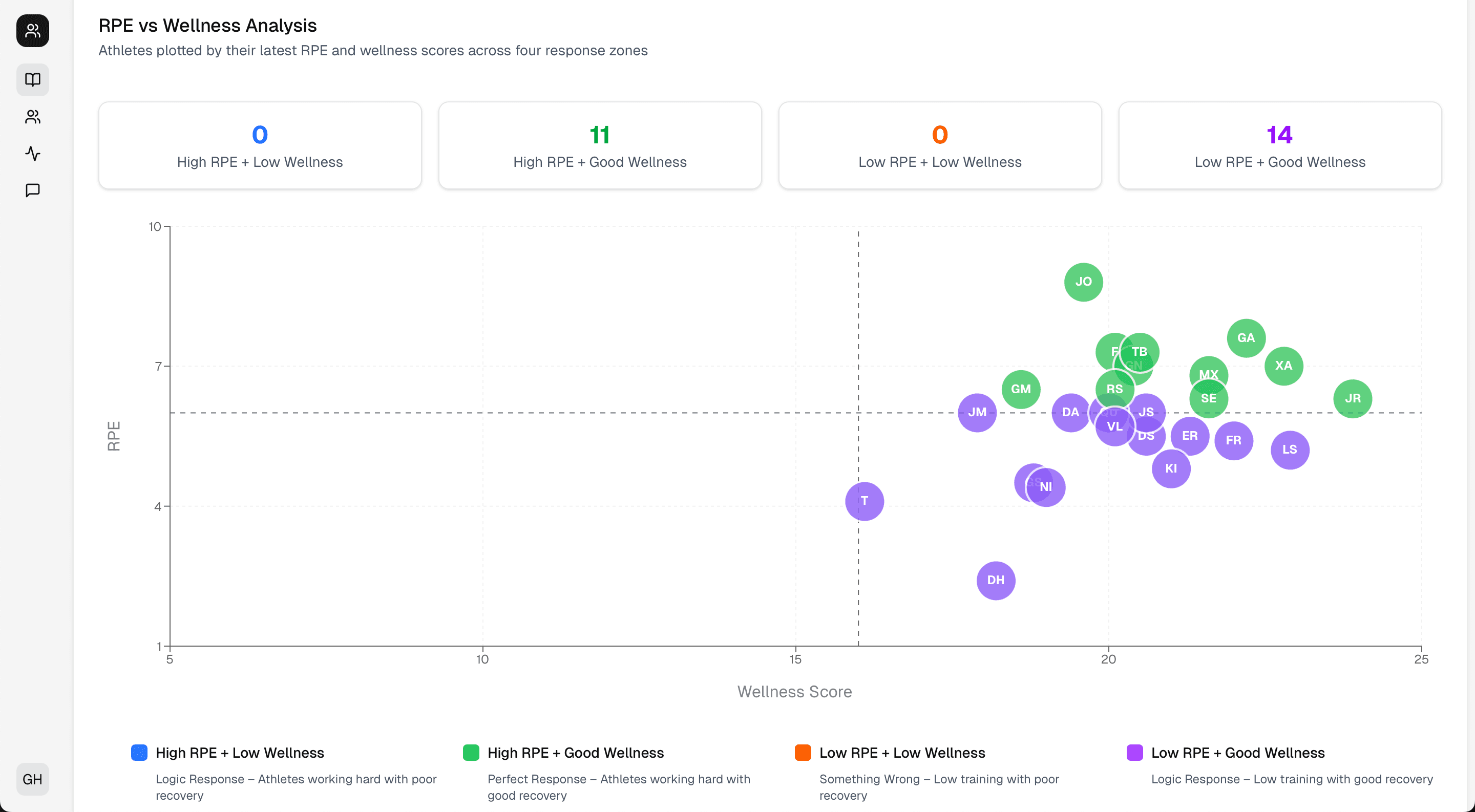
Confirmed product workflow
Practical club fit
Generate ACWR automatically
Use Fractall to collect RPE and wellness data, review training load, and reduce the manual work behind weekly load decisions.
FAQs
ACWR questions coaches ask most often
Use these answers as practical guardrails, not universal laws.
What is a safe ACWR range?
There is no universal safe number. Many coaches use roughly 0.8 to 1.2 as a stable zone, 1.2 to 1.4 as a spike zone, and above 1.4 to 1.5 as a larger spike.
Example: Always combine the band with player history, wellness, pain, and match demands.
Should youth teams use ACWR?
Yes, but gently. The goal is to avoid sudden load jumps, not to micromanage young athletes.
Example: Be especially careful around growth spurts, tournaments, exam periods, and players training with multiple teams.
Do teams need GPS data?
No. A 7/21 ACWR model can start with internal load from RPE and session duration.
Example: GPS can become a second layer later, but consistent RPE is a realistic first step.
Why use 7 days and 21 days?
The 7-day window fits the football microcycle, while 21 days gives a recent three-week base.
Example: This keeps the calculation understandable for coaches while allowing rolling daily or weekly review.
Make ACWR part of a real coaching workflow
Fractall helps clubs collect RPE, monitor wellness and pain, and review training load without building another spreadsheet.
Related guides
AI Reports for Coaches: What to Automate
A coach-first guide to using AI in sports performance reports without outsourcing selection, medical judgment, or player relationships.
Training Monotony and Strain: A Coach's Guide
Learn what training monotony and strain mean, how to calculate them from session RPE, and how football coaches can use them safely beside ACWR and wellness data.
How to Plan Weekly Training Load Around Match Day
Plan football training load from MD-4 to MD+1 with session RPE, ACWR, and simple microcycle rules that help players arrive fresh on match day.