Internal Load Monitoring for Small Clubs
You do not need expensive GPS systems to monitor training load. Learn how small clubs can use RPE, wellness, and ACWR on any budget.
Internal load
Measure how athletes experienced the work, not only what they did
Internal load captures the physiological and psychological stress an athlete experiences in response to training.
Internal load
The athlete's response to training, usually captured through RPE, heart rate, or wellness markers.
Example: A 70-minute session at RPE 7 produces 490 arbitrary units of session-RPE load.
External load
The physical output completed by the athlete, such as distance, speed, power, or accelerations.
Example: GPS distance can describe what happened; RPE helps describe how hard it felt.
RPE
Athlete perception
Usually collected on a 0-10 or CR10 scale.
minutes
Session duration
Multiplied by RPE to estimate session load.
7d
Acute load
Short-term workload over the latest week.
28d
Chronic base
Longer-term exposure used for load comparison.
Core metrics
Start with session RPE, then layer weekly load signals
Session RPE is the base input. From there, small clubs can build useful weekly monitoring without a data department.
| Metric | What it measures | Why it matters |
|---|---|---|
| Acute load | Load over the last 7 days. | Shows short-term fatigue and recent work. |
| Chronic load | Rolling longer-term average. | Represents the athlete's recent load base. |
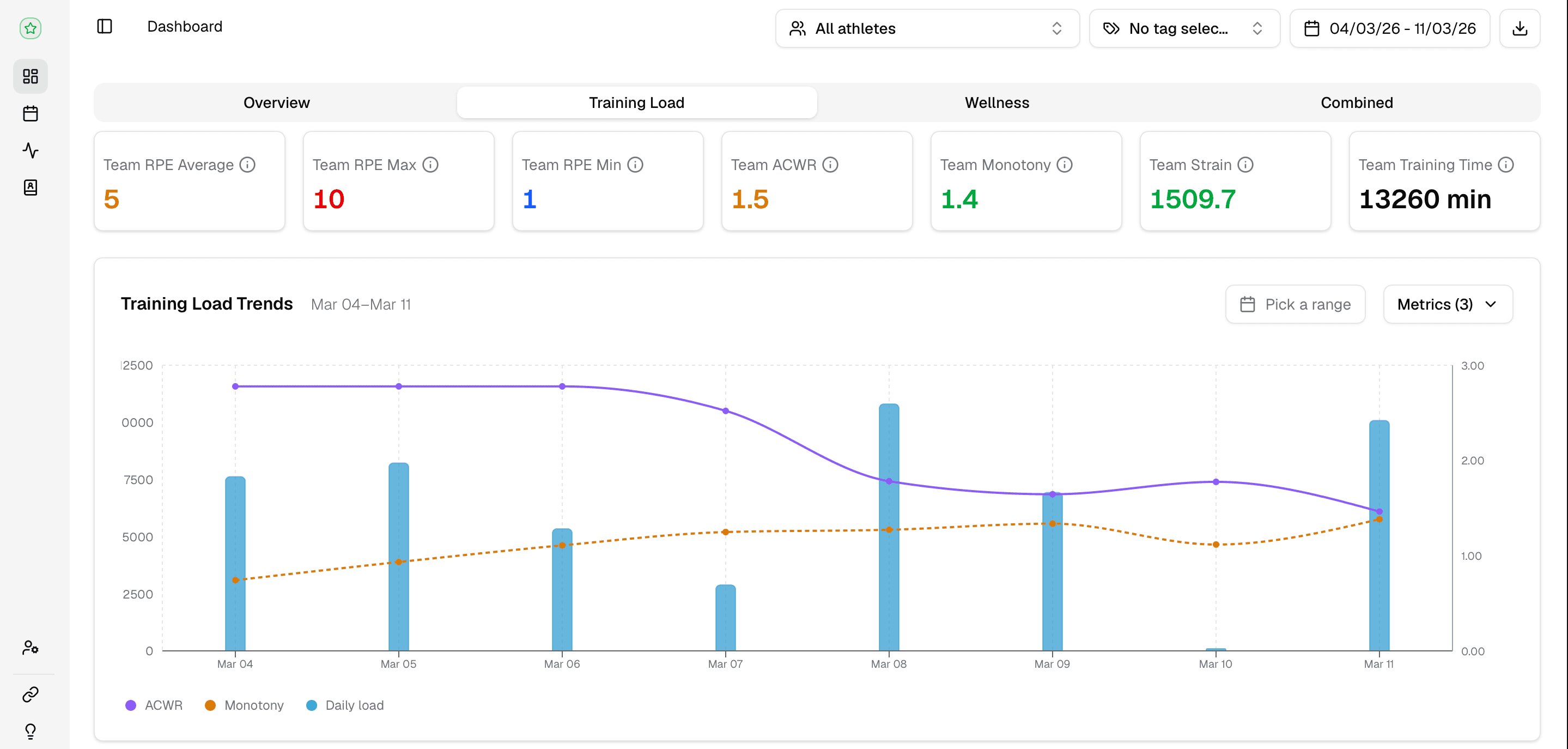
| ACWR | Acute load divided by chronic load. | Flags spikes or drops relative to recent exposure. |
| Monotony | Daily load variability. | Shows whether the week is too repetitive. |
| Strain | Weekly load multiplied by monotony. | Combines weekly stress and lack of variation. |
Implementation
Build the habit first, then scale the system
The hard part is not the maths. It is collecting and reviewing the data consistently enough for coaches to trust it.
- 1
Choose one RPE scale
Use CR10 or a simple 1-10 variant, then keep it consistent all season.
- 2
Collect after every session
Ask for RPE soon after training or matches so recall stays accurate.
- 3
Record duration
Multiply RPE by session minutes to calculate session load.
- 4
Add wellness context
Track sleep, soreness, fatigue, mood, and stress so load is not read alone.
- 5
Review weekly
Check ACWR, wellness, monotony, and strain before planning the next block.
Fractall workflow
Athletes submit RPE and wellness through mobile app flows.
Fractall calculates training load, ACWR, monotony, and strain automatically.
Coaches review load and wellness together before planning the next session.
Start load monitoring without GPS
Use Fractall to collect RPE and wellness, calculate load metrics, and review athlete readiness without spreadsheet work.
Examples
Internal load helps small clubs act before problems become obvious
The same session-RPE workflow supports pre-season, return-to-play, and weekly load design.
Pre-season spike risk
If pre-season volume jumps and several players report RPE 9-10, staff can adjust the next session before soreness or soft-tissue issues escalate.
Common mistakes
Data only helps when staff review it and act
Internal-load systems fail when they become a collection habit without a decision habit.
Collecting but never reviewing
Ignoring individual variation
Delayed reporting
Using load in isolation
FAQs
Internal load monitoring questions
Short answers for small clubs starting a practical training-load workflow.
How often should I collect RPE?
What is a safe ACWR range?
Can I monitor without GPS?
Is this only for elite athletes?
Starting checklist
- Choose a consistent RPE scale.
- Collect RPE within 30 minutes after sessions.
- Record session duration.
- Add a few wellness questions.
- Calculate weekly ACWR for each player.
- Review load and wellness before planning.
- Monitor compliance and fix friction early.
Related guides
ACWR in Football: How to Use It Safely and Effectively
A coach-friendly guide to using 7-day acute and 21-day chronic workload ratios to manage football training load without turning ACWR into an injury prediction shortcut.
AI Reports for Coaches: What to Automate
A coach-first guide to using AI in sports performance reports without outsourcing selection, medical judgment, or player relationships.
Training Monotony and Strain: A Coach's Guide
Learn what training monotony and strain mean, how to calculate them from session RPE, and how football coaches can use them safely beside ACWR and wellness data.