RPE Basics for Coaches: How to Use Session-RPE
A practical guide to using RPE and session-RPE to monitor training load without GPS, spreadsheets, or a sports science department.
RPE basics
Give players a shared language for session intensity
RPE stands for rating of perceived exertion. It asks athletes to rate how hard the whole session felt.
RPE
The athlete's rating of how hard a session felt, usually on a 0-10 scale.
Example: 0 means rest, 5 means hard but controlled, 7 means very hard, and 10 means maximal.
| RPE | Description | Example feeling |
|---|---|---|
| 0 | Rest | No effort. |
| 3 | Moderate | Comfortable and sustainable. |
| 5 | Hard | Working but controlled. |
| 7 | Very hard | Strong effort required. |
| 10 | Maximal | All-out and unsustainable. |
Session-RPE
Multiply effort by duration to create internal load
RPE alone tells you intensity. Session-RPE combines that intensity with how long the athlete worked.
RPE
Perceived intensity
How hard the session felt.
min
Duration
How long the athlete worked.
AU
Session load
RPE x minutes.
Example
Estimate session load
Change duration and RPE to see how session load changes.
Estimated weekly load
1800
Implementation
Make RPE a repeatable coaching habit
Session-RPE works when the scale, timing, education, and weekly review stay consistent.
- 1
Choose a 0-10 scale
Use simple descriptors and keep them visible during the first weeks.
- 2
Ask 20-30 minutes post-session
This helps athletes rate the whole session rather than only the final drill.
- 3
Educate athletes
Explain that RPE is not a toughness score. Honest answers make training safer and smarter.
- 4
Record duration and RPE
Calculate session load for every athlete and main session.
- 5
Review weekly totals
Look for spikes, drops, and differences between planned and perceived intensity.
Record every session
- Date.
- Session type.
- Duration in minutes.
- Athlete RPE.
- Calculated session load.
- Weekly load total.
Use cases
Turn session-RPE trends into coaching decisions
The value is not the number by itself. It is the pattern across days, players, and weeks.
| Use case | What to compare | Coach response |
|---|---|---|
| MD-3 vs MD-1 | Main loading day against pre-match taper. | Reduce MD-1 if it starts looking like a main load day. |
| Weekly load | Current week against previous weeks. | Review spikes around 30-40% before they become problems. |
| Unexpected RPE | A normal session rated much harder or easier than usual. | Check sleep, stress, soreness, motivation, or session design. |
Common mistakes
Simple does not mean careless
RPE is easy to collect, but the data quality depends on timing, education, context, and review.
Inconsistent timing
Poor athlete education
Ignoring context
Never reviewing the data
Fractall workflow
Scale session-RPE beyond a spreadsheet
As squads grow, manually collecting RPE, wellness, pain reports, and weekly load trends becomes difficult to sustain.
RPE monitoring in Fractall
Athletes submit RPE and wellness after training and matches.
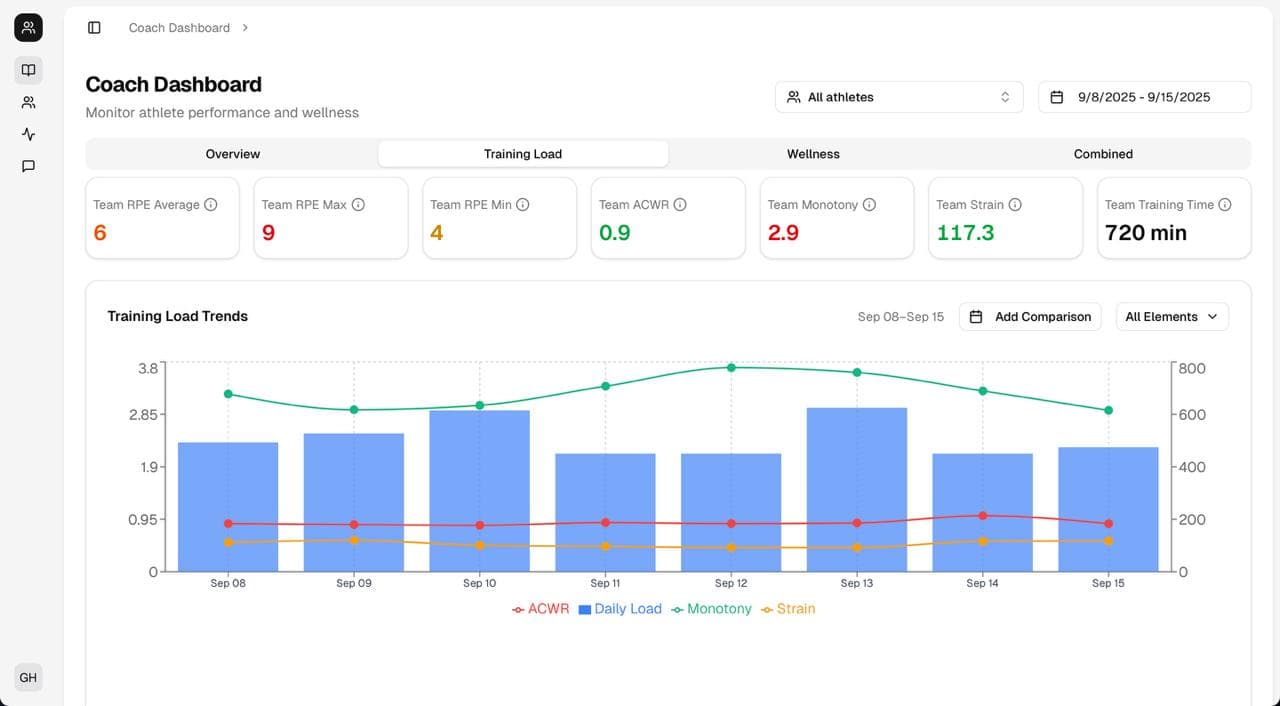
Fractall calculates session load, weekly load, ACWR, monotony, and strain.
Coaches review trends, spikes, and readiness signals in shared dashboards.
Make RPE useful every week
Use Fractall to collect session-RPE, calculate load metrics, and combine training load with wellness context — no hardware required.
Start tomorrow
- Choose a 0-10 RPE scale.
- Explain the scale at the next session.
- Collect 20-30 minutes post-session.
- Record date, type, duration, player, and RPE.
- Calculate session load and weekly load.
- Adjust next week's plan based on the trends.
Related guides
ACWR in Football: How to Use It Safely and Effectively
A coach-friendly guide to using 7-day acute and 21-day chronic workload ratios to manage football training load without turning ACWR into an injury prediction shortcut.
AI Reports for Coaches: What to Automate
A coach-first guide to using AI in sports performance reports without outsourcing selection, medical judgment, or player relationships.
Training Monotony and Strain: A Coach's Guide
Learn what training monotony and strain mean, how to calculate them from session RPE, and how football coaches can use them safely beside ACWR and wellness data.