RPE Basics for Coaches: How to Use Session-RPE to Monitor Training Load
Monitoring training load shouldn’t require a sports science department or expensive GPS systems. Yet many coaches still rely on “feel”, rough notes, or endless spreadsheets to decide whether their team is training too hard, too little, or just right.
The result?
Weeks that are harder than you think. Players arriving at the weekend already fatigued. Or the opposite – match intensity that your training simply didn’t prepare them for.
Session-RPE is one of the simplest and most powerful tools you can use for training load monitoring. It’s low-cost, easy to teach athletes, and works across football, futsal, basketball and most team sports.
This article walks you through exactly how to use RPE and session-RPE in your daily coaching: from definitions to step-by-step implementation, common mistakes, and practical examples from real training weeks.
What Is RPE?
RPE stands for Rating of Perceived Exertion. It’s the athlete’s own perception of how hard a session felt.
Instead of looking at distance, speed or heart rate, RPE asks:
“Overall, how hard was this session for you?”
Coaches use a simple RPE scale. Two of the most common are:
- 0–10 scale (modified Borg)
- 6–20 scale (original Borg)
For most coaches and athletes, the 0–10 scale is easier and more intuitive.
A typical 0–10 RPE scale for coaches might look like:
| RPE | Description | Example feeling |
|---|---|---|
| 0 | Rest | No effort at all |
| 3 | Moderate | Comfortable, could continue for a long time |
| 5 | Hard | Working, but controlled |
| 7 | Very hard | Tough session, strong effort required |
| 9 | Extremely hard | Almost maximal, very challenging |
| 10 | Maximal | All-out effort, cannot sustain longer |
You can refine the descriptors for your sport, but the key is consistency: athletes must understand what “5” vs “8” feels like in the context of your training.
Coach Takeaway:
RPE is the athlete’s internal “volume knob” for effort. When used consistently, it becomes a simple language you and your players share about session intensity.
What Is Session-RPE and How Is It Calculated?
RPE alone tells you how hard the session felt. But as a coach, you also care about how long the player worked at that intensity.
That’s where session-RPE comes in.
The Session-RPE Formula
Session Load = RPE × Session Duration (minutes)
This gives you a single number that represents the athlete’s internal training load for that session.
Example (football training)
- Session duration: 75 minutes
- Player’s RPE: 7 (“very hard”)
Session Load = 7 × 75 = 525 AU
(AU = Arbitrary Units)
Now you can compare loads between:
- Different players in the same session
- Different sessions across the week
- Training sessions vs matches
All using the same simple metric.
Why is this powerful?
- It transforms a subjective feeling into a quantified load value.
- It makes team sports load monitoring possible even without external devices.
- It works across football training load, futsal conditioning, basketball practices, and more.
Coach Takeaway:
Session-RPE turns “it felt hard” into a usable number. That number becomes the foundation of your training load monitoring.
Why Internal Load Matters for Small and Medium Clubs
In an ideal world, every club would have GPS, heart rate systems, and force plates. In reality, many small and medium clubs don’t have the budget, staff, or time.
This is where internal load is your best ally.
Internal vs External Load (Simple View)
- External load:
What the athlete did (distance, high-speed running, accelerations, jumps, etc.). - Internal load:
How the athlete’s body responded (RPE, heart rate, blood markers, etc.).
Even when two players cover the same distance at the same speed, their internal training load can be very different due to fitness, fatigue, stress, or injury history.
For small clubs:
- External load tech may be too expensive or hard to manage.
- Internal load via RPE/session-RPE is cheap, universal, and quick.
- It respects the athlete’s subjective experience, which research consistently shows is valuable for understanding fatigue and readiness.
Benefits of focusing on internal load:
- Works with simple tools (forms, apps, or platforms like Fractall).
- Easy to implement in football, futsal, basketball, handball and more.
- Gives a whole-squad view of how demanding your week really was.
Coach Takeaway:
If you can’t measure everything, measure what matters most and is realistic for your context. Session-RPE gives you a robust, science-backed metric without needing hardware.
How to Implement Session-RPE Step-by-Step
Here’s a practical, tomorrow-ready process to implement session-RPE in your team.
1. Choose Your RPE Scale
Use the 0–10 scale for simplicity.
Define it clearly to players. For example:
- 0 = Rest
- 5 = Hard but controlled
- 7 = Very hard
- 10 = Maximal effort
You can show this on a printed poster in the gym or changing room.
2. Decide When to Ask for RPE
Timing is crucial.
- Collect RPE 20–30 minutes after the end of the session.
- This reduces the influence of the very last drill and allows athletes to rate the overall session.
You can:
- Ask them individually as they leave.
- Use a digital form/app they fill in on their phone.
- Use a monitoring platform that centralizes responses.
3. Educate Your Athletes
Spend 5–10 minutes explaining:
- Why you are doing this (to help them, not to judge them).
- How the scale works.
- That honesty is crucial – “7” is not better than “5”; it just means a different session type.
Initially, you may need to correct some players:
“If that felt quite comfortable and you could do much more, maybe that’s a 4, not a 7.”
4. Record the Values
For each session, record:
- Date
- Session type (e.g., MD-3, MD-1, strength, recovery)
- Duration in minutes
- RPE from each athlete
Then, calculate:
Session Load = RPE × Duration
Even in a simple spreadsheet, you can compute this automatically.
A platform like Fractall can centralize this and generate instant visualizations, but the core idea is the same.
5. Calculate Weekly Load
Sum each player’s session loads across the week:
Weekly Load = Σ session loads (for that week)
Example (football training load – single player):
| Day | Type | Duration | RPE | Session Load |
|---|---|---|---|---|
| Mon | MD-3 | 75 min | 6 | 450 AU |
| Tue | MD-2 | 60 min | 7 | 420 AU |
| Thu | MD-1 | 45 min | 4 | 180 AU |
| Sat | Match | 95 min | 8 | 760 AU |
Weekly Load = 450 + 420 + 180 + 760 = 1,810 AU
Now you can compare:
- This week vs last week
- This player vs others
- Training load vs perceived match demands
6. Repeat Consistently
You’ll get the most value when you:
- Collect RPE for every main session and game.
- Keep the scaling, timing, and messaging consistent.
- Review data at least once per week.
Coach Takeaway:
Session-RPE works if you treat it like any other key coaching habit. Clear scale, consistent timing, simple recording, and weekly review.
Interpreting Session-RPE Data: Practical Coaching Use Cases
Once you’re collecting session-RPE, how do you turn numbers into decisions?
Here are some practical examples.
1. Comparing Training Days (MD-3 vs MD-1)
You may plan:
- MD-3 = High load
- MD-1 = Light, tactical, low load
Session loads should usually reflect that.
Example:
- MD-3: average load across squad = 500–600 AU
- MD-1: average load across squad = 150–250 AU
If MD-1 loads creep up near MD-3 (e.g., 400–500 AU), you may be doing too much the day before a match.
2. Tracking Weekly Load Over Time
You can monitor whether your weekly load is:
- Progressively increasing during pre-season.
- Stable during competitive periods.
- Reduced in deload weeks or during congested fixtures.
If a player’s weekly load jumps by 30–40% compared to their previous weeks, that’s a flag to check, even without GPS.
3. Spotting Atypical Spikes or Drops
Examples:
- A player who usually reports RPE 5–6 suddenly reports 8–9 in a normal session.
- A normally demanding drill produces surprisingly low RPE and session load.
These situations may indicate:
- Accumulated fatigue, poor sleep, or external stress (if RPE is higher).
- Adaptation/fitness gains or low engagement/intensity (if RPE is lower).
Coach Takeaway:
Use session-RPE trends, not single values. Patterns over weeks tell you who is coping well, who needs protection, and where your session design might not match your goals.
Common Mistakes When Using RPE and How to Avoid Them
Even though session-RPE is simple, there are common traps. Here are 6 mistakes and fixes.
Mistake 1: Inconsistent Timing
Mistake
Sometimes asking right after training, sometimes an hour later.
Fix
Standardize: collect RPE 20–30 minutes post-session every time.
Coach Takeaway:
Consistency in timing = consistency in data.
Mistake 2: Poor Athlete Education
Mistake
Athletes are never properly taught the scale, so they randomly pick numbers.
Fix
Spend time explaining the scale, give examples, and check their understanding early on.
Coach Takeaway:
Invest one session in education, save months of low-quality data.
Mistake 3: Using RPE as a “Test” of Toughness
Mistake
Players believe high RPE is “good” and low RPE is “soft”, so they bias responses.
Fix
Emphasize that RPE is not a performance score. It’s information to help manage load and protect them.
Coach Takeaway:
RPE is about honest communication, not judgment.
Mistake 4: Ignoring Context
Mistake
Interpreting a high RPE without considering heat, travel, stress, or recent matches.
Fix
When RPE is unexpectedly high or low, ask: “What could explain this today?”
Coach Takeaway:
Numbers don’t replace coaching; they support better questions.
Mistake 5: Not Combining RPE with Session Duration
Mistake
Looking only at the RPE number and not calculating session load.
Fix
Always multiply by duration to compare sessions and weeks accurately.
Coach Takeaway:
RPE × minutes is what turns impressions into training load monitoring.
Mistake 6: Collecting Data but Never Reviewing It
Mistake
Gathering RPE after every session, but never analyzing it.
Fix
Schedule a weekly 15–20 minute review to check player loads, weekly totals, and notable spikes.
Coach Takeaway:
Your monitoring system is only as good as the decisions you make with it.
Combining RPE with Wellness for a Better Picture
Session-RPE is powerful on its own, but it becomes even more valuable when combined with wellness monitoring.
Key wellness indicators:
- Sleep quality
- Fatigue
- Muscle soreness
- Stress
- Mood
Example: A Red Flag Pattern
Over 4–5 days, you notice:
- RPE values are high (7–8) in ordinary sessions.
- Wellness scores show poor sleep, high fatigue, and increased soreness.
Even if external training load hasn’t changed, this combination suggests:
- The athlete is struggling to recover.
- You may need to adjust their individual load, add recovery strategies, or investigate further.
On the other hand:
- Stable or improving wellness + progressively increased session-RPE load can indicate positive adaptation.
Coach Takeaway:
Session-RPE tells you how hard the session was. Wellness tells you how ready the player was to handle it. Together, they give a more complete view of injury risk and performance readiness.
Coach-Friendly Summary & Checklist
Key Definitions
- RPE: Athlete’s rating of how hard a session felt.
- Session-RPE: RPE × duration (minutes) = internal training load in AU.
- Weekly Load: Sum of all session loads in a week.
Do’s
- Do use a simple 0–10 RPE scale and explain it clearly.
- Do collect RPE 20–30 minutes after each session and match.
- Do calculate session load and weekly load for each player.
- Do review trends weekly and look for spikes or drops.
- Do combine session-RPE with wellness data when possible.
Don’ts
- Don’t change the scale or timing frequently.
- Don’t treat RPE as a “toughness” score.
- Don’t ignore context (travel, stress, illness, heat).
- Don’t collect data if you’re never going to look at it.
- Don’t rely only on external data if you have no capacity to manage it.
“Start Tomorrow” Checklist
You can start a basic session-RPE system in one week:
- Choose a 0–10 RPE scale and print it for players.
- Explain the scale at the next training session.
- Decide your standard timing: 20–30 minutes post-session.
- Create a simple sheet or form with: date, session type, duration, player name, RPE.
- After each session, collect RPE from all players and calculate session load.
- At the end of the week, compute weekly load for each player and note:
- Highest and lowest loads
- Any big jumps vs previous weeks
- Adjust next week’s plan based on what you see (e.g., slightly lower MD-1, extra recovery for overloaded players).
Coach Takeaway:
You don’t need perfect data or complex tools to start. A simple, consistent session-RPE routine already puts you ahead of most teams.
How Fractall Can Help with Session-RPE and Training Load Monitoring
As your monitoring matures, managing RPE, wellness, pain reports, and weekly loads for an entire squad can become time-consuming in spreadsheets.
This is where Fractall can support your workflow.
Fractall is a sports intelligence platform for small and medium clubs that focuses on:
- Training load monitoring with RPE and session-RPE
- Wellness tracking (sleep, fatigue, soreness, stress, mood)
- Pain mapping and clear dashboards
Instead of manually calculating and graphing loads, Fractall can:
- Collect and centralize your players’ responses
- Automatically calculate session loads and weekly loads
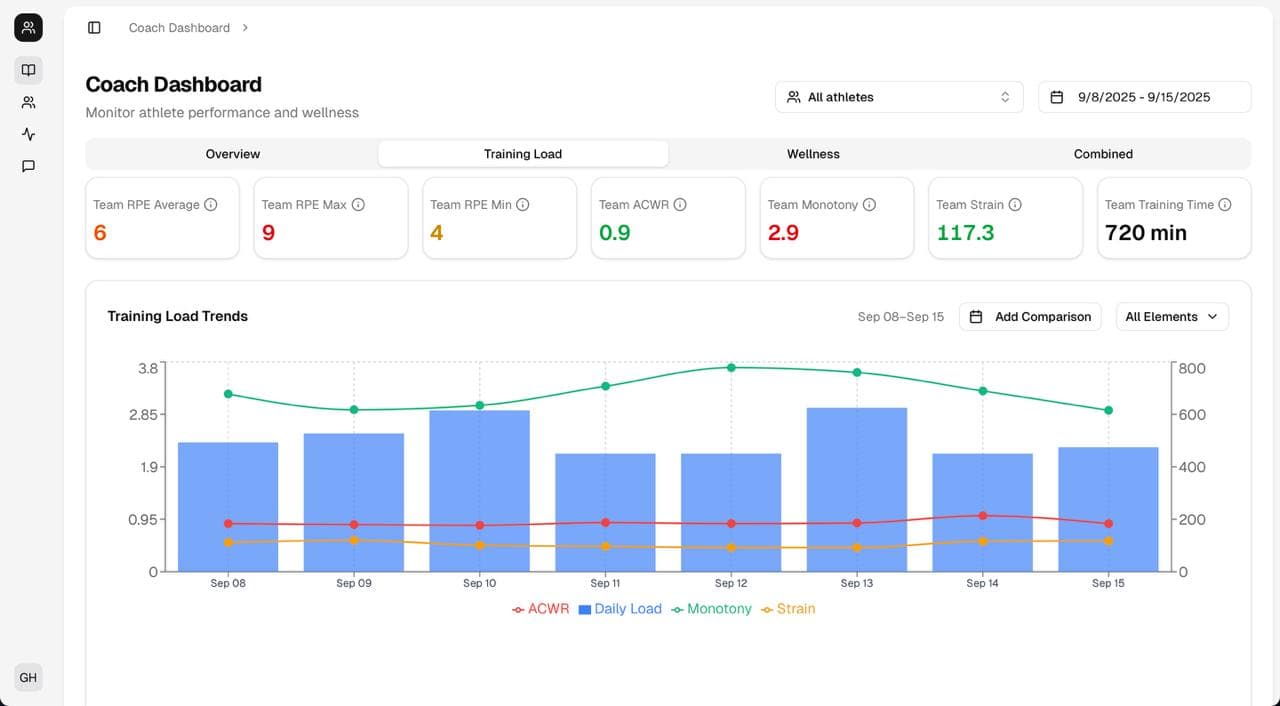
- Visualize trends, spikes, and high-risk patterns in simple, coach-friendly dashboards
This means less time spent on admin, and more time making informed decisions based on clear, visual insights.
If you’re already using session-RPE in your team, a tool like Fractall helps you scale the system, reduce manual work, and bring your staff around a shared, easy-to-understand picture of your squad’s load.
👉 Start exploring Fractall here: https://fractall.fit/
👉 Ready to try it with your team? Sign up for Fractall
And if you want to keep learning about practical sports intelligence for small and medium clubs, follow us on LinkedIn:
Fractall on LinkedIn
Frequently Asked Questions (FAQ)
1. What is a good RPE scale to use in football?
For football and most team sports, the 0–10 scale is usually the easiest to teach and apply. It’s intuitive, works well with players of different ages, and integrates smoothly into session-RPE calculations. The key is to define the descriptors clearly and use the same scale consistently.
2. How many times per week should I collect RPE?
Ideally, you should collect RPE:
- After every main training session
- After every match
This allows you to calculate accurate session loads and weekly loads, and to follow patterns over time.
3. Can I use session-RPE without any technology?
Yes. You can start with:
- A printed RPE scale
- A clipboard or paper sheet
- A simple spreadsheet
Technology and platforms (like Fractall) make it easier and faster, especially with larger squads or multiple teams, but they are not strictly required to begin.
4. How long does it take for players to give reliable RPE scores?
Most players adapt fairly quickly if you explain the scale well and use it consistently. Within 2–3 weeks, you’ll usually see more stable, realistic scores. Early on, you may need to coach their understanding (e.g., helping them calibrate what “5” or “8” feels like).
5. Does session-RPE replace GPS and other external load tools?
No – it doesn’t replace them, but it can complement or stand in for them, especially in clubs without access to expensive hardware. External load tells you what players did; internal load (session-RPE) tells you how their body responded. Together, they offer the most complete picture, but session-RPE alone is already a powerful, evidence-informed tool for training load monitoring.