Weekly Athlete Monitoring Report: A Coach's Complete Guide
Most coaches already know that monitoring matters. The problem is rarely a shortage of data — it is turning a full week of wellness scores, RPE submissions, and load numbers into something every member of your staff can read and act on in under five minutes.
A weekly athlete monitoring report solves that problem. It consolidates an entire microcycle of performance data into a single, shareable document — giving coaches, physiotherapists, and performance staff a clear picture of squad readiness before the week begins. At Fractall, this is the principle behind every reporting feature we build: monitoring only creates value when it supports action.
This guide explains what a strong weekly report should contain, how to structure it for coaching decisions rather than data archiving, and the most common mistakes coaches make when reporting on performance data.
What Is a Weekly Athlete Monitoring Report?
A weekly athlete monitoring report is a structured summary of a squad's health, wellness, and training load data across a defined seven-day period — typically aligned with the competitive microcycle.
Rather than requiring coaching staff to log in to a platform each day, the report packages key performance indicators into a single document that can be shared with physios, head coaches, assistant coaches, or club directors — regardless of platform access.
At its core, a well-designed weekly report answers three questions:
- How did the squad respond to last week's training and match load?
- Which athletes need closer attention this week?
- Who carries a risk — and why?
Why Does the Weekly Report Matter for Coaches?
Performance monitoring only creates value when data reaches the right person, at the right time, in a format they can interpret. Research by Foster et al. (2001), which established session-RPE × duration as a valid method for quantifying internal load, was built on exactly this principle: data must be collected consistently, analysed in context, and communicated clearly to have practical impact.
In practice, coaching staff at small and medium clubs include people who are not connected to the monitoring platform — head coaches, physios, assistant coaches, or club directors. When load and wellness data stays inside a dashboard only the S&C coach can access, those staff members make decisions without it.
The weekly report closes that gap. It transforms raw monitoring data into a concise briefing document. One that a head coach can read in under five minutes. One that changes how the week is planned.
Coach Takeaway: A dashboard gives you data access. A weekly report gives your entire staff a shared language for that same data.
What Should a Weekly Athlete Monitoring Report Include?
Not every metric belongs in a weekly report. The goal is clarity, not completeness. These are the sections that consistently drive coaching decisions:
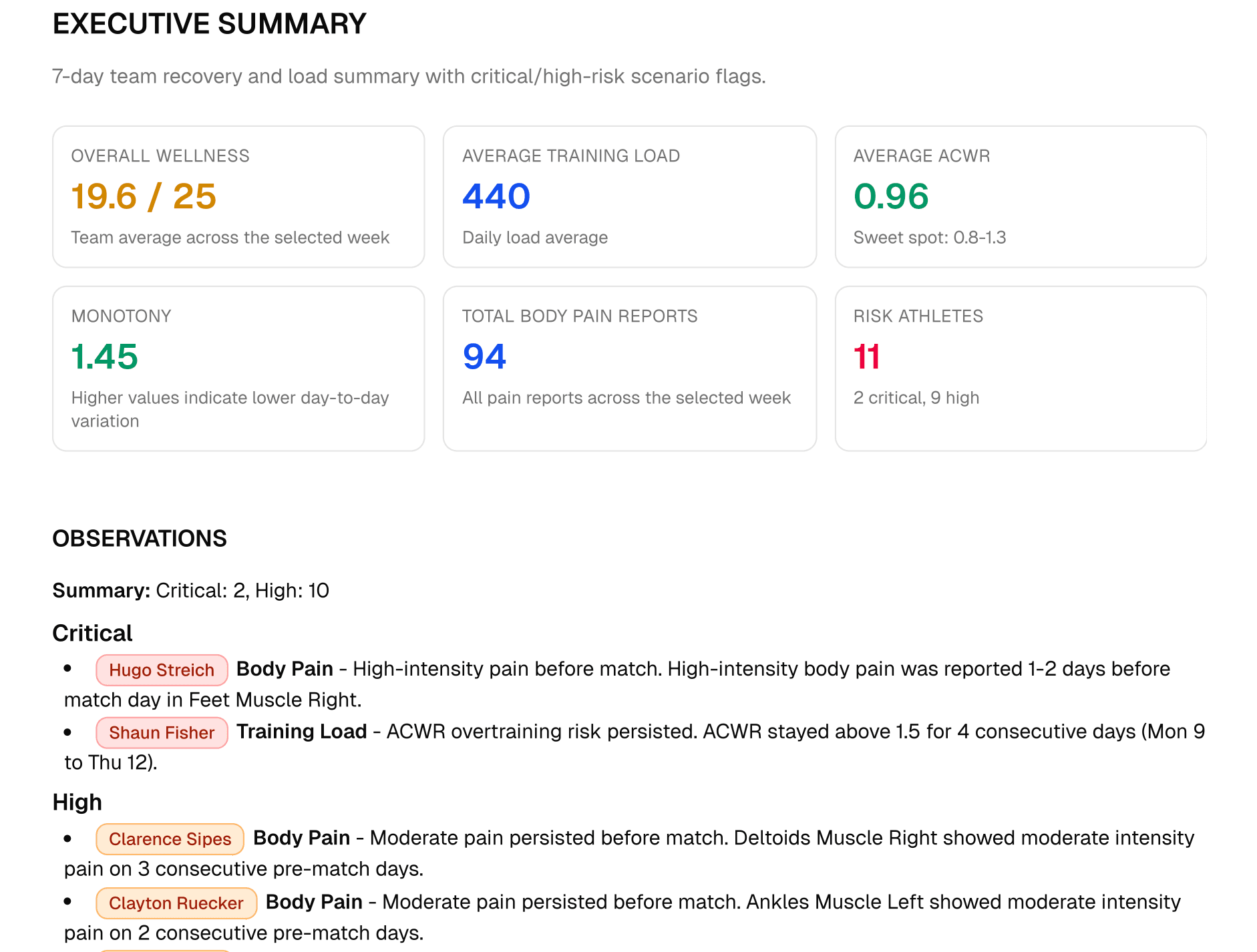
1. Executive Summary
Squad-level overview: overall wellness trend, average training load, ACWR range, and the number of athletes flagged as critical or high-risk. This section should be interpretable in 30 seconds.
2. Daily Load Trend with ACWR Thresholds
A visual representation of how load evolved through the microcycle, with reference zones marked. Using a rolling 7:28 average approach for ACWR calculation, coaches can identify whether the squad trained within a manageable range — or whether an unplanned load spike occurred.
As Gabbett (2016) highlighted in his work on the training-injury prevention paradox, rapid changes in load relative to adaptation carry more risk than high load in isolation. A load trend chart makes this visible without requiring statistical expertise.
3. Wellness Evolution Across All Five Markers
How the squad scored across fatigue, sleep quality, stress, mood, and muscle soreness across the full week. Viewing these markers as a pattern rather than isolated scores is what transforms wellness data into actionable insight.
One report gives information. A pattern gives understanding.
4. Body Pain Heatmap
A visual map of pain and discomfort reports by muscle group and severity. Particularly valuable for physiotherapists and S&C coaches identifying patterns before they escalate — especially during fixture-congested periods.
5. Individual Athlete Observations
Athletes flagged as critical or high-risk, with the specific metrics that triggered each flag and brief contextual notes. This section tells coaches not just that a player needs attention, but why.
How to Structure a Weekly Report for Coaching Decisions
Follow this sequence when building or reviewing your weekly report:
- Start with the squad picture. Is the group as a whole within a healthy load and wellness range? This sets the context for every individual decision that follows.
- Review load against the planned microcycle. Did training load match what was scheduled? Were there unexpected spikes after a midweek match or a high-intensity session?
- Check wellness trends, not single-day scores. A squad dropping from 4.2 to 3.1 average wellness across three consecutive days is a meaningful signal. A single low score on Monday morning often is not.
- Identify who needs intervention. Use the flagged athlete list to prioritise conversations, load modifications, or physiotherapy referrals before the next session.
- Share before the week starts. The report is most useful when it reaches the head coach, physio, and assistant coach before Tuesday's first training session — not after.
Real Examples from Sport
In football, a typical microcycle runs from Sunday through Saturday. A weekly report reviewed on Monday morning gives performance staff a structured view of how the squad recovered from the previous fixture — and how much training capacity remains before the next one.
At clubs like SC Beira-Mar and SC Espinho — early adopters of Fractall's monitoring platform — weekly reporting has helped surface patterns that daily session data alone could not reveal: mid-week fatigue dips in subgroups of players, cross-referenced with sleep quality scores, pointing to recovery factors rather than training volume.
In basketball and futsal, where fixture congestion is even more acute, weekly reports give S&C coaches a structured way to communicate load rationale to head coaches without a performance background — translating ACWR data into plain language before naming the squad for the next fixture.
Common Mistakes Coaches Make with Weekly Reports
1. Reporting data instead of decisions. A report listing every metric without prioritisation becomes noise. The executive summary should answer "who needs attention and why" — not "here is everything we collected."
2. Sharing reports after decisions have already been made. A Monday morning report that arrives on Wednesday afternoon has missed the planning window. Build report generation into a fixed step — Sunday evening or Monday morning at the latest.
3. Using jargon that limits the audience. If the head coach has to ask what ACWR means every time they see it, the report is not reaching its potential. Use visual thresholds and plain-language summaries for non-specialist readers.
4. Flagging individuals without context. A single high-risk flag means little without surrounding context: is this a player's first flag in four weeks, or their third consecutive one? That context changes the decision entirely.
5. Not adapting to the competitive calendar. A weekly report structure designed for a standard week breaks down during congested fixture periods. Adjust report cadence and flagging thresholds to match the actual training structure.
How to Implement a Weekly Monitoring Report Today
- [ ] Define your audience and delivery time (e.g. physio, head coach, S&C lead — every Monday by 9am)
- [ ] Confirm data completeness — aim for at least 70–80% squad compliance across RPE and wellness submissions
- [ ] Review the executive summary first — squad-level picture before individual flags
- [ ] Surface flagged athletes proactively before the first training session of the week
- [ ] Compare this week's flags against last week's — are previously flagged athletes recovering or worsening?
- [ ] Write for the head coach, not just the S&C department — plain language in every summary section
How Fractall Helps
The Weekly Report at Fractall automates everything described above. In a single PDF, coaches and staff receive: an executive summary of squad wellness, load, and ACWR; the daily load trend with ACWR thresholds visualised; wellness evolution across all five markers; a body pain heatmap by muscle group and severity; and individual athlete observations with critical and high-risk flags — with context, not just numbers.
It is designed to be sent to any staff member — with or without platform access. No login required. No dashboard training needed. A physiotherapist can open it. A head coach can read it. A club director can understand it.
Explore Fractall's plans or start a free trial to see the Weekly Report in the context of your own squad.
Because monitoring only creates value when it supports action.
Frequently Asked Questions
What should a weekly athlete monitoring report include?
A complete weekly monitoring report should include an executive summary of squad wellness and training load, a daily load trend with ACWR thresholds, wellness evolution across key markers (fatigue, sleep quality, stress, mood, and muscle soreness), a body pain heatmap by muscle group and severity, and individual observations for flagged athletes. The document should be structured so any staff member — including those without platform access — can interpret the key findings without requiring sports science expertise.
How often should coaches generate athlete monitoring reports?
For teams on a standard one-match-per-week schedule, a weekly report aligned with the microcycle — generated on Sunday evening or Monday morning — is sufficient. During congested periods with two or more matches per week, a mid-week summary can supplement the full weekly document. The defining rule: the report must arrive before training decisions are made for the week, not after.
What is ACWR and why is it included in weekly monitoring reports?
ACWR (Acute:Chronic Workload Ratio) compares an athlete's recent training load (last 7 days) against their longer-term load baseline (last 28 days). It helps coaches identify whether load has increased too quickly relative to what athletes are adapted to. Including ACWR in a weekly report provides coaching staff with an interpretable indicator of load progression — not as a rule to follow, but as context that supports decisions. It does not dictate who trains. It informs the conversation.
How many athletes need to submit data for a weekly report to be meaningful?
A practical threshold is 70–80% squad compliance across RPE and wellness submissions for the week. Below this level, squad-level averages can be skewed by too few data points and individual flags lose reliability. The most effective way to improve compliance is to demonstrate to athletes that their submissions change something — that flagged soreness or poor sleep leads to a visible coaching response.
Can the weekly report be shared with staff who don't use the monitoring platform?
Yes — and this is one of the most valuable features of a PDF-format report. Physiotherapists, head coaches, assistant coaches, and club directors can all receive the same briefing document without requiring platform accounts or onboarding. Fractall's Weekly Report was built specifically with this multi-staff communication use case in mind.
What is the difference between a weekly monitoring report and a real-time dashboard?
A real-time dashboard gives coaches live access to individual and squad metrics — useful for daily check-ins and post-session reviews. A weekly report provides a structured summary of the full microcycle in a single, shareable document — designed for planning conversations and staff briefings. The dashboard informs daily decisions. The weekly report informs weekly planning and cross-staff communication.
Key Takeaways for Coaches
- A weekly monitoring report turns a full week of data into a five-minute briefing any staff member can act on
- Include: executive summary, daily load trend with ACWR, wellness evolution across five markers, body pain heatmap, and individual flags with context
- Deliver before the first training session of the week — not after decisions have been made
- Flag athletes with context, not just numbers — first occurrence versus recurring pattern changes the intervention
- Design the report for your least technical reader: the head coach, not the S&C specialist
- Monitoring only creates value when it supports action