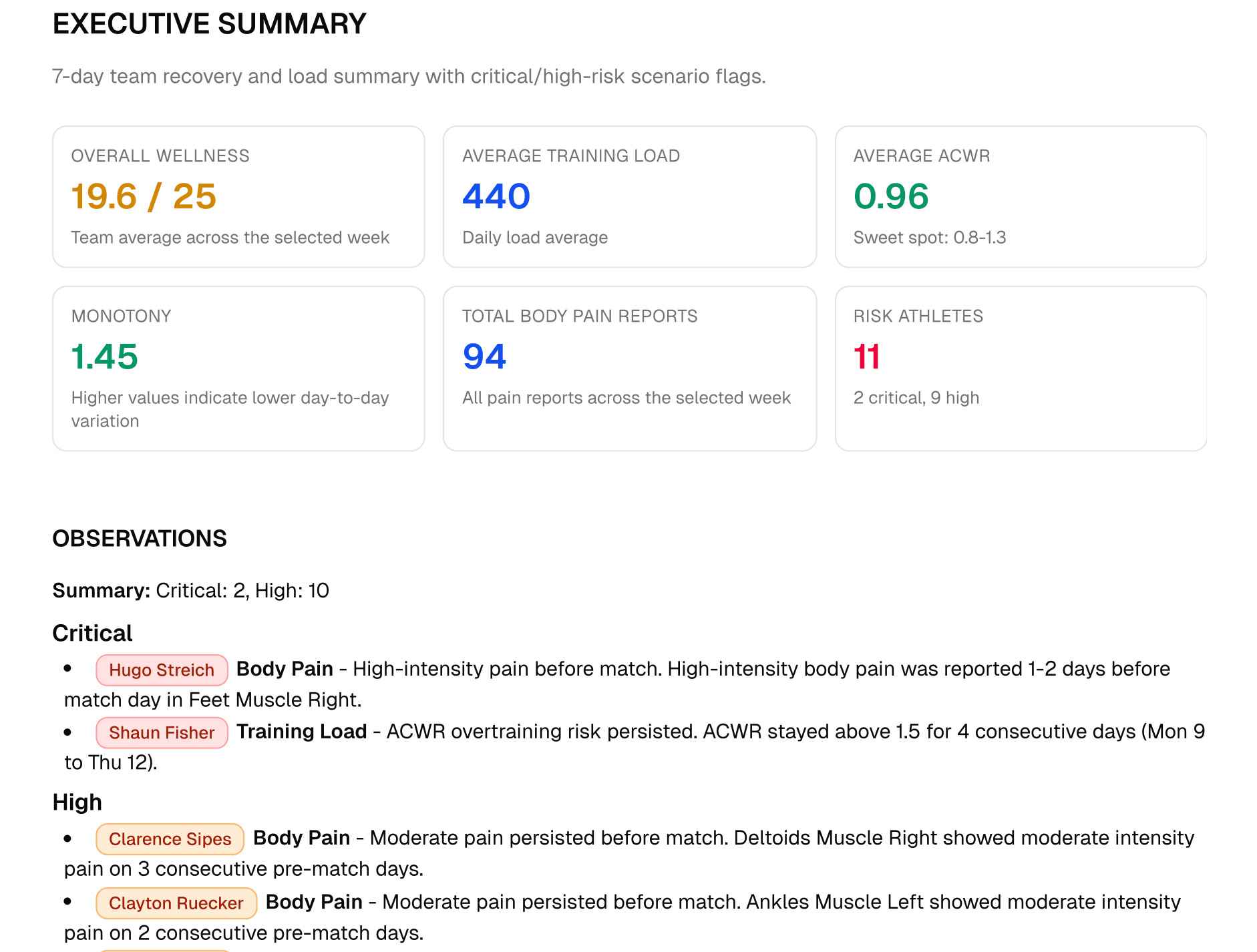
A weekly team monitoring report gives coaches and staff a complete picture of squad wellness, training load, and injury risk — in a single document that anyone on the backroom team can read and act on.
For years, performance data lived in dashboards and spreadsheets. The S&C coach could access it. Everyone else was left guessing. That gap has a cost. When the head coach, physiotherapist, and club director are working from different information — or no information at all — monitoring stops being a shared team tool and becomes a solo responsibility.
This article explains what a weekly monitoring report should contain, how to structure it, who should receive it, and how getting the right document in front of the right people is one of the highest-leverage decisions a performance department can make. Learn more about how Fractall approaches this at fractall.fit.
What is a Weekly Team Monitoring Report?
A weekly team monitoring report is a structured document summarising the most relevant athlete and squad data collected over a seven-day period — typically aligned to the competitive microcycle.
At minimum, it should cover:
- Internal load — how hard athletes actually trained, expressed through session RPE × duration
- Wellness markers — fatigue, sleep quality, stress, muscle soreness, and mood
- Workload ratios — ACWR, monotony, and strain
- Body pain and discomfort — location, severity, and trend across the week
- Flagged athletes — individuals who require closer attention before the next session
The report is not a raw data export. It is a summary designed for interpretation — by people who may not have direct dashboard access, including head coaches, physiotherapists, team directors, and medical staff.
Why Does Weekly Reporting Matter for Coaches?
Monitoring only creates value when it reaches the person who can act on it.
A well-structured weekly report solves one of the most persistent problems in performance departments: the gap between data collection and decision-making. Consider a typical training week. The S&C coach is tracking RPE. The physio is logging soreness complaints. The head coach is planning the next session without either piece of information. Each person holds a fragment. None has the full picture.
A weekly monitoring report bridges that gap. It:
- Gives the head coach visibility into squad readiness before naming a lineup
- Gives the physiotherapist context to prioritise treatment sessions
- Gives the club director a snapshot of how the squad is responding to training demands
- Gives the S&C coach a communication tool — not just a data tool
As Foster et al. (2001) demonstrated, session-RPE provides reliable, low-cost insight into how athletes are adapting to training. The challenge is rarely the data itself. It is getting that data in front of the right people.
Coach Takeaway: A monitoring report is only as useful as its distribution. If it lives in a dashboard that only one person opens, it is not functioning as a team tool.
How to Structure a Weekly Team Monitoring Report Step by Step
A well-designed report follows a clear hierarchy: from team-level summary to individual athlete flags. This allows any reader — regardless of technical background — to understand the most important information first.
- Executive summary — Lead with decision-critical information: overall team wellness trend for the week, average ACWR across the squad, number of athletes in risk or caution zones, and any notable load spikes or drops.
- Daily load trend with ACWR visualisation — Show how load evolved across each day of the microcycle, with ACWR thresholds marked. A coach should see at a glance whether the squad moved through the week on a rising, stable, or declining curve — and whether they are approaching the 1.3 threshold associated with elevated injury risk.
- Wellness evolution across all five markers — Track fatigue, sleep quality, stress, muscle soreness, and mood across the full week. Show both team averages and distribution. A squad averaging 4/5 but containing several athletes at 2/5 needs different management than a uniformly distributed group.
- Body pain heatmap by muscle group and severity — A visual map of reported discomfort organised by body region and severity level. If five athletes report posterior thigh discomfort in the same week, that is a training load signal — not a coincidence.
- Individual athlete observations — For each flagged athlete, include a brief, context-specific note: what the flag is, what the likely context is, and what the recommended focus should be before the next session.
What Do Real Weekly Reports Look Like in Sport?
In football, the competitive microcycle typically runs from match day through to the following fixture — a seven-day window. Load distribution across that week is rarely uniform: higher-intensity sessions early, a reduction mid-week, then a controlled ramp before match day.
A weekly monitoring report built around that structure shows the head coach whether athletes returned from the last match with elevated fatigue, how soreness tracked through the first training days, and whether ACWR remained within the 0.8–1.3 range associated with lower injury risk in the literature (Gabbett, 2016).
In basketball, where fixture density is often higher and rotation more frequent, the same report gives staff visibility into which athletes are accumulating chronic loads quickly — and which may be under-loaded relative to their training history, creating a different type of vulnerability.
The report format is consistent. The content reflects the sport and the microcycle. That is by design.
Coach Takeaway: The value of a weekly report is not in any single edition. It is in the pattern that emerges across consecutive weeks — which is why consistency of collection matters more than the quality of any individual report.
Common Mistakes Coaches Make With Weekly Monitoring Reports
Reporting data without context. An ACWR of 1.4 is a flag. Without knowing whether the athlete is returning from injury, in pre-season or mid-season, or had an unusually intense fixture the previous weekend — that number leads to inconsistent decisions. Reports must include context.
Making the report too detailed for its audience. A 20-page data export is not a report. A report is a selection. The head coach needs three or four key takeaways before Tuesday's session. Build the report for that reader first.
Sending the report without a conversation. The most effective performance departments treat the weekly report as the start of a discussion, not the end of one. Without a brief conversation — even five minutes before training — the document often does not change anything.
Inconsistent reporting frequency. A report that arrives irregularly trains staff to treat it as optional. Weekly cadence is not just best practice — it is what builds the habit of acting on monitoring data across the whole team.
Ignoring athletes who look fine. A clean report across all markers can mask under-reporting. Athletes who consistently score 5/5 on wellness despite high training loads may be self-censoring. The weekly report should flag statistical outliers in both directions.
How to Implement a Weekly Monitoring Report Today
If your club is not yet producing a weekly monitoring report, here is a practical starting point:
- Define your audience — who receives it? Head coach only? Full staff? Calibrate depth and language to the least technically experienced reader.
- Standardise your collection — RPE must be collected post-session, every session. Wellness surveys should be completed at least four days per week to generate meaningful averages. Explore Fractall's collection tools to see how WhatsApp-based data collection reduces compliance friction without requiring a new app.
- Choose a fixed send time — Monday morning before the first session of the week is a common choice. Consistency builds the habit.
- Keep the main document under two pages for non-specialists — include a detailed appendix for those who want more.
- Track whether it changes decisions — if the report exists but never influences training planning, recovery allocation, or lineup decisions, the format or distribution needs to change.
How Fractall Helps With Weekly Monitoring Reports
Fractall automates the weekly monitoring report end-to-end. Athletes submit RPE and wellness data via their mobile device — no new app required, no spreadsheet to maintain. Fractall processes that data automatically and generates a structured weekly PDF containing everything described above: executive summary, daily load trend with ACWR thresholds, wellness evolution across all five markers, body pain heatmap, and individual athlete observations with risk flags.
The report is designed to be readable by any member of the coaching and medical staff — not just the person who collected the data. One export. One document. Shared with everyone who needs it.
Start a free trial at app.fractall.fit and see your first weekly report generated from your own squad's data within the first week of use. See Fractall's pricing — plans start at €14.95 per month with a six-week free trial.
Monitoring only creates value when it supports action. The weekly report is how that action starts.
Frequently Asked Questions
What should a weekly athlete monitoring report include? A complete weekly athlete monitoring report should include an executive summary of squad wellness and training load, a daily internal load trend with ACWR thresholds visualised, wellness scores across five markers — fatigue, sleep quality, stress, muscle soreness, and mood — a body pain summary organised by muscle group, and individual observations for flagged athletes. The report should be readable by all members of the coaching and medical staff, not only the performance specialist who collected the data.
How often should a team monitoring report be sent? Weekly reporting aligned to the competitive microcycle is the standard approach in professional and semi-professional sport. For clubs in congested fixture periods, a mid-week update for flagged athletes can supplement the full weekly report. The most important factor is consistency — irregular reporting reduces its usefulness as a decision-support tool and erodes the team habit of acting on monitoring data.
What is ACWR and why does it appear in weekly reports? ACWR (Acute:Chronic Workload Ratio) compares an athlete's recent training load across the last seven days to their longer-term load history across the last 28 days. A ratio between 0.8 and 1.3 is generally associated with lower injury risk, as supported by research from Gabbett (2016) and subsequent literature. It appears in weekly reports as a key indicator for athletes who may have spiked or dropped in load relative to their training baseline — ACWR does not dictate decisions, it supports them.
How do you collect wellness data from athletes without spreadsheets? Platforms like Fractall collect wellness and RPE data via mobile-friendly daily check-ins — athletes respond in under 60 seconds. Coaches receive structured data automatically. No manual entry, no chasing responses, no copy-pasting into spreadsheets. WhatsApp-based collection in particular has been shown to reduce the friction that causes compliance to drop over time.
Who should receive the weekly monitoring report? At minimum: the S&C coach or performance lead, the head coach, and the physiotherapist or medical staff. In larger squads, position coaches or assistant coaches may benefit from position-specific views. The report should be calibrated to its audience — a head coach needs a two-minute read, not a detailed data appendix. The goal is to get the right level of information in front of every person who makes decisions that affect athlete load and recovery.
Can a weekly monitoring report help with return-to-play decisions? A weekly monitoring report provides relevant context for return-to-play planning — particularly through the body pain heatmap and individual athlete observations section. It supports the clinical decision-making of physiotherapists and medical staff; it does not replace it. The report surfaces patterns over time, which is particularly valuable in the later stages of rehabilitation when load progression needs to be carefully managed against the athlete's chronic load baseline.
Coach Checklist: Key Takeaways
- [ ] Executive summary covers wellness trend, average ACWR, and athlete risk flags — readable in under two minutes
- [ ] Daily load trend includes ACWR thresholds, not just raw load numbers
- [ ] Wellness evolution tracks all five markers across the full week, not just averages
- [ ] Body pain heatmap is included for physiotherapy and medical staff
- [ ] Individual observations are context-specific — not data dumps, but actionable notes
- [ ] Report is distributed to head coach and medical staff — not only the S&C coach
- [ ] Send time is fixed, consistent, and aligned to the microcycle every week