

Pre-Season Monitoring: A 6-Week Plan for Coaches
Plan and monitor a 6-week pre-season with sRPE, ACWR, and wellness checks, no GPS needed. A week-by-week readiness guide for small-club coaches.
Updated first published
Quick answer
Why it matters
Pre-season is where the season's injuries are set up
Players come back detrained after the off-season, and the temptation is to make up for lost time fast. That jump off a low base is exactly the pattern that gets athletes hurt.
5-7x
Higher non-contact injury risk
When ACWR exceeds 2.0 on a low chronic base (EPL, 33 players, 3 seasons).
0.8-1.3
ACWR working range
The commonly cited sweet spot for balancing fitness and injury risk.
Expect ACWR to read high early, and don't panic
The shape of the block
Split the 6 weeks into base, build, and sharpen
A pre-season block has a rhythm. The first weeks rebuild a foundation, the middle weeks carry the heaviest load, and the last weeks sharpen and taper into the opening fixture.
| Phase (weeks) | Load focus | Monitoring focus |
|---|---|---|
| Base (weeks 1-2) | Rebuild volume from a low base. Moderate intensity, generous recovery. | Establish baselines. Watch soreness and sleep as bodies re-adapt. |
| Build (weeks 3-4) | Highest weekly load of the block. Add intensity and football-specific work. | Watch ACWR and monotony. This is where spikes hurt people. |
| Sharpen (weeks 5-6) | Reduce volume, keep intensity sharp. Friendlies replace some training load. | Confirm readiness is rising. Flag anyone still carrying fatigue or pain. |
Coach takeaway
The inputs
What to monitor, and why each one earns its place
You don't need a lab. Four data streams, collected on the athlete's phone, tell you almost everything you need to manage a pre-season block.
Training load (RPE x duration)
Wellness (McLean scale)
Body pain mapping
Physical-test baselines
The playbook
A week-by-week pre-season load ramp
This is a starting template, not a prescription. Anchor it to your own squad's starting fitness and your fixture date, then let the monitoring data pull individuals off the plan when they need it.
| Week and load | Session focus | Watch for |
|---|---|---|
| Week 1 (low, rebuild) | Aerobic base, movement quality, low-intensity football. | Excessive soreness, poor sleep from the sudden return. |
| Week 2 (low to moderate) | Add volume. Introduce more football-specific work. | Anyone whose soreness isn't settling between sessions. |
| Week 3 (moderate to high) | Raise intensity. First heavier conditioning blocks. | ACWR climbing too fast on individuals returning late. |
| Week 4 (peak load) | Peak weekly load. Full-intensity football and conditioning. | Monotony (too many samey hard days), strain, falling wellness. |
| Week 5 (moderate, sharpen) | Cut volume, keep intensity. First friendlies. | Fatigue that isn't lifting as volume drops. |
| Week 6 (low, taper) | Match-specific sharpness, set-pieces, final friendly. | Any lingering pain flags before the opening fixture. |
- 1
Set week-one baselines
Run a short physical-test battery and start daily wellness and sRPE from day one, so you have a reference to measure against.
- 2
Ramp load gradually into week four
Increase weekly internal load step by step. Avoid large jumps between weeks, especially for players who arrived back late or under-prepared.
- 3
Watch ACWR through the build phase
Weeks 3-4 are where acute load rises fastest. Keep individuals in a sensible range and pull back anyone spiking well above their chronic base.
- 4
Sharpen and confirm readiness
In weeks 5-6, drop volume, keep intensity, and use friendlies as load. Retest to confirm the block built fitness rather than fatigue.
Week-to-week checks
- Weekly load rose gradually, with no single sharp spike.
- ACWR stayed roughly in the 0.8-1.3 range for most players.
- No player has a sustained falling wellness trend.
- Pain flags are being reviewed individually, not averaged away.
- Late returners are on a slower, separate ramp.
Reading the data
How to know the block is working
A pre-season is working when fitness is rising and the warning signals stay quiet. Here's how to tell the difference between productive fatigue and a player heading for the treatment table.
| Signal | Looks healthy when | Red flag when |
|---|---|---|
| ACWR | Reads high early, then settles as the chronic base builds. | A sharp acute jump on a still-low base (a real spike, not just a high reading). |
| Monotony | Weeks have clear hard and easy contrast. | Every day looks the same, with no recovery variation. |
| Wellness trend | Dips after hard days, recovers within a day or two. | Falls for several days and doesn't rebound. |
| Body pain | Occasional, low-intensity, resolves quickly. | Same region, rising intensity, across multiple check-ins. |
| Physical tests | Late-block retest shows maintained or improved output. | Retest output drops, suggesting accumulated fatigue. |
Individuals over averages
In practice
Run the whole loop without a spreadsheet
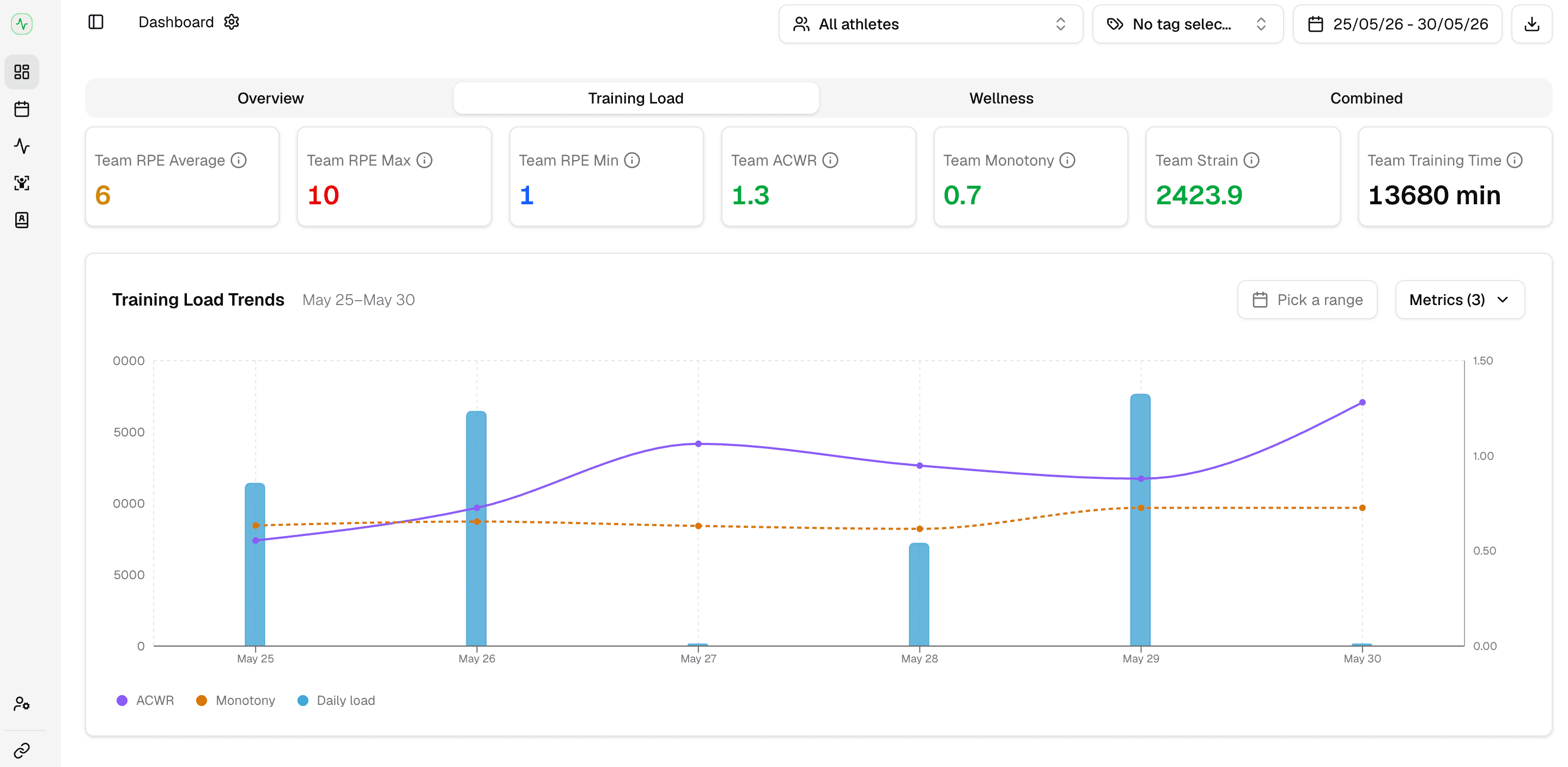
The monitoring above is simple in theory and painful in a spreadsheet: chasing sRPE submissions, recalculating ACWR by hand, and eyeballing wellness across a full squad. This is the job Fractall automates.
Fractall pre-season loop
Athletes submit sRPE and daily wellness on their phone, plus body pain and physical-test results.
Fractall calculates internal load, ACWR, monotony, and strain automatically as the block progresses.
The coach dashboard flags spikes, falling wellness, and rising pain by player, not just by team average.
Export a PDF at the end of each phase to review the ramp with staff before the next block.
Monitor your pre-season without spreadsheets
Collect sRPE and wellness, calculate ACWR and monotony automatically, and see player readiness before every session.
FAQs
Pre-season monitoring questions
Short answers for coaches building a monitored pre-season block.
How long should a pre-season block be?
Do I need GPS to monitor pre-season load?
What ACWR should I aim for in pre-season?
How do I handle players who join late?
What's the single most useful thing to track?
What changes once the first fixture arrives?
Coach recap
- Rebuild a base in weeks 1-2 before loading hard in weeks 3-4.
- Ramp weekly load gradually and avoid spikes off a low base.
- Track load, wellness, pain, and physical-test baselines together.
- Manage individuals, especially late returners, not just the squad average.
- Carry the same monitoring loop into the season once fixtures begin.
Related guides
Two Games a Week: What Wellness Data Shows Before Match 2
Fractall data on football teams playing two games a week: on match morning, fatigue sits less than half as far above normal. How to read wellness between games.
ChatGPT and Claude for Strength and Conditioning Coaches
What an S&C coach can ask ChatGPT or Claude about squad load, wellness and injuries, and the privacy settings to change before any athlete data goes in.
CMJ Test: Protocol, Norms and Why Devices Disagree
The same countermovement jump reads nearly 7 cm apart on a force plate, a phone app and a sensor. Triple the U16 to U18 gap. The protocol and the norms.