

Menstrual Cycle Tracking for Female Athletes
Menstrual cycle tracking for female athletes, explained for coaches: what the science supports, what it doesn't, and how to set it up without overclaiming.
Updated first published
Why it matters
Why the menstrual cycle belongs in your monitoring
You already track load and wellness. Menstrual cycle tracking adds the missing piece for female athletes: a private, athlete-controlled signal that explains symptoms and flags health problems early.
Quick answer
11%
of female athletes had discussed female-health issues with their coach
von Rosen et al. 2022, 1,086 athletes across 57 sports.
81%
agreed menstrual health is treated as taboo in their sport
Same cohort. Silence is the default, not a decision.
53%
rated their coaches' knowledge of cycle issues as poor or very poor
A knowledge gap you can close with a shared, private record.
The basics
The four phases, in plain language
You don't need a physiology degree to use this. You need a shared vocabulary and a healthy respect for how much it varies between athletes.
The menstrual cycle
A roughly monthly hormonal cycle, counted from the first day of one period to the first day of the next. A textbook cycle is about 28 days, but normal cycles range widely, and the timing of ovulation shifts from athlete to athlete and month to month.
Example: Two athletes can both have healthy cycles and still be in different phases on the same training day. Averages describe a group, not the player in front of you.
| Phase | Roughly when | What athletes commonly report |
|---|---|---|
| Menstruation | Cycle days 1 to about 5, when bleeding occurs. | Some report cramps, fatigue, and broken sleep. Many report nothing unusual. |
| Follicular | From the end of the period up to ovulation. | Oestrogen rises. Some athletes say they feel good here, but this is individual, not a rule. |
| Ovulation | Around mid-cycle, when an egg is released. | Oestrogen peaks. The exact day is hard to pin down without a test. |
| Luteal | After ovulation until the next period starts. | Progesterone rises. Late in this phase some report higher perceived effort, heat sensitivity, and premenstrual symptoms. |
The word that matters most is 'estimated'
The evidence
What the science actually says about performance
This is where good intentions meet weak evidence. Read it before you build cycle phases into a training plan.
What this means for your week
Health first
When a missing period is a health flag, not a training variable
The biggest payoff from cycle tracking is catching a health problem early, well before it costs an athlete a season.
Treat these as reasons to refer, not to adjust load
- Periods that stop for three or more months in an athlete not using hormonal contraception.
- Cycles that become markedly irregular over a season.
- Missing periods alongside low energy, frequent illness, or repeated bone stress injuries.
- An athlete raising a concern about her cycle that is outside your expertise.
Common question
Does the menstrual cycle change injury risk?
Coaches ask this most about the ACL. The honest answer is that the evidence does not support a confident yes.
Getting started
How to start tracking, step by step
Tracking only works if athletes trust it. Build for consent and privacy first, data second.
- 1
Explain why, and make it optional
Tell athletes you want to understand symptoms and protect their health, not police their bodies. Make clear that logging is their choice and can be stopped at any time. Consent is the foundation, and without it the data is both unreliable and wrong to collect.
- 2
Keep it private and athlete-controlled
Menstrual data is personal. It should be logged by the athlete on her own device, visible to the small group of staff who need it, and never passed around in a shared spreadsheet column. If athletes don't control it, most will not share it.
- 3
Log the two things that matter
Record when the period starts and any symptoms that affect training, such as cramps, fatigue, or poor sleep. That is enough to spot patterns and health flags. You do not need to estimate ovulation to get value.
- 4
Read it next to load and wellness, per athlete
Look at each athlete's reported symptoms and cycle alongside her sRPE, training load, and wellness scores. Build a picture of how she responds across her own cycle. Compare her to herself, not to a phase chart or to a teammate.
- 5
Refer health concerns out
If tracking surfaces missing or irregular periods, route it to a doctor or sports physician. Your job is to notice and refer, not to diagnose.
In Fractall
How Fractall tracks the menstrual cycle
Fractall puts cycle context inside the wellness check-in athletes already complete, then shows estimated phases next to the rest of their data. It's part of every plan, with no add-on.
From a one-tap log to phase context on your dashboard
Athletes log menstruation with a single toggle inside the daily wellness check-in. The toggle is only visible to athletes who identify as female, and logging is always their choice, on their own phone.
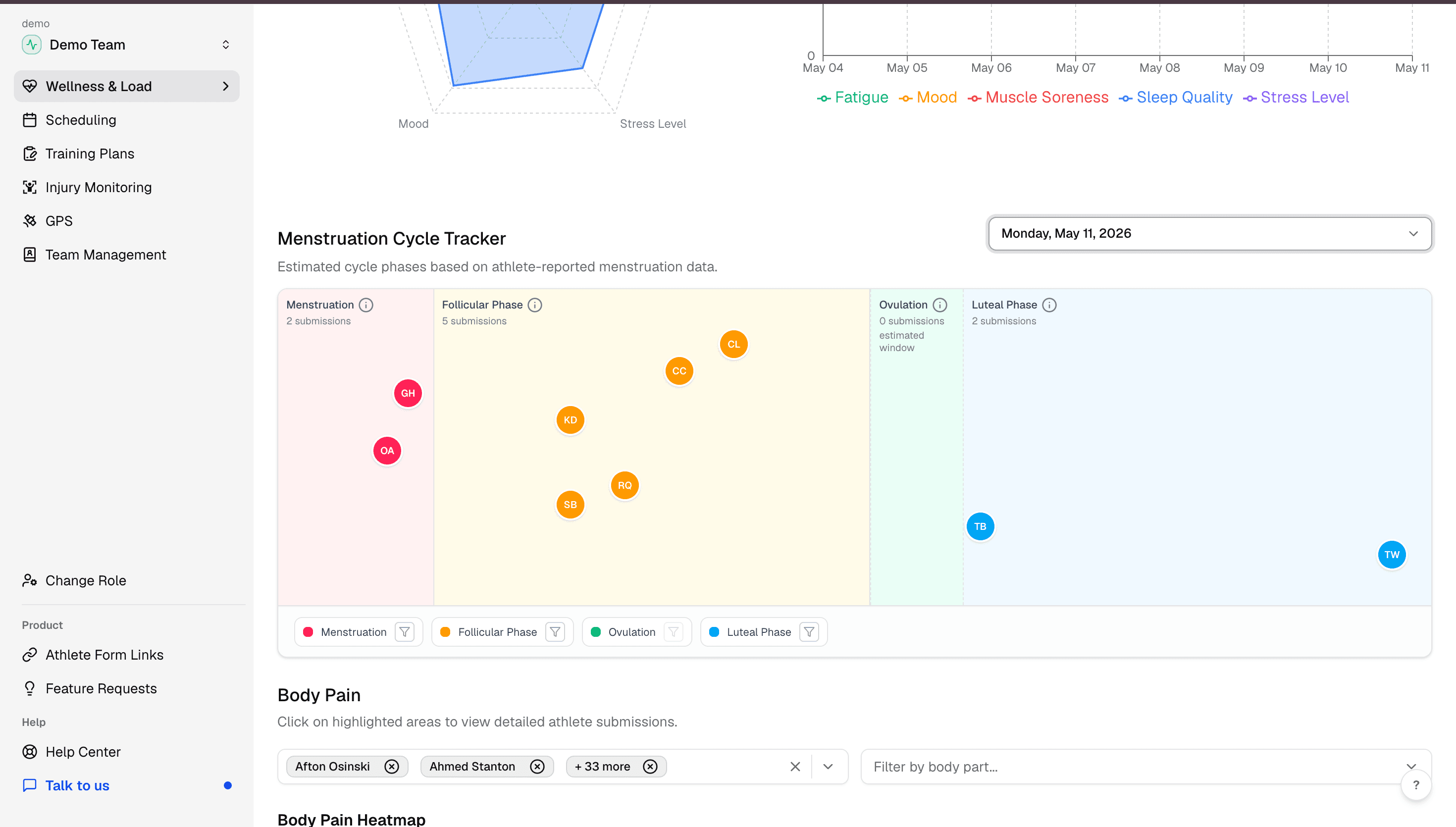
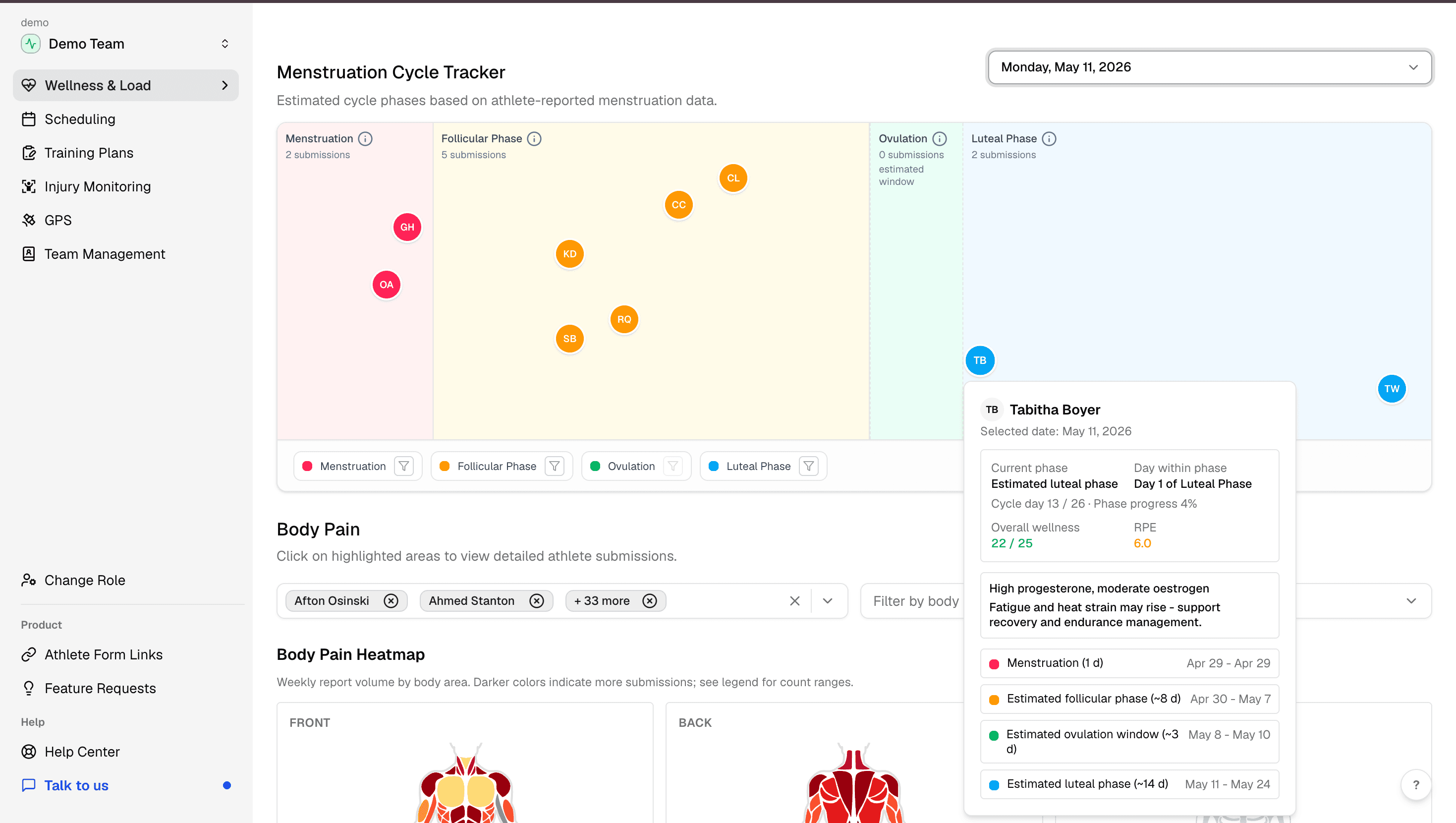
The coach Wellness tab plots each athlete on her estimated phase, menstruation, follicular, ovulation, or luteal, with estimated dates for what's coming, right beside sRPE, load, and wellness.
Open an athlete to read plain-language physiological context for her current phase, drawn from current research and expert interviews, then make the call yourself. Phase context also flows into one-click PDF reports.
FAQs
Frequently asked questions
Short, honest answers to the questions coaches ask first.
Should athletes train differently in each phase of their cycle?
Not as a blanket rule. The best available meta-analysis found only a trivial performance difference across phases, graded the evidence as low quality, and recommended an individualised approach. Track how each athlete responds across her own cycle and adjust from that, rather than applying a phase-based template to the whole squad.
Can a tracking app tell me exactly which phase an athlete is in?
No. Calendar and app-based tracking give an estimated phase, not a verified one. Confirming a phase properly requires reporting the period plus hormone testing. Estimated phases are useful context as long as you treat them as estimates.
What should I do if an athlete's periods stop?
Treat it as a health flag and refer her to a doctor or sports physician. Absent or irregular periods can signal low energy availability and Relative Energy Deficiency in Sport, per the 2023 IOC consensus. This is not something to train through.
Does the menstrual cycle affect ACL injury risk?
The evidence is mixed and low quality. A 2023 systematic review found it inconclusive whether any phase raises non-contact ACL injury risk, though knee laxity may be higher around ovulation. It is worth awareness, not a reason to change training by phase.
How do I get athletes comfortable logging something this personal?
Make it optional, private, and controlled by the athlete on her own device, and explain that the goal is symptom awareness and health, not surveillance. In one study of over 1,000 athletes, most had never discussed the topic with a coach and 81% saw it as taboo, so honest data depends on trust and privacy.
Track the cycle inside the wellness check-in athletes already do
Fractall adds private, athlete-controlled cycle tracking to the same daily check-in, then shows estimated phases next to load and wellness. Start a 1-month free trial from €16.67 per team per month.
Related guides
Two Games a Week: What Wellness Data Shows Before Match 2
Fractall data on football teams playing two games a week: on match morning, fatigue sits less than half as far above normal. How to read wellness between games.
ChatGPT and Claude for Strength and Conditioning Coaches
What an S&C coach can ask ChatGPT or Claude about squad load, wellness and injuries, and the privacy settings to change before any athlete data goes in.
CMJ Test: Protocol, Norms and Why Devices Disagree
The same countermovement jump reads nearly 7 cm apart on a force plate, a phone app and a sensor. Triple the U16 to U18 gap. The protocol and the norms.