

Athlete Wellness Monitoring: A Practical Guide for Coaches
Learn how to track fatigue, sleep, soreness, stress, and mood so wellness data supports real coaching decisions without spreadsheets.
Updated first published
Quick answer
Five signals, a 1-5 scale, collected before training
Quick answer
Wellness monitoring
Training load says what athletes did; wellness says how they are coping
Athlete wellness monitoring collects subjective readiness markers before training so staff can spot recovery, stress, and soreness patterns earlier.
Athlete wellness monitoring
Daily or session-based self-reporting of subjective wellbeing markers such as fatigue, sleep, soreness, stress, and mood.
Example: A player reporting poor sleep and high soreness for three days needs a different conversation than a player with the same weekly load and stable wellness.
Core markers
Start with five signals athletes can report reliably
The best first wellness survey is short enough to complete consistently and broad enough to explain readiness.
| Marker | What it tells staff | Coaching use |
|---|---|---|
| Fatigue | How tired the athlete feels today. | Spot accumulated tiredness before a high-intensity session. |
| Sleep quality | Whether recovery was supported overnight. | Interpret flat training behavior or repeated low energy. |
| Muscle soreness | How the body is responding to recent load. | Modify volume or recovery when soreness persists. |
| Stress | Non-training pressure affecting readiness. | Add context before treating poor performance as effort only. |
| Mood | A subjective signal of psychological readiness. | Prompt a check-in when mood drops repeatedly. |
Scale rule
Implementation
Collect before training and review both today and the trend
A single score can guide immediate decisions. Three to four weeks of consistent data reveals the patterns that matter most.
- 1
Choose the five markers
Use fatigue, sleep, soreness, stress, and mood as the starting set.
- 2
Define the scale
Use clear verbal anchors so athletes understand what each score means.
- 3
Set the collection window
Collect before training when the question is readiness for the next session.
- 4
Review daily and four-week views
Use today for acute decisions and trends for accumulated fatigue or recurring patterns.
- 5
Establish individual baselines
Compare athletes against their normal range instead of relying only on squad averages.
Fractall wellness workflow
Athletes submit daily wellness check-ins through the mobile app.
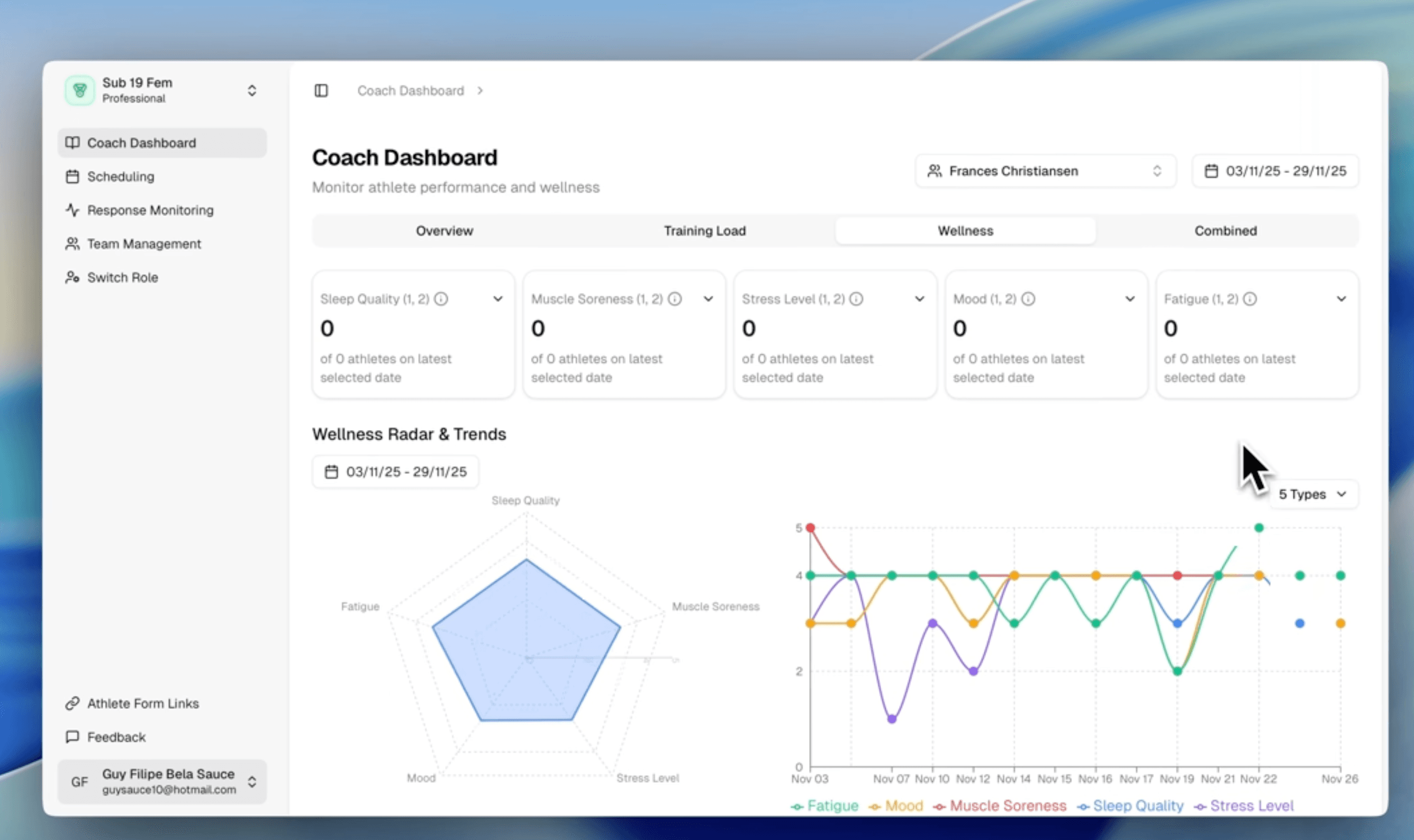
Coaches review wellness markers, trends, body pain, and readiness context in the dashboard.
Staff use the trend view to adjust training, recovery, or athlete conversations.
Track wellness without spreadsheet admin
Use Fractall to collect wellness check-ins, review athlete trends, and combine readiness with training-load context.
Examples
Wellness data is most useful when it changes the next decision
The same five markers support different coaching decisions depending on squad, phase, and athlete baseline.
Modify Thursday intensity after Tuesday soreness
A U19 coach uses weekly wellness summaries to identify players entering a high-intensity session with unresolved soreness and modifies their work.
Common mistakes
Wellness data loses value when it never changes behavior
The biggest risk is not collecting too little data. It is collecting data that no one uses.
Using one timeframe for everyone
Collecting without acting
Only reading composite scores
Ignoring training phase
Losing the week before an injury
FAQs
Athlete wellness monitoring questions
Short answers for coaches building a reliable wellness workflow.
How often should wellness be monitored?
What is a normal wellness score?
How do we improve completion?
Can wellness replace GPS?
Key takeaways
- Track fatigue, sleep, soreness, stress, and mood.
- Use one consistent scale across the season.
- Collect before training when possible.
- Review individual baselines, not only squad averages.
- Look at four-week trends as well as today's score.
- Let wellness data influence real coaching decisions.
Related guides
Winter Break Training Plan for Football S&C Coaches
Winter break training plan for football: what two weeks off costs, the minimum to prescribe at home, and how to log it so January ACWR stays honest.
Two Games a Week: What Wellness Data Shows Before Match 2
Fractall data on football teams playing two games a week: on match morning, fatigue sits less than half as far above normal. How to read wellness between games.
ChatGPT and Claude for Strength and Conditioning Coaches
What an S&C coach can ask ChatGPT or Claude about squad load, wellness and injuries, and the privacy settings to change before any athlete data goes in.