

1 Month Free Access (cancel anytime)
FootballTraining loadPlanning

Winter Break Training Plan for Football S&C Coaches

Winter break training plan for football: what two weeks off costs, the minimum to prescribe at home, and how to log it so January ACWR stays honest.

Published
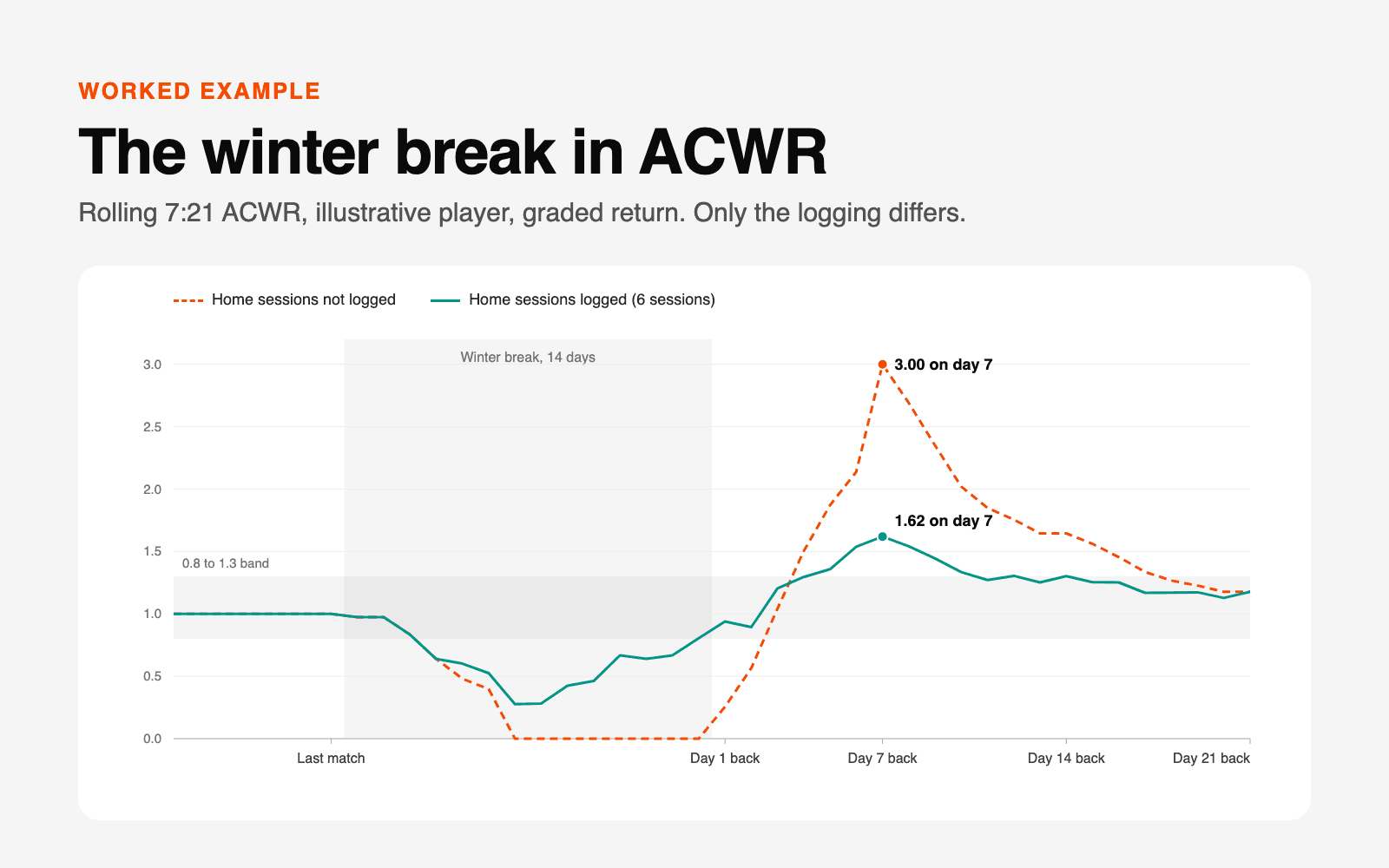
Line chart of rolling 7:21 ACWR for one illustrative player across a 14-day winter break and three weeks back. With home sessions not logged, ACWR falls to 0 and reaches 3.00 on day 7 back. With six home sessions logged, it peaks at 1.62.

Winter break

The short answer

What to prescribe, what to record, and which leagues actually stop in 2026-27.

Quick answer

A two-week winter break costs footballers about 2 to 4% in repeated sprint ability, while Yo-Yo IR1 distance does not change significantly (Rodríguez-Fernández et al. 2018). Two or three short high-intensity sessions a week plus one strength session is the dose that held fitness in the studies. Then log every home session: if nothing is logged, rolling ACWR (acute to chronic workload ratio) reads exactly 3.00 on day 7 back, whatever the players did.
Most winter break programmes online cover the training half. This guide also covers the numbers: what happens to your load data while the squad is apart, and how to read it in January. Below: what drops first, what to set up before the break, the minimum to prescribe, a worked ACWR example, and the first three weeks back.
Not every league has a two-week break, so check yours first. In 2026-27, Germany, the Netherlands and Switzerland go about three to four weeks between matches. Austria and Poland stop for six to seven, which is closer to a short pre-season. Spain gets about 12 days, and the Portuguese top two divisions miss one weekend. In Portugal the real two-to-three-week break is in the national youth championships.
LeagueLast match before / first afterGap between matches
Bundesliga20 Dec 2026 / 8 to 10 Jan 2027About 3 weeks
Eredivisie20 Dec 2026 / 8 Jan 202719 days
Swiss Super League19 or 20 Dec 2026 / 16 or 17 Jan 20274 weeks
Austrian Bundesliga11 to 13 Dec 2026 / 22 to 24 Jan 2027About 6 weeks
Ekstraklasa11 to 14 Dec 2026 / 29 Jan 2027About 7 weeks
Belgian Pro League26 to 27 Dec 2026 / restart not yet fixedAbout 2.5 weeks
LaLigaNo matches 22 Dec to 2 Jan / 2 to 3 Jan 2027About 12 days
Liga Portugal Betclic and Liga 227 Dec 2026 / 10 Jan 202714 days, one weekend off
Portugal national Sub-1920 Dec 2026 / 9 Jan 202720 days
Portugal national Sub-1719 Dec 2026 / 3 Jan 202715 days
Premier LeaguePlays 26 Dec to 6 JanNo break
Dates as published by October 2026: DFB (Bundesliga), eredivisie.nl, Swiss Football League and Austrian Bundesliga fixture frameworks, Ekstraklasa outline via Wisła Kraków, Sporza (Belgium), Comuniate (LaLiga), A Bola and Record (Portugal). Kick-off dates can move when broadcasters pick fixtures. Check your league's own calendar before you plan.

Evidence

1. Two weeks off costs repeated sprint ability first

Endurance and strength mostly hold. Repeated sprinting does not.

The quality to protect over a two-week break is repeated sprinting. The closest study to a real winter break followed 17 professional and 16 young elite players through two weeks off at Christmas with no training. Their best sprint in an 8 x 30 m test got 3.0% slower (professionals) and 1.9% slower (youth). Yo-Yo IR1 distance did not change significantly (Rodríguez-Fernández et al. 2018).

+4.0% vs +1.5%

Slower best repeated sprint after two weeks off, faster players against slower ones

Rodríguez-Fernández et al. 2018. The fastest players lose the most, so they are the ones who most need a programme.

Academy players lose power and speed too. After two weeks without training in the middle of the season, U15 and U17 players were worse on squat jump, countermovement jump, 20 m sprint and the 30-15 IFT (Padrón-Cabo et al. 2025). In older players, single sprints and strength held up better: 26 days off left 10 m sprint and leg-press strength unchanged in U20 players (Pereira et al. 2020), and 4 weeks off left sprint and jump unchanged in adults (Loturco et al. 2023).
The cost shows up again on the way back. Semi-professional players who stopped for two weeks needed two weeks of retraining to recover Yo-Yo IR2, and three weeks for repeated sprints (Joo 2018). That is most of January.
One figure to drop: you will find claims that VO2max falls by about 20% in three weeks. We found no source for that in football. A 2021 meta-analysis of 12 football detraining studies did find clear VO2max losses, pooled across detraining periods of two weeks or more, so it doesn't isolate a two-week break (Clemente et al. 2021).
Rodríguez-Fernández A et al. (2018), PLoS One 13(8):e0201111. Padrón-Cabo A et al. (2025), J Strength Cond Res 39(2):e149-e154. Pereira LA et al. (2020), Sports 8(11):141. Loturco I et al. (2023), J Strength Cond Res 37(10):2058-2063. Joo CH (2018), PLoS One, doi:10.1371/journal.pone.0196212. Clemente FM, Ramirez-Campillo R, Sarmento H (2021), Sports Med, doi:10.1007/s40279-020-01407-4.

Before the break

2. Before the break, test the squad and put every home session on the calendar

The last week before the break is when you set up the January comparison.

Set up the January comparison while the squad is still together. Two things make the return readable: a test result from just before the break, and a logged load for every session players do while away. Both have to be set up while the squad is still together.

In the last week before the break

  • Run one aerobic test you will repeat in January week one: the 30-15 IFT or Yo-Yo IR1.
  • Add a sprint you can repeat at a park or pitch: 10 m and 30 m, and a repeated-sprint test if you already use one.
  • Write the home programme, with the first days of the break as full rest.
  • Schedule every home session as a dated session for the squad, with its duration and a target RPE, so each one can be rated.
  • Agree how players rate sessions: the same 0 to 10 scale as the season, on the same day.
  • Give the fastest players their sprint work explicitly. They lose the most.
  • Pull injured players out of the squad programme and give them their own return-to-play plan.
For the aerobic test, the protocol and score tables are in our 30-15 IFT guide. Testing the same way in December and January matters more than which test you pick.

During the break

3. During the break, prescribe two or three hard sessions a week and get them rated within 24 hours

Keep the sessions short and hard, and get each one rated the same day.

Intensity is what keeps fitness on a small dose, so cut the minutes and keep the sessions hard. Semi-professional players who did 3 x 12 minutes at 80 to 90% of maximum heart rate, three times a week, kept their Yo-Yo IR2 and repeated-sprint performance over two weeks off (Joo 2018). For strength, one session a week kept strength and 40 m sprint in professional players over 12 weeks, while one every second week did not (Rønnestad et al. 2011). A wider review reached the same conclusion: keep the intensity and you can cut the volume by a third to two thirds (Spiering et al. 2021). That review covered periods of four weeks or more and found too little data on athletes to set a dose for them.
Generic running alone may not be enough for repeated sprints. In a study of youth players over a two-week break, only the group that did 4v4 small-sided games plus 6 x 30 m sprints improved repeated sprint ability. The 4 x 4 minute interval group declined as much as the group that did nothing (Rodríguez-Fernández et al. 2020). Small-sided games need a group, which most players won't have over Christmas, so the programme below adds sprints to the interval sessions. We found no study testing sprints alone over a break.
Break daySessionPlanned load (minutes x RPE)
1 to 4Rest0
5Intervals: 3 x 12 min at 80 to 90% of max heart rate40 x 7 = 280
7Strength: one set per exercise at normal relative load40 x 5 = 200
9Intervals, then 6 x 30 m sprints40 x 7 = 280
11Intervals40 x 7 = 280
12Strength40 x 5 = 200
14Intervals, then 6 x 30 m sprints40 x 7 = 280
This is an illustrative programme built from the studies above, and it is the one used in the ACWR example in section 4. It starts with four rest days, so it sits below the dose in Joo's study: four interval sessions over the two weeks, where Joo's group did six. It adds up to 1,520 AU over the 14 days, about a third of what the same player would do in two normal weeks.
Ask for each rating on the day of the session. In youth athletes, a session RPE given 24 hours later was nearly identical to the one given 30 minutes after (r = 0.98, typical error 8.3%), while a rating given 72 hours later had a typical error of 35.3% (Scantlebury et al. 2018). One study in basketball also found app-collected ratings less valid than face-to-face ones (Fox et al. 2020), so treat break ratings as a little rougher than in-season ones and keep the scale exactly the same.
Keep the daily wellness check-in going too. Across 56 studies, subjective measures such as fatigue, sleep and soreness tracked changes in load more consistently than objective markers (Saw et al. 2016), and they are the only daily signal you get from a player at home. Compliance depends on how easy the check-in is and on whether someone reacts to it (Saw et al. 2015), so follow up with the players who haven't answered. Our guide to why compliance breaks wellness monitoring covers what keeps response rates up.
Joo CH (2018), PLoS One, doi:10.1371/journal.pone.0196212. Rønnestad BR, Nymark BS, Raastad T (2011), J Strength Cond Res, doi:10.1519/jsc.0b013e31822dcd96. Spiering BA et al. (2021), J Strength Cond Res 35(5):1449-1458. Rodríguez-Fernández A et al. (2020), J Strength Cond Res 34(8):2128-2135. Scantlebury S et al. (2018), J Strength Cond Res, doi:10.1519/jsc.0000000000002099. Fox JL, O'Grady CJ, Scanlan AT (2020), Int J Sports Physiol Perform, doi:10.1123/ijspp.2019-0908. Saw AE, Main LC, Gastin PB (2016), Br J Sports Med, doi:10.1136/bjsports-2015-094758. Saw AE et al. (2015), J Sports Sci Med 14:137.

Worked example

4. Worked example: with nothing logged, ACWR reads 3.00 a week after the return

One illustrative player, the same 14 days, four ways of logging and returning.
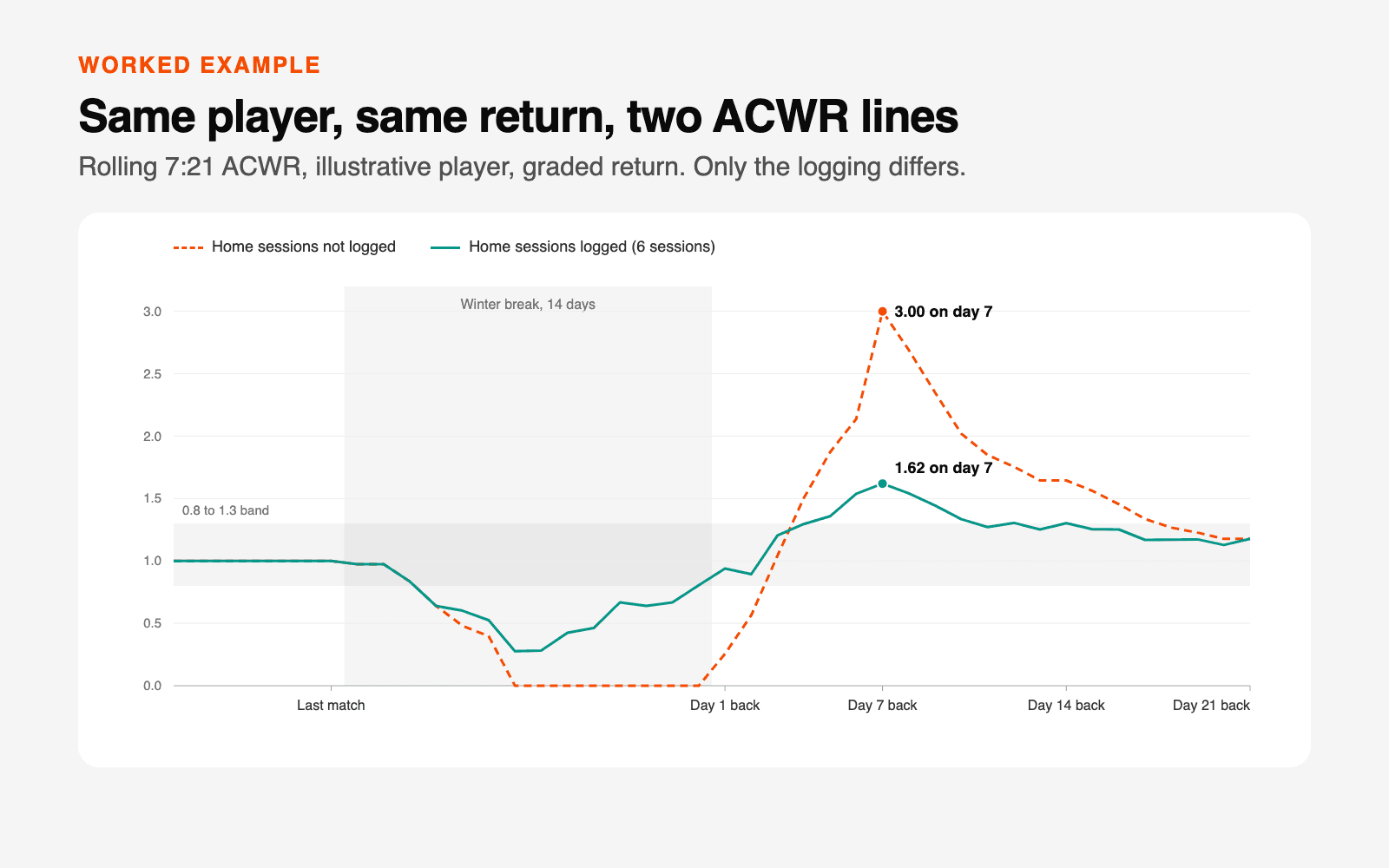
If the home sessions aren't logged, January ACWR measures the gap in your logs. Rolling ACWR compares the average daily load of the last 7 days with the average of the last 21 (or 28). Days with no logged load count as zero. After two empty weeks, the 21-day average is mostly zeros, so any normal training week looks like a spike.
Line chart of rolling 7:21 ACWR for one illustrative player. Before the break both lines sit at 1.0. During the 14-day break the unlogged line falls to 0 and the logged line to about 0.3 to 0.8. On day 7 back the unlogged line peaks at 3.00 and the logged line at 1.62. Both settle near 1.2 by day 21.
Rolling 7:21 ACWR for one illustrative player with a graded return. The dashed orange line has the home sessions missing; the teal line has them logged.
The player is made up but built from a normal football week: 2,355 AU (arbitrary units, minutes x RPE) across five sessions and a Saturday match, for six weeks. Then the 14-day break with the home programme from section 3, then three weeks back. The full-load return is a 2,550 AU week with a friendly on day 6. The graded return builds to it over three weeks: about 70%, 85%, then 100%. The ratios are calculated the way Fractall calculates its default rolling ACWR.
Scenario (same player, same 14 days)ACWR on day 4 / day 7 backDays above 1.5 in the first 21 back
Home sessions not logged, full-load return1.77 / 3.009
Home sessions not logged, graded return1.50 / 3.0012
Home sessions logged, full-load return1.50 / 1.885
Home sessions logged, graded return1.30 / 1.623
The 3.00 is arithmetic. If nothing was logged in the 14 days before the return, then on day 7 back the only load in the 21-day window is the load from the last 7 days. The 7-day average is then three times the 21-day average, so the ratio is exactly 3.00 however hard or easy that first week was. A player who trained six times at home and a player who did nothing get the same number.
The graded return makes this worse when nothing is logged: 12 days above 1.5 instead of 9, because the lower load rebuilds the 21-day average more slowly. So the coach who brings players back carefully gets more red flags than the one who doesn't. With the home sessions logged, the same graded return goes above 1.5 for three days around the day-6 friendly. That one is a real signal: this player did a third of normal load over the break, and a friendly in week one is a big jump from there.
The EWMA version of ACWR (exponentially weighted moving average) smooths this. With the graded return, its peak is 1.42 with nothing logged and 1.26 with the home sessions logged. It still can't tell trained players from untrained ones without the logs. Our EWMA vs rolling average guide explains why the two methods disagree.

Read ACWR as context

No study we found measured ACWR in the weeks after a winter break, so the example above shows only how the formula behaves. ACWR itself is contested as an injury predictor (Impellizzeri et al. 2020), and a 2026 meta-analysis found only a small, very inconsistent association with injury (Ding et al. 2026). The stronger finding is narrower: big jumps in load on a low chronic base carried the highest non-contact injury risk in elite players (Bowen et al. 2017, 2020). That is the situation a January return creates, which is why the logs matter. Our ACWR guide for football covers how to read the ratio without a fixed band.
Example calculated by Fractall on 20 October 2026 with rolling coupled 7:21 ACWR and EWMA (7-day acute, 21-day chronic), rest days counted as zero, rounded to two decimals. Illustrative player; no club data used. Impellizzeri FM et al. (2020), Int J Sports Physiol Perform, doi:10.1123/ijspp.2019-0864. Ding L et al. (2026), Front Public Health, doi:10.3389/fpubh.2026.1896651. Bowen L et al. (2017), Br J Sports Med, doi:10.1136/bjsports-2015-095820. Bowen L et al. (2020), Br J Sports Med, doi:10.1136/bjsports-2018-099422.

The return

5. In the first three weeks back, build to normal load and retest in week one

The January injury data points at training sessions.

Treat the first week back like the start of a short pre-season, because the injury data points at training sessions. When the Bundesliga cut its winter break from 6.5 to 3.5 weeks, the overall injury rate did not change, but training injuries rose (incidence rate ratio 1.49) and knee injuries rose (1.66), with more risk in January (aus der Fünten et al. 2014). After the much longer COVID layoff, UEFA's injury study found training injuries stayed higher than before the pandemic while match injuries did not (Waldén et al. 2022).
The break itself may help. Teams with a winter break, averaging 10 days, lost 303 fewer days to injury per season than English teams without one, and had fewer severe injuries from January to March (Ekstrand et al. 2019). That is an association across 15 countries; it doesn't show the break caused it, and climate differed too.

Weeks one to three back

  • Week one: retest the aerobic test and sprints from December, and compare each player with their own result.
  • Build load over two to three weeks. In the example, 70%, 85% and 100% of a normal week.
  • Keep sprint work in from the first session, in small doses. Repeated sprinting is what dropped.
  • Read ACWR player by player: anyone with no logged home sessions will show a high ratio whatever they did.
  • Ask the players who stopped rating sessions what they actually did. Their numbers can't tell you.
  • Watch fatigue and soreness in the morning check-in more closely than the ratio in week one.
How a full pre-season build works, week by week, is in our 6-week pre-season monitoring plan. For the long breaks in Austria and Poland, that plan fits better than this one.
aus der Fünten K et al. (2014), J Athl Train 49(6), doi:10.4085/1062-6050-49.3.51. Waldén M et al. (2022), Sports Med Open, doi:10.1186/s40798-022-00457-4. Ekstrand J, Spreco A, Davison M (2019), Br J Sports Med 53(19):1231.

In Fractall

Running the break in Fractall

Schedule the home sessions, let players rate them from their phone, and read the whole break in one report.
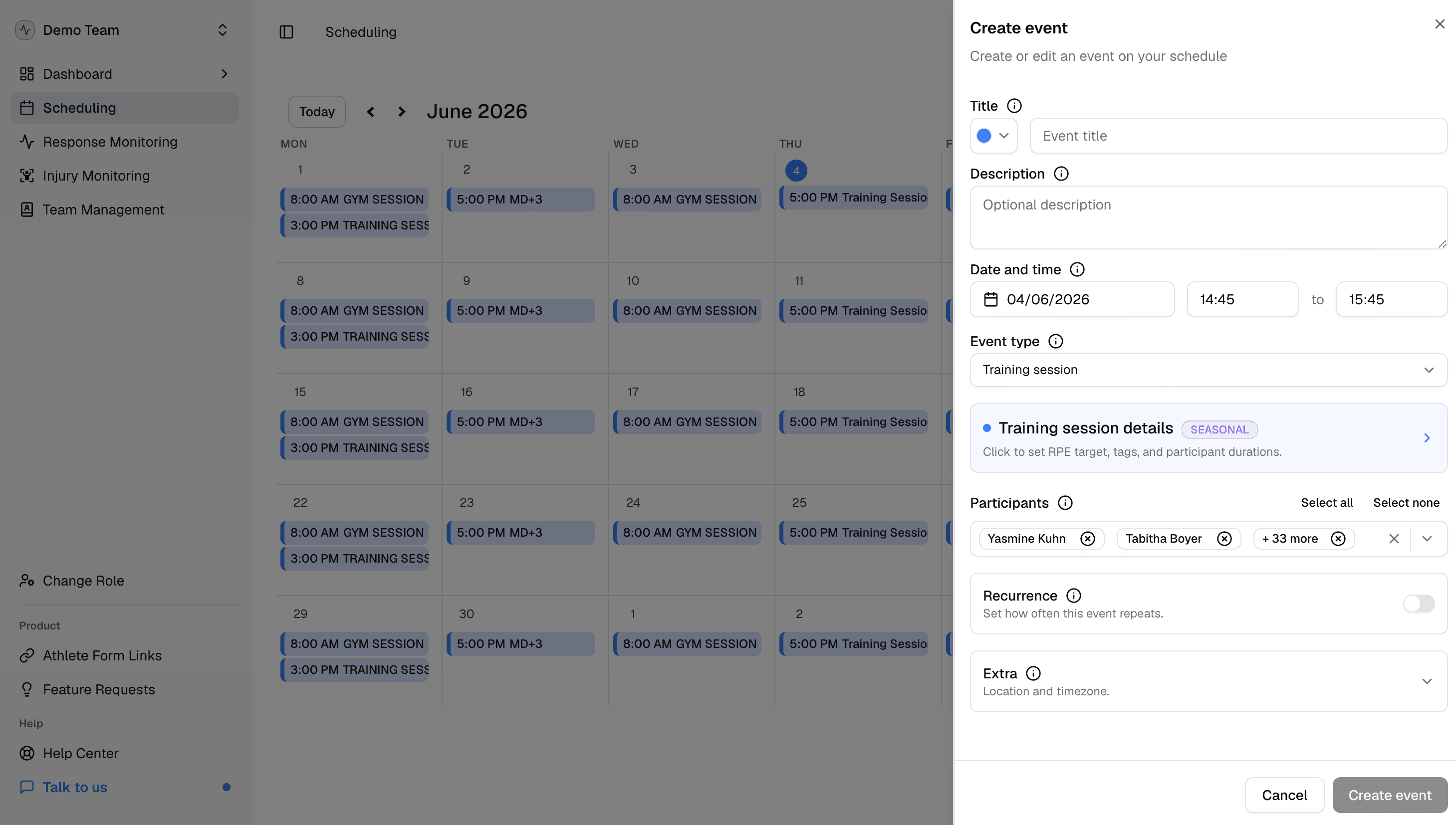
In Fractall, a home session is a training session on the calendar like any other. Add it for the squad or for chosen players, with its time, duration and a target RPE. Players see it in the app and rate it with session RPE afterwards, and the rating becomes load in the same ACWR, monotony and strain views you use in season.
Fractall calendar with the Add activity dialog open: date and time, a required title field, activity type set to Training session, participants set to all squad, and a target RPE slider.
Adding a session in Fractall. The title is what players see in the app, so put the content there.

A winter break in Fractall

1

Before the break, schedule each home session on its day for the squad, with a realistic duration and a target RPE. Duplicate the first one to save retyping.

2

Write the session content in the title, for example 'Home: intervals + 6 x 30 m', because the title is what players see on their phone.

3

Players answer the daily wellness check-in and rate each session from home. Reminders follow the schedule you set for the team.

4

Check response monitoring every couple of days and send a reminder to the players who haven't answered.

5

In January, open a range report over the break and the first two weeks back (reports cover up to 28 days), then retest and compare with December.

Response monitoring shows who has and hasn't submitted, which is the closest thing to attendance while the squad is apart. The wellness check-in works from any phone on any day.

What Fractall won't do for you over the break

  • Players can only rate sessions you scheduled. They can't add a session of their own, so schedule what you want logged.
  • Load uses the scheduled duration unless you edit it, so set realistic minutes.
  • There are no recurring sessions yet. Duplicate them instead.
  • Don't mark the period with the calendar's Break option: it removes the sessions inside it. Leave the weeks open, or name a mesocycle 'Winter home block'.
  • Unlogged days count as zero load, and there is no way to exclude the break from ACWR. That is the reason to log the home sessions.
  • Submissions need a connection. A player without signal has to submit once back online.
  • There is no repeated-sprint test or side-by-side December vs January view yet. Filter the test results by date to compare.

Plan the break before the squad leaves

Schedule the home sessions, collect session RPE and wellness from every phone, and read the whole break in one report. The first month is free.

Start free trial

Limits

What this guide can't tell you

Small studies, mostly men, and an example player who doesn't exist.

The detraining studies cited here are small, from 14 to 45 players, in professional, semi-professional and academy squads. Treat the ranges above as the best available picture for your squad.
The ACWR example uses one invented player and Fractall's own formula. Other tools calculate ACWR differently, and your squad won't follow one neat weekly pattern. The point that holds everywhere is the zero: any tool that counts unlogged days as rest will produce the same January artefact.
League dates come from calendars published before the season. Some restart dates were not fixed yet, and broadcasters move fixtures.

FAQs

Frequently asked questions

What coaches ask before the squad goes home for Christmas.

How much fitness do footballers lose in a two-week break?

Less than most programmes claim, and mostly in repeated sprinting. In a study of professional and youth players over a two-week Christmas break with no training, the best sprint in a repeated-sprint test got 1.9 to 3.0% slower while Yo-Yo IR1 distance did not change significantly (Rodríguez-Fernández et al. 2018). Strength and single-sprint speed mostly held over 3 to 4 weeks off in other studies.

How many sessions a week should players do over the winter break?

Two or three short high-intensity sessions and one strength session a week. Semi-professional players who did 3 x 12 minutes at 80 to 90% of maximum heart rate, three times a week, kept their Yo-Yo IR2 and repeated-sprint performance over two weeks (Joo 2018), and one strength session a week kept strength in professional players (Rønnestad et al. 2011). Intensity matters more than volume.

Should football players rest completely over Christmas?

Two weeks of complete rest has a cost. Semi-professional players who stopped for two weeks needed two weeks of training to get Yo-Yo IR2 back to baseline and three weeks for repeated sprints (Joo 2018). In the same study, players who kept doing interval sessions three times a week didn't lose that fitness in the first place.

How do you bring players back after the winter break?

Build up over two to three weeks instead of returning at full load, retest in the first week, and keep sprint work in from the start in small doses. After the Bundesliga shortened its winter break, the overall injury rate did not change, but training injuries and knee injuries were higher than with the longer break, with more risk in January (aus der Fünten et al. 2014).

Why does ACWR spike after a break?

Because days with no logged load count as zero. After 14 empty days, chronic load is low, so a normal week back looks like a large jump. With rolling 7:21 ACWR, if nothing was logged in the 14 days before the return, the ratio on day 7 back is 3.00 whatever the players actually did. Logging home sessions keeps the ratio honest.
How do you handle the winter break with your squad? If you have a home programme that holds up in January, or a way to get players to log it, we would like to hear it.

Related guides