

EWMA vs Rolling Average ACWR: Which Should Coaches Use?
EWMA vs rolling average ACWR, explained for coaches: why the two methods disagree, when EWMA catches a load spike the rolling average misses, and which to trust.
Published
Quick answer
Same ratio, different weighting
Both methods calculate the acute:chronic workload ratio. They differ only in how they weight recent sessions against older ones.
The short version
The difference
What is the difference between EWMA and a rolling average?
Both take training load over an acute and a chronic window and divide one by the other. The only thing that changes is the weight each session carries.
Rolling average ACWR
Averages load across the window with equal weight on every day, then divides the acute average by the chronic average. Simple, and the version most spreadsheets use.
Example: A session 27 days ago counts exactly as much toward chronic load as yesterday's session.
EWMA ACWR
Applies an exponential decay so the most recent sessions carry the most weight and older ones fade gradually rather than dropping out abruptly.
Example: Yesterday's session counts for much more than a session three weeks ago, which better matches how fitness and fatigue actually decay.
Why they disagree
Why a rolling average can miss a spike
A rolling average has two blind spots: it reacts slowly to a real jump, and it lurches when a big session drops out of the window.
The practical read
| Session age | Rolling average weight | EWMA weight (approx.) |
|---|---|---|
| Yesterday | ~3.6% | ~6.9% |
| 1 week ago | ~3.6% | ~4.2% |
| 2 weeks ago | ~3.6% | ~2.5% |
| 3 weeks ago | ~3.6% | ~1.5% |
| 4 weeks ago | ~3.6% | ~1.0% |
Which to use
Which method should coaches use?
Match the method to the situation. When load is steady the two agree; the difference matters most exactly when your athletes are least predictable.
| Situation | Rolling average | EWMA |
|---|---|---|
| Load is stable week to week | Fine, close to the EWMA value | Similar result, little practical gain |
| A sharp load spike this week | Reacts slowly, can understate the jump | Reacts faster, flags the spike sooner |
| A big session leaves the window | Sudden cliff in chronic load | Fades gradually, fewer artefacts |
| Athlete returning from a lay-off | Can misjudge the rebuild pace | More responsive to the ramp back up |
59
Elite footballers studied
Murray et al. (2017) compared both methods over two seasons of load and injury data.
EWMA
More sensitive method
Explained more of the variation in injury likelihood than the rolling average at high ratios.
What EWMA doesn't fix
EWMA is more sensitive, not a cure for ACWR's flaws
Switching the weighting method improves one thing. It does not answer the deeper criticisms of the ratio, and it is worth being honest about that.
How to hold it
Fractall workflow
Let the dashboard handle the method
The reason most coaches stay on a rolling average is that EWMA is fiddly to maintain in a spreadsheet. When the tool computes it, that reason disappears.
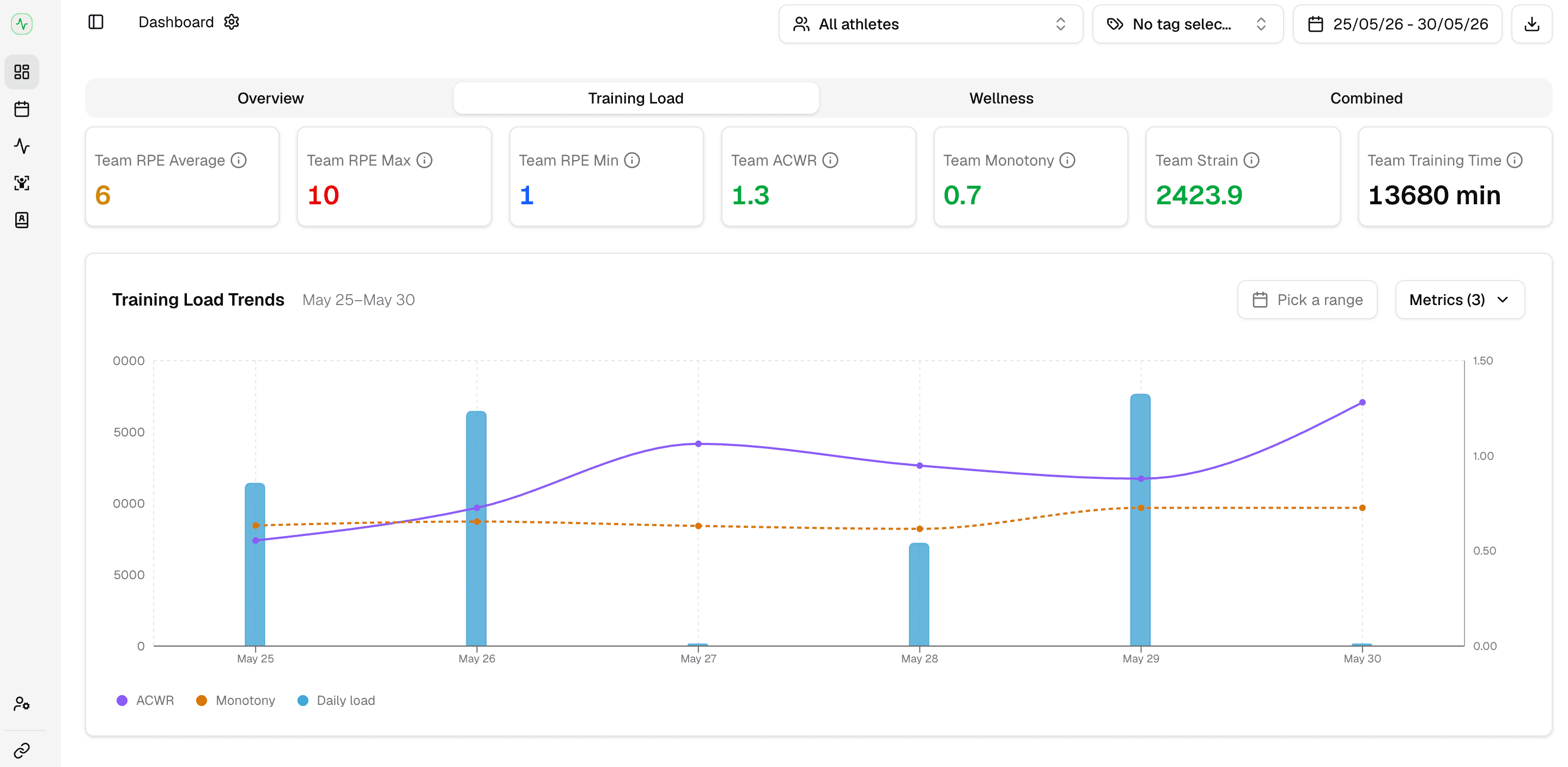
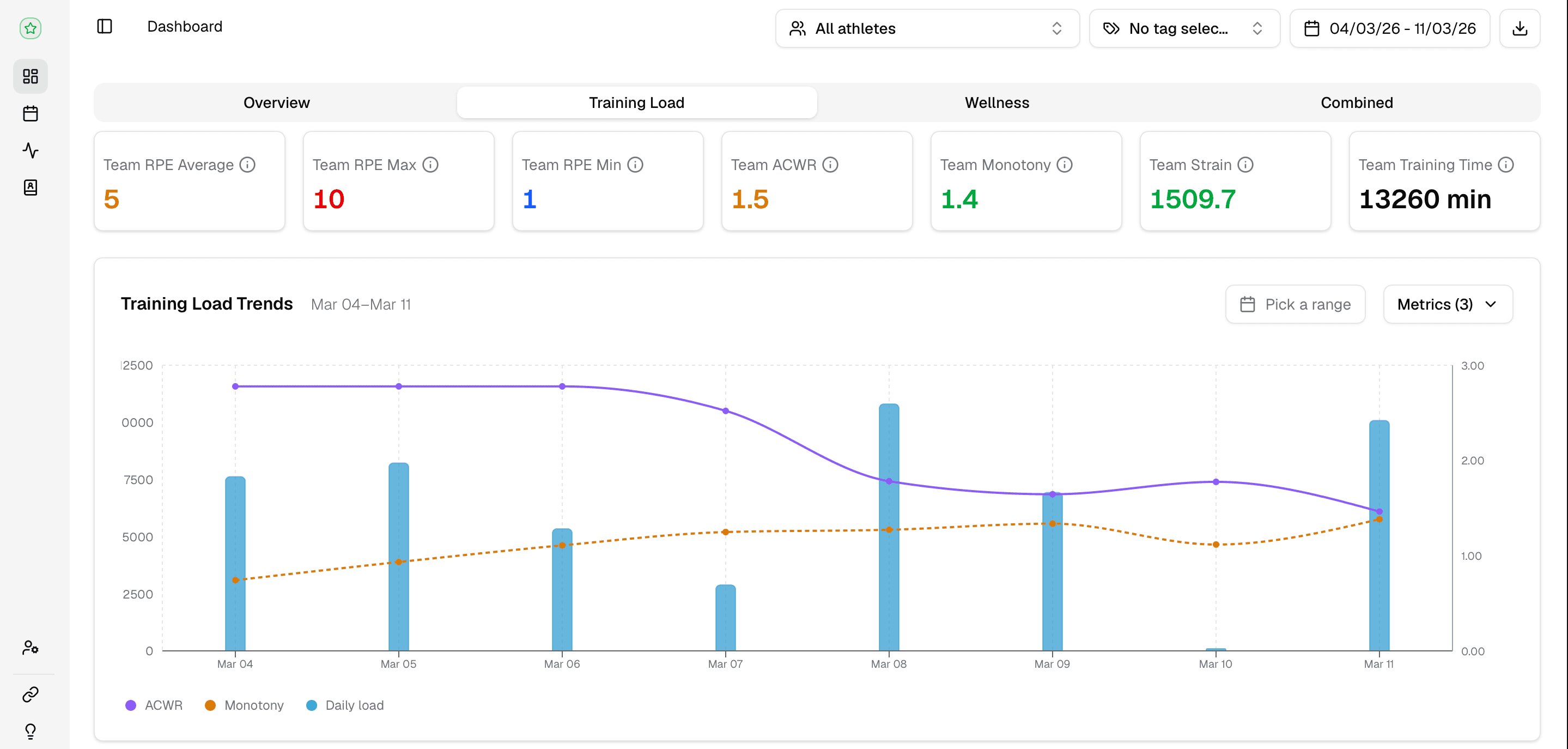
1. Load trend over time
Read the ratio against recent history to see whether this week is a genuine jump or just window noise.
2. Athlete-level detail
Move from the squad view to the individual players whose ratio is climbing.
3. Context beside the number
Wellness, pain, and minutes sit next to the ratio so one metric is never read alone.
A weekly ACWR rhythm without the maths
Athletes submit session RPE; the load input builds itself.
The dashboard computes the ratio, including the EWMA method, and plots the trend.
You scan for spikes and drops, then check wellness and context before acting.
See ACWR calculated for you
Fractall collects session RPE and computes the acute:chronic workload ratio, so you read the signal instead of maintaining the formula.
FAQs
EWMA vs rolling average ACWR: common questions
Short, practical answers to the questions coaches ask when choosing a method.
Is EWMA better than a rolling average for ACWR?
It is more sensitive to recent load spikes, and in one elite-football study (Murray et al., 2017) it detected raised injury likelihood the rolling average understated.
Example: When week-to-week load is stable, the two methods agree closely and the advantage is small.
What does EWMA stand for?
Exponentially weighted moving average. It averages training load but gives the most recent sessions more weight, so older sessions fade instead of dropping out abruptly.
Example: That decay is why EWMA reacts to a spike sooner than a flat rolling average.
Do I have to calculate EWMA by hand?
No. The decay maths is awkward in a spreadsheet, but a monitoring tool computes it from your session-RPE inputs.
Example: Fractall's ACWR dashboard runs the calculation so the method choice costs you no extra work.
Can I use EWMA without GPS?
Yes. EWMA is a weighting method, not a data source, so it works on internal load from session RPE.
Example: Small and medium clubs can use EWMA with nothing more than consistent RPE collection.
Does EWMA prevent injuries?
No. It is more sensitive to load spikes than a rolling average, but ACWR of any kind is a signal to review, not a predictor.
Example: Read it alongside wellness, soreness, minutes, and history before making a call.
Put ACWR to work without the spreadsheet
Fractall collects session RPE, computes the acute:chronic workload ratio, and shows load beside wellness and pain so you decide with context.
Related guides
Two Games a Week: What Wellness Data Shows Before Match 2
Fractall data on football teams playing two games a week: on match morning, fatigue sits less than half as far above normal. How to read wellness between games.
ChatGPT and Claude for Strength and Conditioning Coaches
What an S&C coach can ask ChatGPT or Claude about squad load, wellness and injuries, and the privacy settings to change before any athlete data goes in.
CMJ Test: Protocol, Norms and Why Devices Disagree
The same countermovement jump reads nearly 7 cm apart on a force plate, a phone app and a sensor. Triple the U16 to U18 gap. The protocol and the norms.