4 Weeks Free Access (cancel anytime)
Interactive GuidePhysical testsAerobic testingTest norms

30-15 IFT: Protocol, VIFT Scores and Interval Paces

The test steps in 0.5 km/h, but the change worth acting on is 1 km/h. The protocol, what VIFT actually measures, and how to set interval speeds from it.

Published
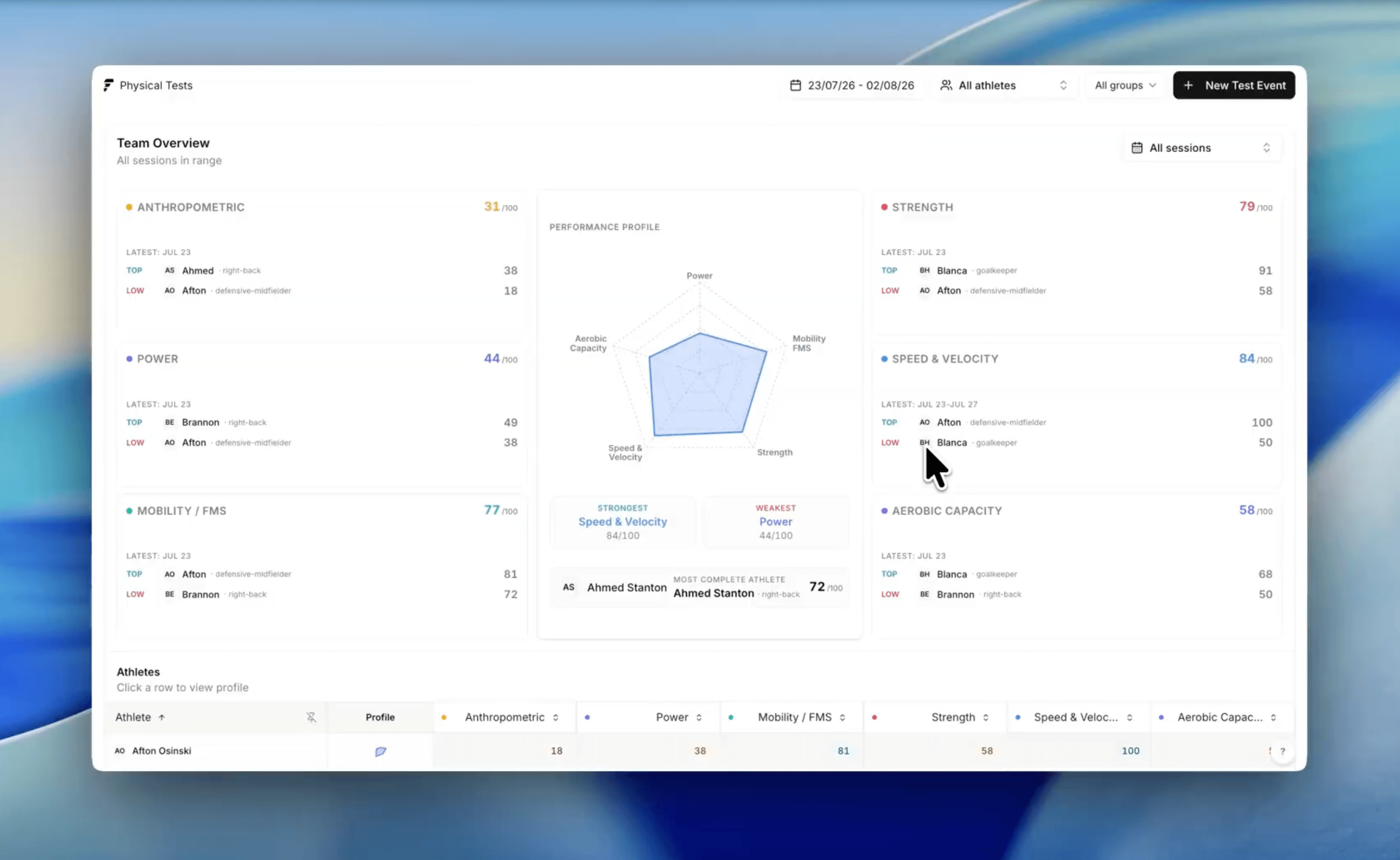
Fractall physical tests team overview, scoring a squad across anthropometric, power, mobility, strength, speed and aerobic capacity on a 0 to 100 scale, with a performance profile radar and a sortable athlete roster.

30-15 IFT

What the 30-15 actually measures

Thirty seconds of shuttle running, fifteen seconds of walking, getting half a km/h faster every stage until you cannot hold the pace.

Quick answer

The 30-15 Intermittent Fitness Test is 30-second shuttle runs separated by 15-second walking recoveries, starting at 8 km/h and rising 0.5 km/h per stage. Your score is VIFT, the speed of the last stage you finished. It takes about 21 minutes. Modelled elite soccer profiles sit between 18.5 and 20.5 km/h. The test's own measurement error is 0.5 km/h, one whole stage, so a meaningful change starts at 1 km/h and a player who goes from 19.0 to 19.5 has not demonstrably improved.
Most aerobic tests give you a number and leave you to work out what to do with it. The 30-15 was built the other way round. Martin Buchheit designed it in 2000 to solve a prescription problem: how fast should each player run their intervals? The score comes out as a running speed because that is what you feed back into the session.

VIFT

The velocity of the last stage an athlete completed in the 30-15 IFT, in km/h.

Example: A player who finishes the 19.0 km/h stage and fails during the next one scores a VIFT of 19.0 km/h.

The detail that makes it different from a continuous test is the recovery. Fifteen seconds of walking between efforts means the score reflects how well an athlete recovers between bursts, not only how much oxygen they can use. Add the turns at each end and you are also measuring change of direction. Those are the qualities that decide a match, which is the argument for running it over a track test.
There are four versions: the original 40 m course, a 28 m version for small spaces, an ice version, and a straight-line version on a 400 m track. They are not interchangeable, so record which one you ran alongside the score. If you want a protocol with no audio track and no course to measure, the Bronco needs four cones and a stopwatch, though it gives you a time rather than a prescription speed.
Buchheit M, Dikmen U, Vassallo C. The 30-15 Intermittent Fitness Test: two decades of learnings. Sport Performance and Science Reports, 2021;148(v1). Protocol detail also from the official test documentation at 30-15ift.com. The original validation is Buchheit M. The 30-15 intermittent fitness test: accuracy for individualizing interval training of young intermittent sport players. Journal of Strength and Conditioning Research, 2008;22(2):365-374.

Protocol

Running it without breaking it

The two things squads get wrong are the recovery walk and the tolerance zone.

  1. 1

    Mark the course

    Cones at 0 m, 20 m and 40 m for the original version, with a second cone colour 3 m in from each end and either side of the midline to mark the tolerance zones. The small-space version uses 0, 14 and 28 m, and its zones shrink to 2 m.

  2. 2

    Start everyone on the 0 m line

    The first 30-second run is at 8 km/h, slow enough that the opening stages feel easy. The app also offers a 10 km/h start, and on the 28 m course a 10 km/h start begins from the midline instead.

  3. 3

    Run 30 seconds, then walk for 15

    The audio track beeps when they should be at the midline and again at the far end. Each stage adds 0.5 km/h.

  4. 4

    Walk forward in the recovery, never back

    In the 15 seconds they walk on to the next mark, and that mark is where the next run starts. Walking back to the nearest line shortens the test and invalidates the score.

  5. 5

    Stop on exhaustion or three misses

    The test ends when an athlete stops, or fails to reach the 3 m zone at the beep three times in a row. Record the speed of the last stage they completed. That is their VIFT.

The recovery walk is the rule most squads break. Athletes finish a run somewhere between two cones, and the instinct is to drift back to the line they just passed. They must walk forward to the next mark instead, because that mark is the start line for the next run. Walking backwards shortens every subsequent shuttle and inflates the score.
The 3 m zones are a tolerance, not a target. An athlete should be aiming to arrive at the line on the beep. The zone exists so a player who is fractionally short is not eliminated, and missing it three times in a row is what ends the test.

Before you trust a 30-15 score

  • Same version every time. A 28 m VIFT and a 40 m VIFT are different numbers.
  • Same surface. It is worth recording, for the same reason it matters on the Yo-Yo.
  • A speaker everyone can hear over wind. Players pacing off a beep they cannot hear are running a different test.
  • Walk-forward briefed and policed, every stage.
  • Note the last completed stage, not the one they failed in.
Buchheit notes the test can go in as early as the first or second week of pre-season, because it can sit between technical sequences and be counted as one of them rather than added on top of the week. If you are working out where testing fits around everything else, our six-week pre-season monitoring plan places it without wrecking the sessions either side.

Interpretation

What a good VIFT looks like

Four modelled elite soccer profiles spanning 2 km/h, and the reason two different athletes land on almost the same score.

Modelled profile (example positions)Max aerobic speed and max sprint speedVIFT
Fit and fast (full backs)MAS 18.5, MSS 34.0 km/h20.5 km/h
Fit and slow (midfield)MAS 18.5, MSS 29.0 km/h20.0 km/h
Less fit and fast (central defenders, attackers)MAS 16.0, MSS 35.0 km/h19.0 km/h
Less fit and slowMAS 16.0, MSS 30.0 km/h18.5 km/h
Player profiles from Buchheit, Dikmen & Vassallo, Sport Performance and Science Reports, 2021;148, Table 1. These are simulated profiles from an energetics model, described in the paper as believed to be representative of the distributions in elite soccer. They are not measured squads. The same paper carries a chart of real normative VIFT values by sport, age, sex and playing standard (Laursen & Buchheit, 2018); we have not reproduced values from it because they are plotted rather than tabulated, and reading numbers off a chart is not a source. MAS is maximal aerobic speed and MSS is maximal sprinting speed. Squad averages quoted in the same paper include 18.3 km/h (Kaufmann et al., 2020) and, across a pooled group of studies, 19.5 km/h.
Read the middle two rows together, because they carry the whole lesson. The fit-but-slow midfielder and the less-fit-but-fast defender are separated by 2.5 km/h of maximal aerobic speed, and by only 1.0 km/h of VIFT. Sprint speed covers most of the aerobic gap.
So a VIFT is not an aerobic fitness score, and treating it as one will mislead you about who needs conditioning. It is a prescription speed that happens to bundle aerobic capacity, sprint speed, recovery between efforts and turning ability into one number. That bundling is a feature when you are setting interval paces and a trap when you are diagnosing a player. For a squad-wide picture across jump, sprint and change-of-direction alongside aerobic work, our physical test norms for football carries the population detail for each.
Published bands that sort VIFT into excellent, good and average exist, including the ones Fractall ships. Treat them the way you should treat any borrowed band: as a starting point until your own squad has enough history to replace them. The same caution applies to the Yo-Yo IR1 rating table, which was produced by inverting a VO2max formula rather than by measuring squads.

Reliability

The smallest change that isn't noise

The test's own measurement error is one full stage, which is why a meaningful change starts at 1 km/h rather than at the statistical threshold.

0.5 km/h

The test's typical measurement error

Exactly one stage increment, averaged across the reliability studies in Buchheit's review. When the noise in a measure is that size, a single test can only establish moderate to large changes.

ThresholdIn km/hWhat it means on test day
Average squad spread1.3 km/h (about 7%)Pooled across hundreds of teams, both sexes.
Smallest worthwhile change (0.2 of that spread)0.3 km/h (1.4%)Sits below the test's own error, so one retest cannot confirm it.
Typical measurement error0.5 km/hExactly one stage. This is the noise in a single test.
Moderate change (0.6 of the spread)0.8 km/h (4.2%)The tier 1 km/h clears.
Meaningful and real1.0 to 1.5 km/hThe change plus the error. Also the HIIT grouping boundary.
Start with the spread. Across hundreds of teams the average standard deviation in VIFT is 1.3 km/h, or about 7%, and it holds across both sexes and every performance level. Take the conventional 0.2 of that and the smallest worthwhile change is 0.3 km/h.
Now put the test's own error next to it. Averaged across the reliability studies, the typical error of a 30-15 is 0.5 km/h, which is exactly one stage. The noise is bigger than the 0.3 km/h threshold, and when that happens a single test can only establish moderate to large changes. So 0.3 km/h is a real statistical quantity that you cannot act on from one retest.
Buchheit works it through to a number. A meaningful change sits between one and two stages depending on the approach, with 1 km/h counting statistically as a moderate change. Add the measurement error on top, so that you are confident the change is real rather than noise, and his answer is 1 to 1.5 km/h.
The practical route arrives in the same place. Conditioning coaches tend to group players for interval work in 1 km/h bands, at 18, 19, 20 and 21, so 1 km/h is also what it takes to move an athlete into a different group. Two stages, by either route. A player who goes from 19.0 to 19.5 has moved by exactly the test's own error.
This matters more here than on a jump or a sprint. Buchheit makes the point himself: you can repeat a countermovement jump three times in a minute and average away the noise, but you cannot repeat a maximal 30-15 the same day, or realistically within a few days. One measurement is what you get, so the error on that single number carries more weight than it would elsewhere.
The training expectation lines up with the practical threshold. A block of high-intensity interval work tends to move VIFT by 1 to 1.5 km/h, which is the same size as the threshold, and Buchheit reports no additional benefit from interventions running longer than about a month. Retest after a block rather than on a calendar, because a retest with no training stimulus between it and the last one has nothing to detect.

Application

Setting interval paces from VIFT

The reason the test exists, and the evidence that prescribing off a continuous test instead leaves some of your squad unable to finish.

You prescribe short intervals as a percentage of VIFT. Because each player's reference speed already accounts for their recovery between efforts and their turning, the same percentage lands at a similar physiological cost across a squad running together.

Under 3%

Variation in heart-rate response when intervals are set from VIFT

Against more than 10% when the same session was set from a maximal aerobic speed derived from a continuous track test, where one of three players could not complete the session. Buchheit, JSCR, 2008.

That comparison is the practical case for the test. A continuous track test measures maximal aerobic speed and nothing else. Set a squad's intervals from it and the slower, less fit players end up drawing heavily on their sprint reserve to hit the target, while the fitter ones cruise below their own aerobic speed. Same percentage on paper, different sessions in the legs.
It is one of the most-used field tests that does both jobs from one number, which is worth something to a club that can afford one testing slot. Buchheit puts it more strongly for the prescription half, writing that VIFT has no equivalent for programming interval work. He is careful about the limits too: whether prescribing from VIFT beats prescribing from a full locomotor profile of aerobic speed plus sprint speed is, in his words, still open, and the practical question of whether you can measure maximal sprint speed at all may decide it for you.
Whatever you prescribe, the session still has to be absorbed. A block that moves VIFT 1.5 km/h and leaves half the squad sleeping badly has not obviously worked, which is why interval prescriptions are worth reading against the session RPE behind the week's load rather than on their own.

In Fractall

Where the VIFT lives after test day

A prescription speed is only useful if you can find last block's number when you set this block's paces.

How the 30-15 is recorded in Fractall

1

Enter VIFT in km/h per athlete per session, as one of four aerobic protocols alongside the Bronco and both Yo-Yo levels.

2

The analysis view adds an estimated VO2max column beside it, from Buchheit's 2008 equation. It needs a date of birth and a body weight recorded in the same session, and stays empty without them.

3

The score normalises to a 0 to 100 aerobic score, and load, wellness and test results are all recorded against the same athlete in one platform.

4

Results classify into bands with separate thresholds by sex, and you can override those bands per team once your squad has its own history.

One honest caveat about the shipped bands. Fractall's defaults sit 2 km/h apart, at 16, 18 and 20 km/h for men and 13.5, 15.5 and 17.5 for women. That is wider than the 1 to 1.5 km/h Buchheit calls a meaningful individual change, so a player can improve for real and stay in the same band. The aerobic score is scaled to the same window, which means a VIFT at or below the average band scores zero and one at or above the excellent band scores 100. Read the number itself, not only the band it falls into, and override the thresholds once you have enough of your own data to do it properly.
The dashboard shows the latest result rather than a progress line, so there is no automatic retest delta. Working out whether a change cleared 1 km/h is still your subtraction. What the record does give you is the previous number, which is the half most clubs lose between seasons. You cannot apply a change threshold to a number you no longer have. The aerobic testing category holds all four protocols on the same athlete record.
A VIFT that drops 1 km/h reads one way on its own and another beside a run of poor sleep scores. Physical testing and daily wellness tracking are separate views rather than one combined screen, so that reading across is still yours to do. What you get is both sets of numbers on the same athlete, in one place, instead of in two files.

Physical tests on the athlete record

Fractall stores every physical test against the athlete's own history, next to load and wellness. The first 4 weeks are free.

Start free trial

FAQs

Frequently asked questions

The questions coaches ask when a VIFT has to turn into a training speed.

What is a good 30-15 IFT score?

The four locomotor profiles Buchheit modelled for elite soccer sit between 18.5 and 20.5 km/h, with full backs at the top and the least fit profile at the bottom. Those are simulated rather than measured. Real squad averages quoted in the same review run around 18.3 and 19.5 km/h. Below elite, expect lower. A VIFT is a speed in km/h, so quote it with the version you ran: the 40 m and 28 m courses are not interchangeable.

How long does the 30-15 IFT take?

About 21 minutes on average, with a reported range of 15 to 24 minutes, measured from the first run to exhaustion. That is the test itself. Add a warm-up and a briefing, and budget a full session slot for a squad.

How much does VIFT need to improve before it's real?

Between 1 and 1.5 km/h, which is two to three stages. The statistical smallest worthwhile change is 0.3 km/h, taken as 0.2 of the 1.3 km/h average spread across hundreds of teams. But the typical measurement error of the test is 0.5 km/h, exactly one stage, so the noise is larger than that threshold and one retest cannot confirm it. Buchheit counts 1 km/h as a moderate change statistically, then adds the measurement error to be confident the change is real, which puts the answer at 1 to 1.5 km/h. The same 1 km/h is what moves a player into a different interval-training group.

How do you set interval training speeds from VIFT?

Take a percentage of VIFT as the running speed for short intervals. That is what the test was built for. In Buchheit's 2008 comparison, setting speeds from a continuous maximal aerobic speed test produced more than 10% variation in heart-rate response between players, and one of three could not finish the session. Setting the same session from VIFT let every player complete it, with under 3% variation.

Is the 30-15 IFT better than the Yo-Yo IR1?

They measure overlapping but different things, and the final speeds correlate strongly. VIFT is faster than the Yo-Yo IR1 speed, which ties it more closely to maximal sprinting speed and the anaerobic speed reserve. The practical split is what you want the number for: the 30-15 was designed to prescribe interval speeds, and Buchheit writes that VIFT has no equivalent for programming interval work.

Can two different athletes reach the same VIFT?

Yes, and this is the main thing a VIFT does not tell you. In Buchheit's modelled profiles, a fit but slow midfielder with a maximal aerobic speed of 18.5 km/h reaches 20.0 km/h, while a less fit but fast defender with a maximal aerobic speed of 16.0 km/h still reaches 19.0 km/h. Sprint speed covers most of the aerobic gap. Read VIFT as a prescription speed, not as a measure of aerobic fitness on its own.

Related guides