4 Weeks Free Access (cancel anytime)
Interactive GuidePhysical testsAerobic testingTest norms

Bronco Test: Protocol, Times and Why Norms Disagree

Published Bronco squads run up to 59 seconds slower than the standards circulating online. Body mass explains most of the gap. The protocol and every source.

Published
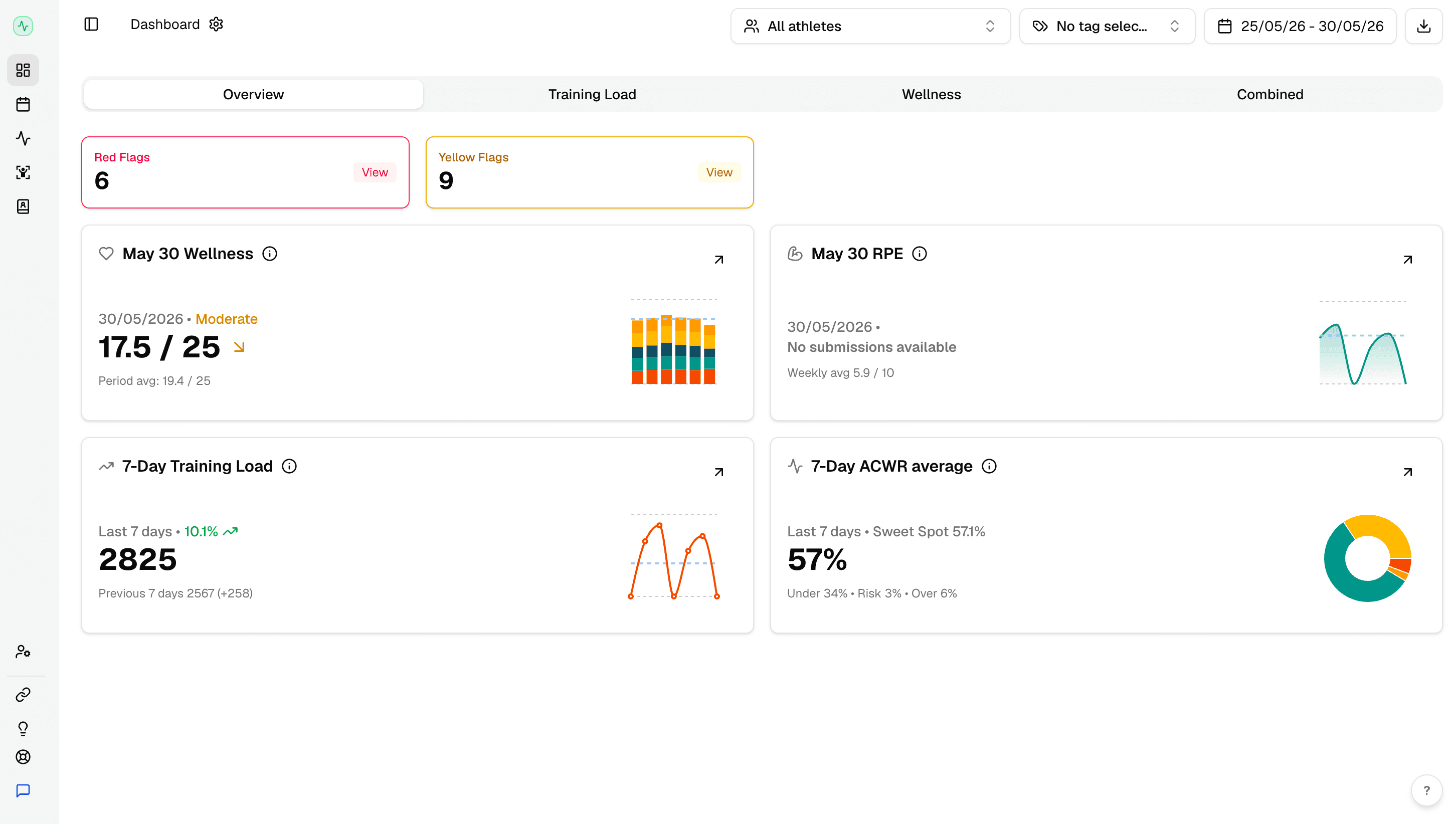
Fractall coach overview dashboard showing squad training load and wellness at a glance, where physical test results sit alongside.

Bronco test

What the Bronco actually is

Five rounds of 20 m, 40 m and 60 m shuttles, 1,200 m in total, run without rest and scored as one finishing time.

Quick answer

The Bronco is five rounds of 20 m, 40 m and 60 m shuttles run back to back without rest, 1,200 m in total, scored as one finishing time. The bands circulating online put elite men at 4:15 to 4:25. Nearly every published squad is slower than that: 47 elite under-20 rugby union players averaged 4:44 for inside backs and 5:17 for tight forwards, and 20 Super League players averaged 4:58. An English Premier League football squad is the fast outlier at roughly 4:18. Typical error between two tests is 2.4%, so on a five-minute Bronco anything inside about seven seconds is noise.
Your squad ran the Bronco on day two of pre-season. You've got 24 times on a clipboard and no way to tell whether 5:02 is any good. So you search for a Bronco table, find one that puts elite at 4:15 to 4:25, and now most of your squad looks unfit.
That table is probably wrong for your players. Every published squad that has actually been measured runs slower than it, except one, and that one is also the lightest by more than ten kilos.

Bronco test

A 1,200 m shuttle run: five rounds of a 20 m, 40 m and 60 m out-and-back sequence, run continuously and timed to completion.

Example: Cones at 0, 20, 40 and 60 m. One round is 240 m. Five rounds, no rest, one time per athlete.

The Bronco came out of New Zealand rugby and has since moved into football pre-seasons. You run it on a pitch with four cones and a stopwatch, which is most of its appeal. It needs no treadmill, gas analyser or timing gates. A club with nothing in the testing budget can run it on day one.
  1. 1

    Set four cones

    In a straight line at 0, 20, 40 and 60 m. The 0 m cone is the start, and it's a turn point on every shuttle.

  2. 2

    Run one round

    Out to 20 m and back, out to 40 m and back, out to 60 m and back. That's 240 m.

  3. 3

    Repeat five times with no rest

    Five rounds is 1,200 m.

  4. 4

    Touch every line

    The foot has to touch or cross the line before the turn. A short turn is a shorter test.

  5. 5

    Take one time

    The clock runs from the start to the end of the fifth round, and each athlete gets one number.

The convention is maximum effort throughout rather than an even pace, though most athletes fade across the five rounds whatever you tell them. Say the same thing every time you test. Instructions move the result as much as training does. If you're deciding where an aerobic test belongs in the week, our six-week pre-season monitoring plan puts it somewhere that doesn't wreck the sessions around it.

Evidence

What published Bronco times actually look like

Four samples, spanning Premier League football, elite under-20 rugby union and Super League rugby league. The spread between the fastest and slowest group is 59 seconds.

SquadBronco resultSource
English Premier League football, 21 male professionals, 83.7 ± 6.9 kg4.65 ± 0.20 m/s, about 4:18Kavanagh et al., Biology of Sport, 2025
Elite under-20 rugby union, inside backs (squad mean 94.8 ± 10.4 kg)284.1 s, or 4:44Deuchrass et al., JASC, 2019
Elite under-20 rugby union, outside backs297.0 s, or 4:57Deuchrass et al., JASC, 2019
Elite under-20 rugby union, loose forwards301.0 s, or 5:01Deuchrass et al., JASC, 2019
Elite under-20 rugby union, tight forwards317.0 s, or 5:17Deuchrass et al., JASC, 2019
Super League rugby league, 20 professionals, 95.4 ± 7.7 kg298.3 s, or 4:58Bennett et al., PLoS ONE, 2024
Kavanagh R, Matteotti M, Oliveira R, et al. The relationship between the 1200 m shuttle test and 40 m sprint test performance and distances covered in English Premier League matches: a retrospective two season study. Biology of Sport, 2025;42(2):105-111, published online October 2024. Deuchrass R, Smith HK, Elliot C, Lizamore C, Hamlin MJ. The 1.2 km shuttle run test: reliability and comparison with the Yo-Yo Intermittent Recovery Level 1 test in young elite rugby union players. Journal of Australian Strength and Conditioning, 2019;27(4). Bennett T, Marshall P, Barrett S, et al. Validation of field-based running tests to determine maximal aerobic speed in professional rugby league. PLoS ONE, 2024;19(7):e0306062.
Kavanagh and colleagues report an average velocity rather than a finishing time. At 4.65 m/s, 1,200 m takes 258 seconds, which is 4 minutes 18 seconds. That conversion is ours, not theirs.
Female norms and youth figures are absent because we couldn't reach a primary source for either. The one women's study we found sat behind a check we couldn't pass. Publishing a number we haven't read would be worse than leaving the row out. The same rule governs the wider table in our physical test norms for football, which carries jump, sprint and change-of-direction benchmarks with the same population detail.

Interpretation

Why the table you found online runs fast

Only the Premier League footballers land inside the circulating elite band. Every other published squad misses it by 19 to 52 seconds.

The bands you'll find on testing sites put elite professional men at 4:15 to 4:25, outstanding at 4:25 to 4:35 and very good at 4:35 to 4:45. Topend Sports publishes that set and most rugby blogs quoting standards are working from something similar. None of them names the squad the bands came from, and we couldn't trace them to a published sample.
Put them next to the table above and the problem shows. Only the Premier League footballers land inside the elite band. Elite under-20 rugby union players miss it by between 19 and 52 seconds. Professional Super League players miss it by 33.
What moves with the times is body mass. The EPL squad averaged 83.7 kg. The rugby union squad averaged 94.8 kg and the rugby league squad 95.4 kg. Eleven kilos is a lot to carry through close to thirty direction changes.
The online bands only become a problem when you apply them without checking which sport and which position they describe. A tight forward at 5:17 is running the time a tight forward runs at that mass.
The 4:12 attributed to Beauden Barrett turns up in nearly every Bronco article, including this sentence. It's an anecdote about one exceptional athlete with no study behind it.

Reliability

The smallest change that isn't noise

Typical error between two Broncos is 2.4%. At five minutes that's about seven seconds.

2.4%

Typical error between two Broncos

47 elite under-20 rugby union players, tested twice across four weeks. 90% confidence limits 2.0% to 2.9%. Deuchrass et al., JASC, 2019.

Run the test twice on the same fit athlete and the two times won't match. Deuchrass and colleagues measured that gap at 2.4%. On a five-minute Bronco that's about seven seconds.
So a player who went 5:04 in June and 4:58 in August hasn't demonstrably improved. Six seconds is inside the test's own error, and you'd get a spread that size out of pitch surface, temperature, how hard they were pushed and where the test sat in the week. A player who went 5:04 to 4:45 has improved. Apply that before you change anyone's programme off the back of a retest.

Before you trust a Bronco retest

  • Same surface. Grass to a 3G pitch moves the time on its own.
  • Same point in the week. A Bronco the day after a match is a different test.
  • One instruction, used every time. Maximum effort or even pace, never one then the other.
  • Note the temperature when you can't control the time of day.
  • At five minutes, seven seconds is the floor before you call it a change.

Common mistake

Don't turn a Bronco time into MAS

Against a treadmill, the 1,200 m shuttle underestimated maximal aerobic speed by 0.77 m/s in 20 professional rugby league players.

Plenty of Bronco calculators will convert your time into a maximal aerobic speed and hand you interval paces off the back of it. Bennett and colleagues tested that against a treadmill in 2024, using twenty Super League professionals. The Bronco correlated with treadmill MAS at r = 0.73, and still underestimated it by 0.77 m/s.
Their explanation is the turns. Decelerating into a cone and accelerating out of it costs time that a straight-line MAS test never charges you, so the average velocity you calculate from 1,200 m sits below the speed the athlete can actually hold. They concluded that a 5-minute run agrees more closely, and they published no correction factor for the shuttle.
If you prescribe intervals as a percentage of MAS, 0.77 m/s matters. An athlete at a true 4.4 m/s who gets read as 3.6 will be handed intervals that are too easy at every percentage you set.
Bennett T, Marshall P, Barrett S, Malone JJ, Simpson A, Bray J, Christopherson C, Nickolay T, Metcalfe J, Towlson C. Validation of field-based running tests to determine maximal aerobic speed in professional rugby league. PLoS ONE, 2024;19(7):e0306062.

In Fractall

Where the time lives after test day

The seven-second rule needs two comparable numbers. Most clubs lose the first one before the second is run.

Most clubs run the Bronco. Far fewer can pull up what a player ran last August, and that's the half that decides whether the seven-second rule is usable at all. You need two comparable numbers before an error margin means anything.

How the Bronco is recorded in Fractall

1

Enter the finishing time per athlete, per session, with cones and a stopwatch as the whole hardware requirement.

2

The result scores like every other test category and sits on that athlete's record next to their training load and wellness.

3

Next pre-season the previous time is still there to compare against, which is the part a renamed spreadsheet tab usually loses.

The Bronco is the only aerobic protocol in Fractall's aerobic testing today, and the dashboard shows the latest result rather than a progress line, so there's no automatic retest delta. Working out whether a change cleared seven seconds is still your subtraction.
A time that drifts 12 seconds the wrong way reads one way on its own and another beside a fortnight of poor sleep scores, which is why test results sit on the same athlete record as daily wellness tracking. The same record carries the session RPE behind the week's load, so a slower Bronco can be read against what the squad actually did in the fortnight before it.

Physical tests on the athlete record

Fractall stores every physical test against the athlete's own history, next to load and wellness. The first 4 weeks are free.

Start free trial

FAQs

Frequently asked questions

The questions coaches ask when a Bronco time doesn't match the table they found.

What is a good Bronco test time?

It depends on the sport and the position more than on fitness. Published samples run from about 4:18 for a Premier League football squad to 5:17 for tight forwards in elite under-20 rugby union. Body mass tracks the spread: the football squad averaged 83.7 kg, the rugby squads 94.8 and 95.4 kg. The bands circulating online put elite men at 4:15 to 4:25, which only the football sample meets, and no published squad is named behind them.

How is the Bronco test structured?

Cones at 0, 20, 40 and 60 m. One round is out and back to 20 m, out and back to 40 m, out and back to 60 m, which is 240 m. Five rounds run without rest makes 1,200 m, timed as a single effort. The foot has to touch or cross each line before the turn.

How much does a Bronco time need to improve before it's real?

About seven seconds on a five-minute test. Deuchrass and colleagues measured the typical error between two Broncos at 2.4%, with 90% confidence limits of 2.0% to 2.9%, in 47 elite under-20 rugby union players. A change smaller than that sits inside the test's own noise.

Can I use a Bronco time to calculate maximal aerobic speed?

Not reliably. Bennett and colleagues compared the 1,200 m shuttle with treadmill-derived MAS in 20 professional rugby league players and found it underestimated MAS by 0.77 m/s, despite correlating at r = 0.73. They concluded a 5-minute run is the more valid measure and published no correction for the shuttle. The turns are the stated reason.

Is the Bronco test used in football?

Yes, though it came from rugby. A 2025 study of an English Premier League squad used the 1,200 m shuttle across two seasons and reported an average velocity of 4.65 ± 0.20 m/s, which works out at roughly 4:18. Most published Bronco norms are still rugby norms, and rugby forwards carry enough extra mass to read slower than a football squad should.

Related guides