

1 Month Free Access (cancel anytime)
Original dataFootballWellness monitoring

Two Games a Week: What Wellness Data Shows Before Match 2

Fractall data on football teams playing two games a week: on match morning, fatigue sits less than half as far above normal. How to read wellness between games.

Published
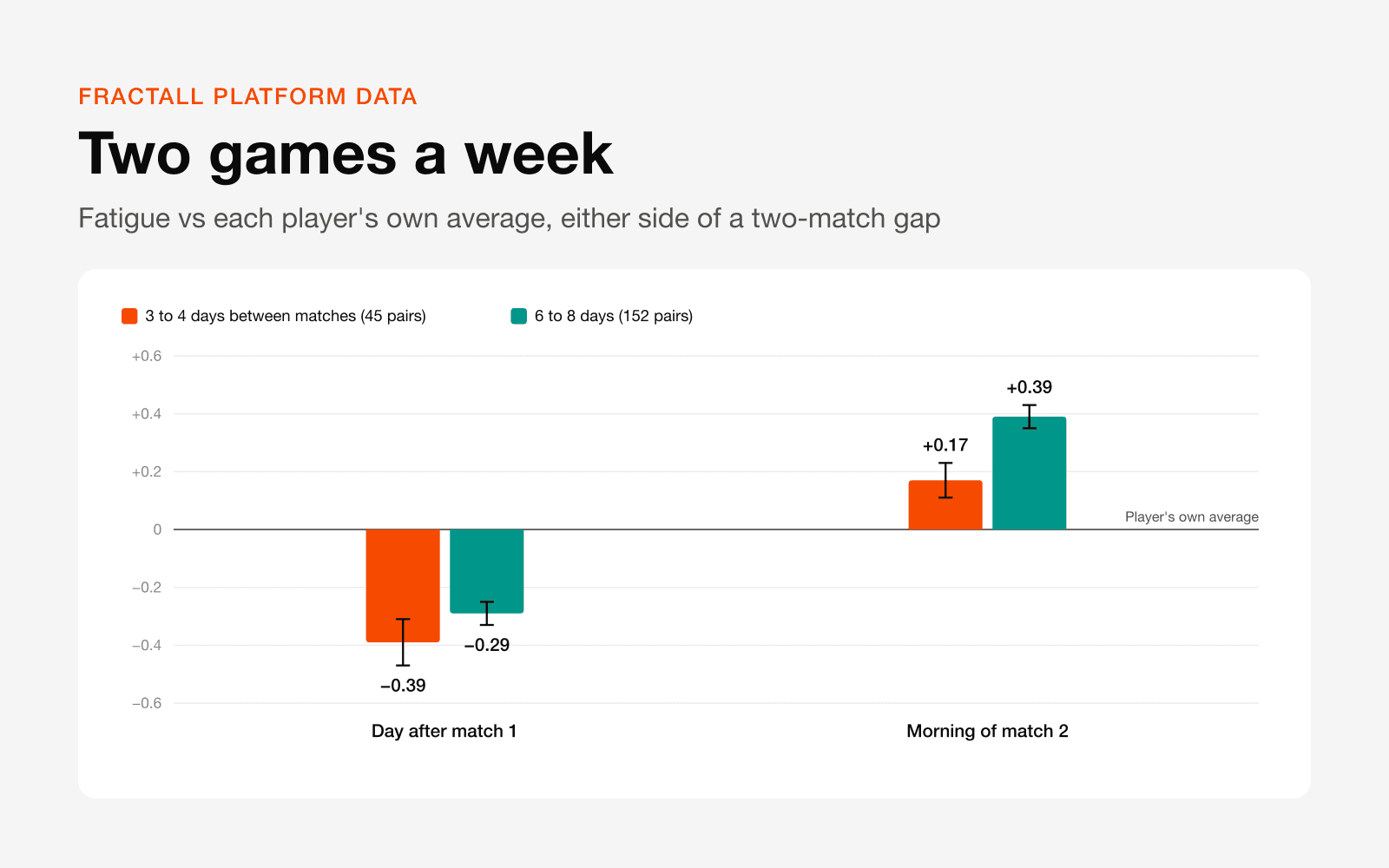
Bar chart of fatigue against each player's own average, the day after match 1 and the morning of match 2, for weeks with 3 to 4 days between matches and weeks with 6 to 8.

Fractall platform data

Two games a week in Fractall wellness data

Daily wellness check-ins from football squads, 197 pairs of consecutive matches. Pulled 7 October 2026.

Quick answer

When a football team plays two games a week, with 3 to 4 days between matches, players still rate their fatigue better than their own average on the morning of the second match, so a fixed red-flag threshold on the squad stays quiet. But the margin above normal is less than half of a normal week's: +0.17 against +0.39 on a 1 to 5 scale, across 45 short-gap and 152 normal-gap match pairs in Fractall data. Compare each player with their own normal match morning, and treat the days between matches as recovery, a short tactical session and activation.
You have a Saturday match, a Wednesday match and another on Saturday. Wednesday morning the wellness scores look fine, so everyone is available. The question this article answers is whether “fine” means the same thing in a two-match week as it does in a normal one.
To check, we took every football squad on Fractall that recorded its matches, paired each match with the one before it, and split the pairs by the gap between them. Then we compared each player's wellness answers with that same player's average across all their check-ins. A player who usually answers 3 and answers 4 today is +1, whatever the rest of the squad does.

45 vs 152

Match pairs 3 to 4 days apart, against pairs 6 to 8 days apart

Football squads only. 433 check-ins on the morning of the second match in short weeks, 1,620 in normal weeks.

Source: Fractall platform data, aggregated, pulled 7 October 2026. Matches come from match-day activities, sessions titled as matches, and GPS sessions the coach marked as match day. Each check-in is compared with that athlete's own mean (athletes with at least 10 check-ins), averaged per match pair, then across pairs. The ± figures are one standard error. Demo teams and Fractall's own club are excluded. No club, athlete or individual answer is identified.

Finding

1. In short weeks, match-morning fatigue sits less than half as far above normal

Players still rate themselves fresher than usual on match morning, by less than half as much as before a normal match.
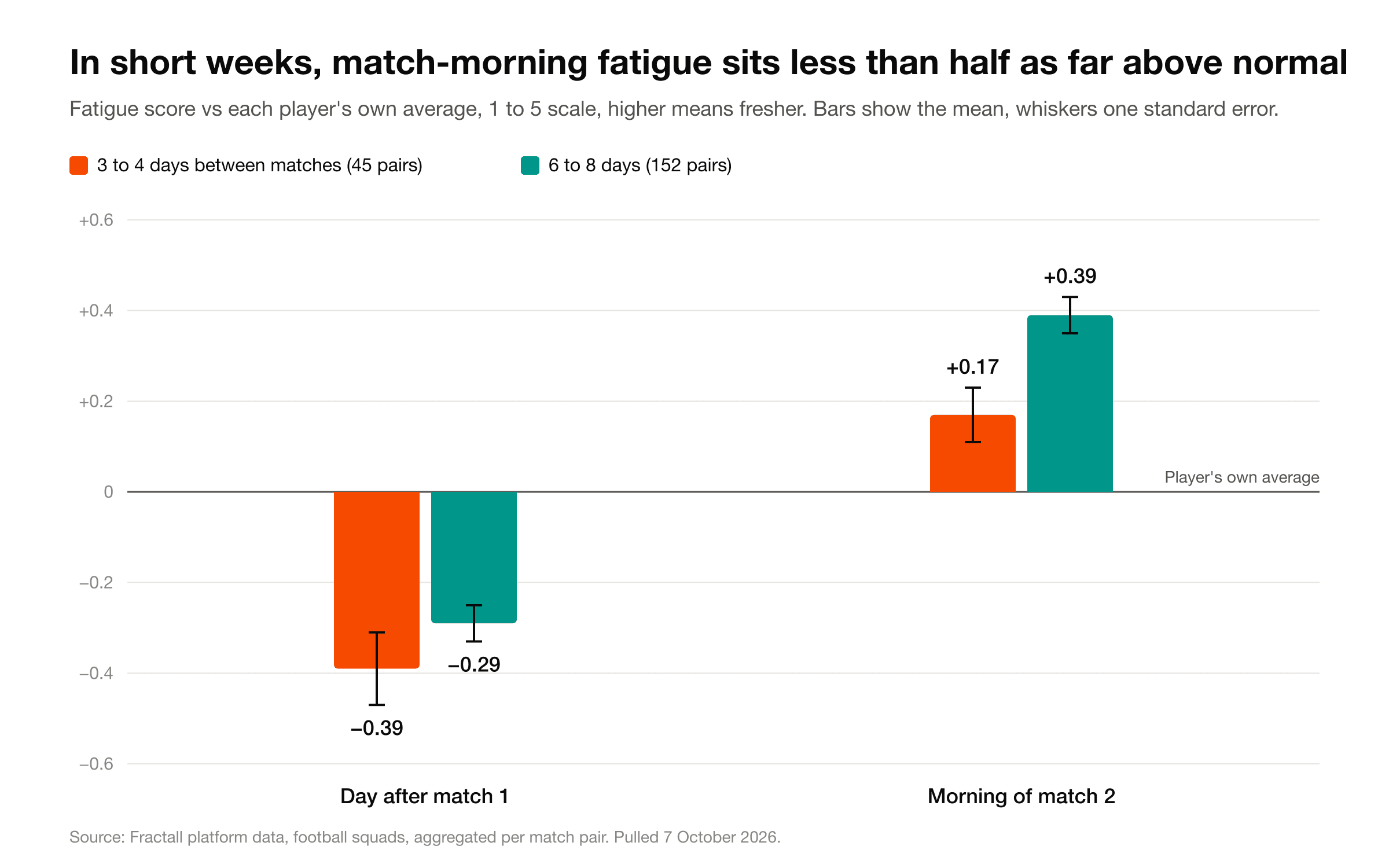
On the morning of the second match, fatigue sat +0.17 above the player's own average in short weeks and +0.39 in normal weeks. Both are positive. Teams usually lighten training before a match, and the questionnaire seems to pick that up, which is why a squad view on match morning looks healthy in either case.
Bar chart. Day after match 1: fatigue is 0.39 below the player's own average in short weeks and 0.29 below in normal weeks. Morning of match 2: 0.17 above in short weeks and 0.39 above in normal weeks.
Fatigue against each player's own average. Short weeks in orange, normal weeks in teal. Whiskers show one standard error.
Vs the player's own average (1 to 5 scale)3 to 4 days between matches6 to 8 days between matches
Match pairs / squads45 / 18152 / 33
Check-ins on match-2 morning4331,620
Fatigue, day after match 1−0.39 ± 0.08−0.29 ± 0.04
Fatigue, morning of match 2+0.17 ± 0.06+0.39 ± 0.04
Soreness, morning of match 2+0.22 ± 0.07+0.31 ± 0.03
Sleep, morning of match 2+0.07 ± 0.05+0.18 ± 0.02
The gap on match-2 morning is about three standard errors, so it is unlikely to be noise at this sample size. Soreness and sleep move the same way, by less. The dip the day after the first match is deeper in short weeks too (−0.39 against −0.29), but that difference is small enough that we wouldn't lean on it.
The same pattern shows up in a stricter cut. Using only matches logged with Fractall's match-day activity type (23 short-gap pairs), match-morning fatigue was +0.28 in short weeks against +0.40 in normal ones.

Evidence

2. Recovery between matches: the body is further behind than the questionnaire

Running in the second match usually holds up, while the muscle injury rate rises.

Three days after a match, the average player is still not fully recovered and can still run at match level. That combination is what makes fixture congestion hard to read. The evidence below comes almost entirely from professional men, so treat it as the best available picture for a semi-pro or academy squad, with the gaps that implies.
QuestionWhat the research foundSource
Is 72 hours enough to recover?Not for every marker. Strength, performance, muscle damage, wellbeing and soreness were still below baseline at 72 hours.Silva et al. 2018, review of 77 studies
Do semi-pro players feel recovered at 72 hours?Muscle strength was back by 72 hours, perceived fatigue was not.Brownstein et al. 2017, 16 semi-pro players
Does running drop in the second match?Usually not. Pooled total distance did not change under fixture congestion.Julian et al. 2021, meta-analysis
Do injuries rise?Muscle injuries do: 1.32 times the rate in league matches with 4 days or fewer of recovery. Total injuries rose only slightly (1.09).Bengtsson et al. 2013, UEFA Elite Club Injury Study
Put next to our data, the picture is consistent. Players rate themselves fresher on match morning, match running usually holds, and the muscle injury rate still goes up. A national-team study found the same direction in the questionnaire: pre-match wellness ratings were worse under congestion (Noor et al. 2021).
Silva JR et al. (2018), Sports Med 48:539-583. Brownstein CG et al. (2017), Front Physiol 8:831. Julian R, Page RM, Harper LD (2021), Sports Med 51:255-273. Bengtsson H, Ekstrand J, Hägglund M (2013), Br J Sports Med 47:743-747. Noor D et al. (2021), J Sci Med Sport 24:1278-1283.
One popular number to drop: the claim that players need exactly 72 hours, or that there is a 96-hour minimum between matches. We found no primary source for the second, and the review behind the first says 72 hours is not enough for every marker. For how the normal one-match week is built, see our guide to planning load from MD-4 to MD+1.

Application

3. Read the wellness questionnaire against each player's own match mornings

A squad average and a fixed cut-off both hide the short-week gap.

The useful comparison is this player on this match morning against the same player on their usual match mornings. In our data the typical player answers better than their overall average before a match, so a player who is at or below their own average on a match morning already stands out. In a short week, expect the whole squad to sit lower than usual and look for the players who dropped further.

Before the second match

  • Pull up each player's last few match mornings, not the squad average.
  • Flag anyone at or below their overall average on match morning. Most players are above it.
  • Read fatigue first. It moved the most in our data; sleep moved the least.
  • Ask flagged players one question in person before you change the plan. A questionnaire score starts a conversation.
  • Check who played most of the first match. Our data can't separate starters from substitutes, but you can.

What about ACWR?

ACWR (acute to chronic workload ratio) will move in a two-match week, and the direction depends on how much training you cut. Treat it with care: in UEFA data on session-RPE load, a 1:4-week ratio of 0.97 to 1.38 already carried more risk than 0.60 to 0.97, and the ratio predicted injuries poorly (McCall et al. 2018). The popular 0.8 to 1.3 “sweet spot” came from cricket, Australian football and rugby league, not football. Our ACWR guide for football covers how to read it without a fixed band.
McCall A, Dupont G, Ekstrand J (2018), Br J Sports Med 52:1517-1522. Gabbett TJ (2016), Br J Sports Med 50:273-280.

Planning

4. Training between games: recovery, one short session and activation

Adapted from studies of professional squads. Your session count will be lower; the order stays the same.

Professional clubs keep training between two close matches short and let the matches do the loading. In the Premier League, daily training in a two-match week looked like a one-match week and the second match was added on top (Anderson et al. 2016). Some clubs merge two days into one session when the gap is short, for example MD+2 with MD-2 (Gómez-Díaz et al. 2024). These are illustrative weeks built on that pattern.

Four days, then three

Sunday (MD+1): recovery for players who played most of the match, a short top-up for those who didn't. Monday (MD+2, which is also MD-2): one short tactical session, low volume, little sprinting. Tuesday (MD-1): short activation and set pieces. Wednesday: match. Thursday (MD+1): recovery and top-up again. Friday (MD-1): short activation. Saturday: match. Collect wellness every morning and sRPE after every session and match, including the top-ups.

Players who didn't play are the group a two-match week under-loads. Over a season, starters in one Premier League squad covered about twice the high-speed running of non-starters (Anderson et al. 2016). Clubs answer with a top-up the day after: about 17 minutes in one study of professional substitutes (Hills et al. 2020), covering less than half of match running in another (Ribeiro et al. 2025). A 2024 review found the effect of top-ups on fitness and injuries is still unclear (Clemente et al.). Keep them short and aimed at the high-speed running the player missed.
Two recovery levers have strong support: food and sleep. On food, the UEFA expert group recommends about 1 g of carbohydrate per kg of body weight per hour for 4 hours after a match, and 6 to 8 g per kg per day for the 48 to 72 hours before the next one (Collins et al. 2021).
Anderson L et al. (2016), J Sports Sci 34:1250-1259 and Int J Sports Physiol Perform 11:1038-1046. Gómez-Díaz A et al. (2024), Biol Sport 41(4):87-100. Gualtieri A et al. (2024), Int J Sports Physiol Perform 19:987-995. Hills SP et al. (2020), J Strength Cond Res 34:2805-2814. Ribeiro J et al. (2025), Biol Sport 42(4):287-297. Clemente FM et al. (2024), Biol Sport 41(4):173-185. Collins J et al. (2021), Br J Sports Med 55:416.

Limits

What this data can't tell you

No minutes played, no injuries, and a sample of clubs that chose to use an app.

We don't know who played. Starters and substitutes are mixed in every number above. We tried splitting players by whether they logged an RPE for the first match, and those who did looked fresher, which says more about who fills in forms than about minutes. So we left that split out.
We don't link any of this to injuries. The data shows what players reported, not what happened to them afterwards.
Some match dates come from session titles such as “vs” or “jogo”, so a few non-match sessions may be in the sample. The stricter cut above points the same way.
The squads span several countries and levels, and short weeks may differ from normal ones in other ways: time of season, travel, the opponent. 45 short-gap pairs is enough to see a pattern, not to set a threshold for your squad. That comes from your own players over time.

In Fractall

Where these numbers come from

The same check-ins a coach already sees on the Wellness tab.
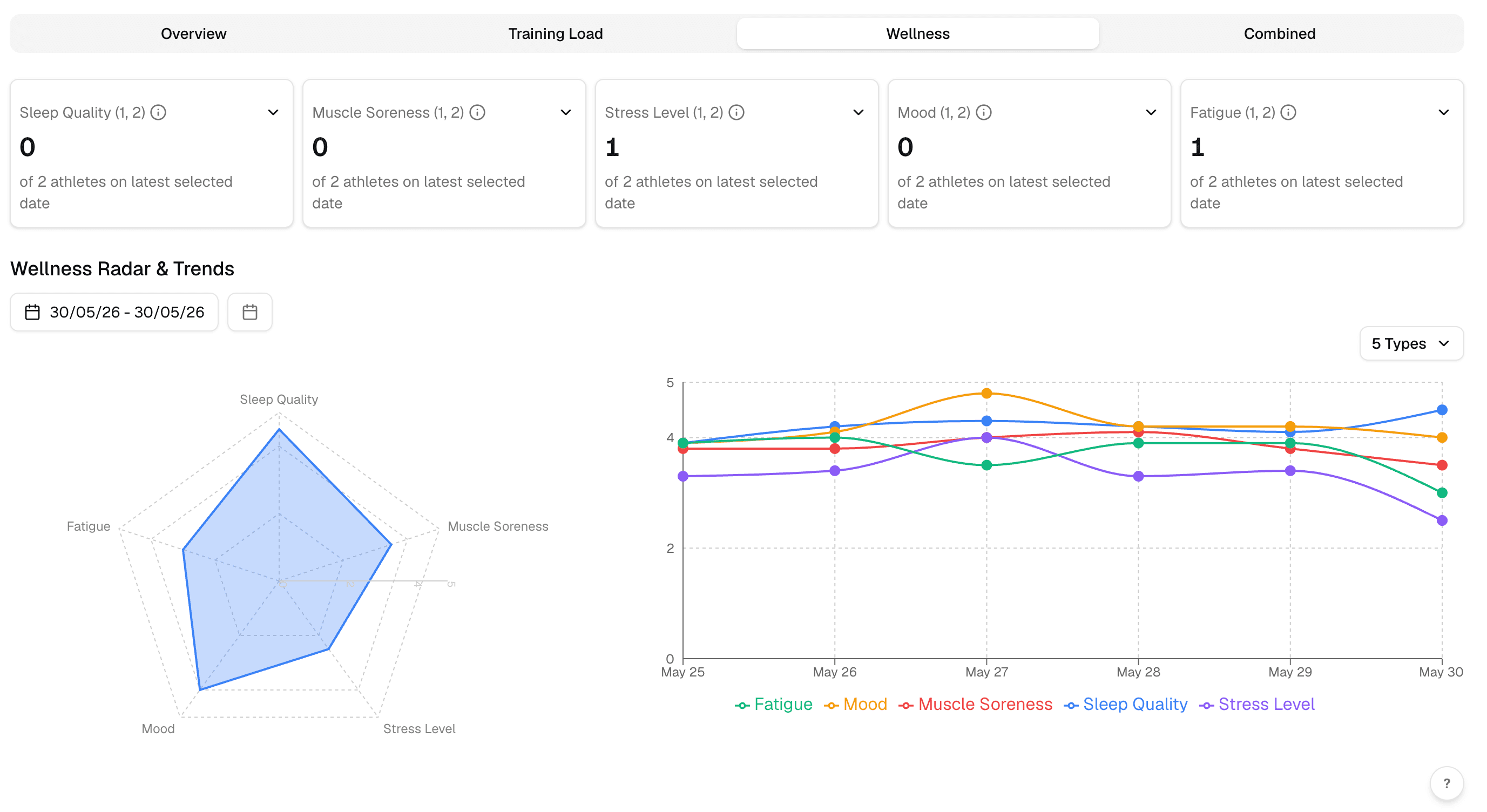
Every number above is built from daily wellness check-ins and matches scheduled as match days, the same data a coach works with in Fractall. Fractall doesn't yet calculate each player's match-morning baseline for you. You can filter the Wellness tab to one player and a date range and read their last few match mornings in a minute.
Fractall Wellness tab with a radar of sleep quality, muscle soreness, stress, mood and fatigue, and daily trend lines for each item.
The Wellness tab: daily trends for each item, filterable by athlete and date range.

A two-match week in Fractall

1

Schedule both matches as match days, so they show on the calendar and in the weekly report.

2

Athletes answer the five wellness items each morning on their phone, and rate every session and match with session RPE.

3

Before the second match, filter the Wellness tab to each player you are unsure about and compare today with their previous match mornings.

4

After the week, the weekly report shows load and wellness day by day with both match days marked.

Session RPE after every match and top-up is what tells you who actually carried the load, which is the one thing this dataset lacks. Fractall's RPE monitoring collects it from the athlete's phone. If you're setting up check-ins for the first time, our wellness monitoring guide covers the questionnaire itself, and our earlier data on when athletes submit covers timing.

Know each player's normal before the next short week

Fractall collects wellness and session RPE from the athlete's phone and keeps every answer on their record. The first month is free.

Start free trial

FAQs

Frequently asked questions

What coaches ask when the fixture list gets crowded.

How much rest do football players need between matches?

There is no single number. A 2018 review of 77 studies (Silva et al.) found hamstring strength, physical performance, muscle damage markers, wellbeing and soreness still below baseline 72 hours after a match. Sprint ability usually comes back sooner, and in a study of semi-professional players perceived fatigue was still raised at 72 hours (Brownstein et al., 2017).

Does fixture congestion increase injury risk in football?

For muscle injuries, the elite men's data says yes. In UEFA's Elite Club Injury Study, league matches played with 4 days or fewer of recovery had 1.32 times the muscle injury rate of matches with 6 days or more, while the total injury rate rose only slightly (Bengtsson et al., 2013). Distance covered in matches usually doesn't drop, so match running data can look normal while the risk is higher.

Can a wellness questionnaire tell you a player hasn't recovered?

Partly. In Fractall data from football squads, players with 3 to 4 days between matches still rated their fatigue better than their own average on the morning of the second match, but by +0.17 on a 1 to 5 scale against +0.39 in weeks with 6 to 8 days. A fixed threshold on squad scores misses that. Comparing each player with their own normal match morning shows it.

What should players who didn't play do in a two-match week?

Professional clubs commonly give them a top-up session the day after the match. In one study of professional substitutes those sessions lasted about 17 minutes (Hills et al., 2020), and in another they covered less than half of match running (Ribeiro et al., 2025). A 2024 review found no clear evidence yet that top-ups protect fitness or reduce injuries (Clemente et al.), so keep them short and aimed at the high-speed running the player missed.

Where does the Fractall data in this article come from?

Daily wellness check-ins from football squads on Fractall, pulled on 7 October 2026 and aggregated per match pair: 45 pairs of matches 3 to 4 days apart and 152 pairs 6 to 8 days apart. Demo teams and Fractall's own club are excluded. No club, athlete or individual answer is identified.
How do you handle the second match in a short week? If you read wellness differently, or found a top-up that works for your squad, we would like to hear it.

Related guides