

1 Month Free Access (cancel anytime)
Injury preventionStrengthCongested fixtures

Nordic Hamstring Curl In Season: How Many and Which Day

How many Nordic hamstring curls to keep in a two-game week and on which day: what the injury trials used, what a low dose still does, and what isn't proven.

Published
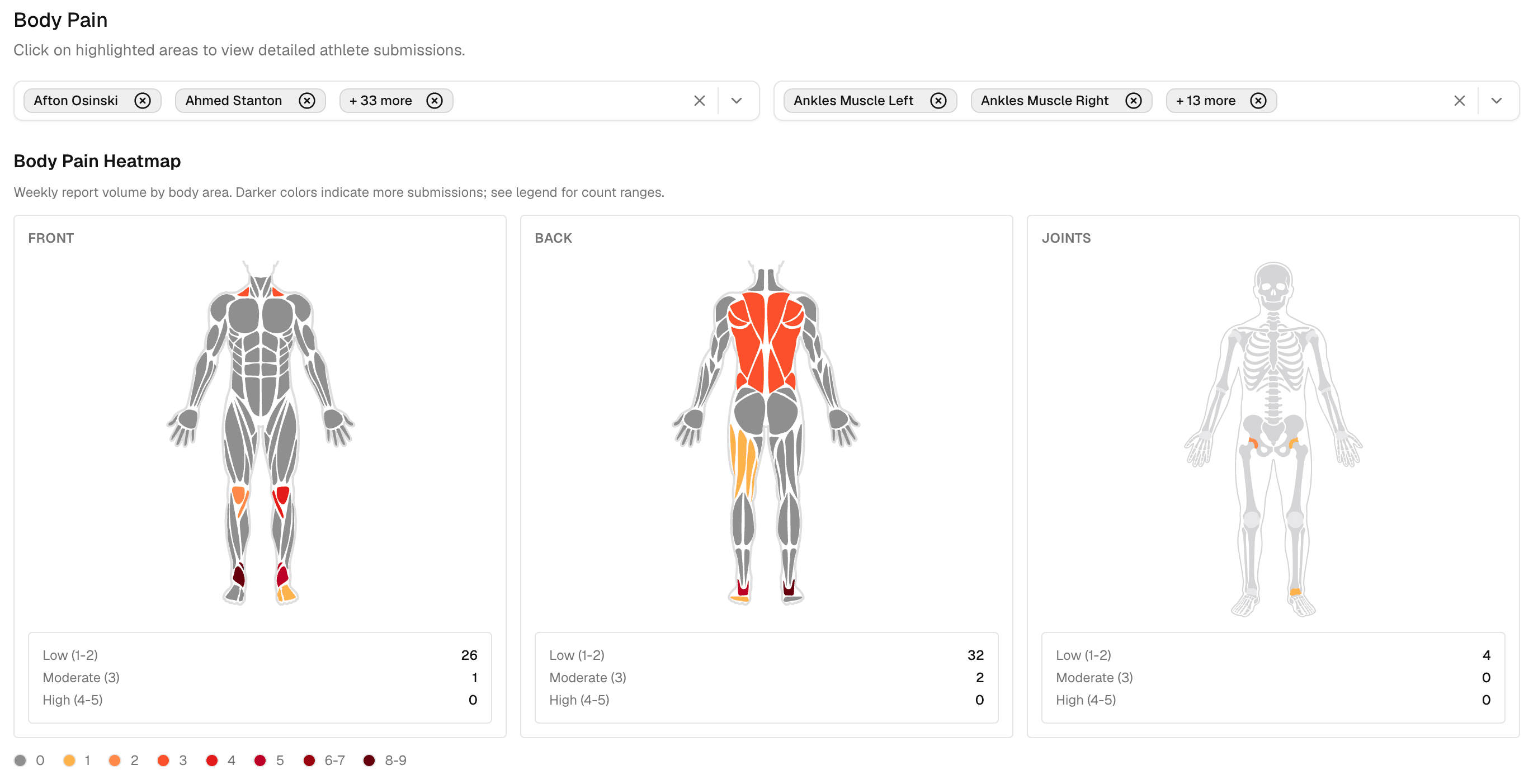
Fractall wellness dashboard with the body pain map, showing where each player reports pain.

Nordic hamstring curl

Keep a small dose through congested weeks

A few maximal reps once a week, away from the day after a match and the day before one. Nobody has proven how little is enough to prevent injuries.

Quick answer

In season, keep the Nordic hamstring curl going instead of stopping: one short session a week of two sets of one or two maximal reps, done after training, never on the day after a match (MD+1) or the day before one (MD-1). Even a few reps a week can hold strength for a while. The longer muscle fibres a full programme builds fade within two to three weeks of stopping. No study has shown that a dose this small prevents hamstring injuries on its own: the injury trials used full programmes.
You ran the Nordic programme in pre-season. Now it is December, the team plays twice in some weeks, and the players hate the soreness. What you need is the smallest dose worth keeping and the day it goes on.
Below: what the injury trials actually prescribed, how little still holds strength, what happens if you stop, where the Nordic fits in a one-game and a two-game week, and how to make the few reps you keep count.

Evidence

1. The injury trials used full programmes

The famous reductions came from 10-week ramps and 25 sessions in 13 weeks. No low in-season dose has been shown to prevent injuries.

StudyWhat players didHamstring injuries
Petersen et al., AJSM, 2011. 50 Danish teams, 942 playersA 10-week progressive Nordic programme, then a weekly session for the rest of the season3.8 vs 13.1 per 100 player seasons. Rate ratio 0.29 (95% CI 0.15 to 0.57)
van der Horst et al., AJSM, 2015. 40 Dutch amateur teams, 579 players25 Nordic sessions in 13 weeks0.25 vs 0.8 per 1,000 player hours. Odds ratio 0.28 (95% CI 0.11 to 0.72)
van Dyk et al., BJSM, 2019. Meta-analysis, 15 studies, 8,459 athletesProgrammes that included the NordicRisk ratio 0.49 (95% CI 0.32 to 0.74)
Impellizzeri et al., J Clin Epidemiol, 2021. Reappraisal of the randomised trialsThe 5 RCTs that randomised to the Nordic, then one more addedRisk ratio 0.56 (95% CI 0.20 to 1.52), then 0.59 (0.27 to 1.29). Inconclusive
Two football trials found large drops in hamstring injuries. Petersen and colleagues followed 942 Danish players: the Nordic group had 3.8 acute hamstring injuries per 100 player seasons against 13.1. Van der Horst and colleagues found 0.25 against 0.8 injuries per 1,000 player hours in 579 Dutch amateurs.
Both used a full programme, not a maintenance dose. Petersen's players did a 10-week progressive programme and then a weekly session. Van der Horst's did 25 sessions in 13 weeks. The original 10-week progression (Mjølsnes 2004) built up to three sessions a week, about 700 reps in total.
The headline you see everywhere, "the Nordic halves hamstring injuries", comes from van Dyk's 2019 meta-analysis. In 2021 Impellizzeri and colleagues pointed out that only 5 of its 15 studies randomised players to the Nordic. On those 5, the risk ratio was 0.56 with a confidence interval of 0.20 to 1.52, and 0.59 (0.27 to 1.29) with one newer trial added. Both intervals cross 1, so the effect could be zero. Their conclusion: a conditional recommendation for football, at best.
One study tested a very low dose against injuries. Cadu and colleagues gave 23 professionals 1 set of 3 maximal reps through 21 in-season weeks. Strength rose about 15%, and the squad had 5 hamstring injuries (22%) against 9 (39%) in the previous season. With a historical comparison and a small squad, that difference was not significant (p = 0.12).
Petersen et al., Am J Sports Med, 2011, PMID 21825112. van der Horst et al., Am J Sports Med, 2015, PMID 25794868. van Dyk et al., Br J Sports Med, 2019, PMID 30808663. Impellizzeri et al., J Clin Epidemiol, 2021, PMID 34520846. Mjølsnes et al., Scand J Med Sci Sports, 2004, PMID 15387805, protocol as tabled by Cuthbert 2020. Cadu et al., J Sport Rehabil, 2022, PMID 35894913.

Dose

2. Strength responds to a small dose; fascicle length needs more

Low-volume Nordic work builds eccentric strength about as well as high volume. Longer fascicles need more reps.

Across 13 studies, Cuthbert and colleagues found very large eccentric strength gains after six weeks or more of Nordics with both high and low volumes (effect sizes 2.12 and 2.28). A 2025 meta-analysis of 42 studies found no link between strength gains and weekly volume, sessions, sets or reps, at low to very low certainty. Its authors still suggested about 29 to 64 reps a week, usually over 2 to 3 sessions, after a progressive start: far more than an in-season dose.
Frequency matters for building strength. In 32 high-level players over 8 weeks, only the twice-a-week group got stronger; once a week changed muscle architecture about as much but not strength (Medeiros 2020). Building strength and holding it are different jobs, and the in-season question is holding it.
The catch is fascicle length. In 11 studies of football players, high volume (2 to 3 sets of 8 to 12, 2 to 3 times a week) lengthened the biceps femoris fascicles; low volume (1 to 2 sets of 3 to 5, once or twice a week) raised strength but did not meaningfully change fascicle length (Cholp and Zemková 2025). On that evidence, a low dose keeps the strength gain and may not keep the change in muscle architecture.
The most on-topic study is small. Lacome and colleagues ran six in-season weeks with 19 elite youth players: a low-volume group did 1 set of 4 Nordics plus 6 stiff-leg deadlifts, a high-volume group 4 such sets. Both gained about 11% eccentric strength and about 5% fascicle length, with no clear difference between them. The authors judged the low volume more suitable for a team facing a congested schedule. The abstract does not say how many sessions a week.
Low volume also takes time to show. In 45 female players, high and low volume both raised eccentric force by 10% to 13%, but the gain was not significant at week 4 and appeared at week 6 (Amundsen 2022).
Cuthbert et al., Sports Med, 2020, PMID 31502142. Franke et al., J Strength Cond Res, 2025, PMID 40991853. Medeiros et al., Int J Sports Physiol Perform, 2020, PMID 32580161. Cholp and Zemková, Front Physiol, 2025, PMID 41178985. Lacome et al., Int J Sports Physiol Perform, 2020, PMID 31034261. Amundsen et al., Transl Sports Med, 2022, doi:10.1155/2022/7133928.

Detraining

3. Stopping for December costs the fascicles first

Fascicle length gains disappeared within two to three weeks of stopping. Strength held for about four.

2 weeks

Until most of the fascicle length gain was gone

20 recreationally active men, six weeks of Nordics, then two weeks off: fascicle length had risen 23% to 24%, then dropped 15% to 17%. Eccentric strength did not drop over four weeks off. Presland et al., Scand J Med Sci Sports, 2018.

An MRI study found the same pattern: fibre length in the hamstrings rose 7% to 18% over nine weeks of Nordics and was back to baseline three weeks after stopping (Pai 2025, 11 participants).
That is the case for a little every week rather than a pause until January. A small dose holds strength. Whether it also holds fascicle length is less clear: it did in one study where every rep was loaded to be maximal (Miura 2025, section 5), and the low-volume studies in section 2 mostly did not lengthen fascicles in the first place.
Presland et al., Scand J Med Sci Sports, 2018, PMID 29572976. Pai S A et al., J Sport Health Sci, 2025, PMID 40578759. Both studies used non-footballers.

Microcycle

4. Where the Nordic goes in a one-game and a two-game week

One practical option, from a single observational paper and the timing studies around it. Not a tested protocol.

Spagnolo and Perna followed 16 English League One players for 28 weeks. Nordics went on MD-4 (2 sets of 2) in one-match weeks and on MD+2 (2 sets of 1) in two-match weeks, as both the test and the dose. Nordic force did not change as the fixtures piled up. There was no control group, so this shows the squad held its strength on that dose, nothing more.

One-game week

DayNordicWhy
MD+1NoneHamstring strength is still down 24 h after a match (Wollin 2018)
MD+2NoneNot needed in a one-game week. MD-4 is the better slot
MD-42 sets of 2 hard reps, after the sessionThe day Spagnolo and Perna used. After training, not before (Lovell 2016)
MD-3 to MD-1NoneKeep the days before the match free of Nordics

Two-game week

DayNordicWhy
MD+1 after either matchNoneStrength was down at 24 h and 48 h after a match in Wollin 2018
MD+2, which is also MD-2 when games are four days apart2 sets of 1 maximal rep, after the sessionSpagnolo and Perna used MD+2 in two-match weeks (the article does not say which match it followed). Strength may still be down at 48 h (Wollin 2018), so stop at two reps
MD-1 before either matchNoneNever the day before a match
Games three days apart, for example Saturday, Tuesday, SaturdayOnly after the midweek game: MD+2 (Thursday)Between Saturday and Tuesday every day is MD+1 or MD-1, so there is no slot there
Why after the session: 30 Nordic reps done before 60 minutes of simulated football cut eccentric hamstring torque during the football by 14% to 19% (Lovell 2016). Over 12 weeks, doing them before or after training built strength equally, about 12% (Lovell 2018). Two hard reps are far fewer than 30, but there is no reason to take the risk before a session.
Why not MD+1: isometric hamstring strength in elite youth players was down 24 and 48 hours after a match, recovered by the next match and dropped again after it (Wollin 2018). For how the rest of the week is loaded, see how to plan weekly training load around match day, and for what the second match of a two-game week does to wellness scores, see what wellness data shows before match 2.
Spagnolo and Perna, Professional Strength and Conditioning (UKSCA), Issue 75, May 2026. Lovell et al., J Sports Sci, 2016, PMID 27267402. Lovell et al., Scand J Med Sci Sports, 2018, PMID 28544170. Wollin et al., Phys Ther Sport, 2018, PMID 29156302.

Intensity

5. Make each rep a maximal one

One set of 6 a week did not hold strength in season. Four to eight loaded reps a week did, in gym-trained men.

Two recent studies seem to disagree. In Franke and colleagues' 2026 trial, 34 athletes did a five-week pre-season block and gained 9.5% eccentric strength, then did either nothing or one set of 6 Nordics a week in season. Both groups were back to baseline after five weeks.
In Miura and Miyamoto's 2025 study, 45 resistance-trained men kept their strength and fascicle length gains for eight weeks on 4 or 8 reps a week. The difference: once a man controlled the full range, he held a weight plate of 2.5 to 15 kg so each rep stayed maximal.
Our reading: effort per rep looks to matter more than the rep count. That is our interpretation of two small studies in different populations, not a proven rule. In practice: few reps, each one a full-effort lowering, and add a plate once a player controls the whole range.
One more warning for December. If a player has not done Nordics recently, do not start now. After a first session of 24 reps, eccentric strength was down for three days and soreness peaked on days two and three. The same session four weeks later cost one day (Coratella 2025). A congested month is the wrong time to pay the first-session price. Our suggestion, which no study has tested: wait for a one-game week, start with 1 set of 2 on MD-4, and check that player's soreness the next morning.
Franke et al., Int J Sports Med, 2026, PMID 42887562 (the sport of the 34 athletes is not given in the abstract). Miura and Miyamoto, Scand J Med Sci Sports, 2025, PMID 40787947. Coratella et al., Int J Sports Med, 2025, PMID 40280182.

Adherence

6. The programme that gets done beats the one on paper

Most elite teams never ran the full Nordic programme. The ones that used it in team training had fewer hamstring injuries.

10.7%

Club-seasons that completed the Nordic programme in full

16 of 150 club-seasons across 50 Champions League and Norwegian Premier League teams, 2012 to 2014. Bahr et al., Br J Sports Med, 2015.

Amateur clubs are no different. Two years after their trial, 69% of 264 Dutch amateur players had never done the programme (van der Horst 2021). In 2020/21, one elite team out of 17 used the full original programme. The five teams that used the Nordic in team training had fewer hamstring injuries, 5 against 11 per team, and 13 of the 16 teams using it reported player complaints, mostly stiffness and soreness (Ekstrand 2022). That study was observational, so other differences between the teams may explain part of it.
A small dose that players actually do every week is the realistic target. To know whether it is happening, and what it costs the next morning, you need four things written down.

What to record through a congested month

  • Who did the Nordic session, and who missed it.
  • Muscle soreness the next morning, per player.
  • Where the soreness is: hamstring, calf or somewhere else.
  • Every hamstring injury, with the date and the mechanism.
For what to write down when a hamstring does go, see what to record when a player gets injured. The Nordic is one lever among several in preventing soft-tissue injuries without GPS.
Bahr et al., Br J Sports Med, 2015, PMID 25995308. van der Horst et al., Clin J Sport Med, 2021, PMID 30550415. Ekstrand et al., BMJ Open Sport Exerc Med, 2022, PMID 35979432.

Technique

How to do a Nordic hamstring curl

Kneel, anchor the ankles, keep the hips straight and lower as slowly as you can.

  1. 1

    Kneel on a pad

    A partner holds both ankles down, or hook them under something that cannot move.

  2. 2

    Lock the hips

    Body straight from knees to head. The hips stay extended for the whole rep.

  3. 3

    Lower as slowly as you can

    Fight the fall all the way down. The slow lowering is the exercise.

  4. 4

    Catch and reset

    Catch yourself with your hands, push back up to kneeling, and start the next rep from the top.

Not to be confused with the reverse Nordic curl, which leans backwards from kneeling and loads the quadriceps.

In Fractall

See what the Nordic session costs the next morning

Soreness, where it hurts and every hamstring injury, on the same player record as the week's load.

Following a Nordic week in Fractall

1

Players answer the morning wellness check-in on their phone, and muscle soreness is one of the scores, so the morning after the Nordic session shows who is still sore.

2

The body pain map shows where: a hamstring that stays sore two mornings running is the one to look at before the next match.

3

If a hamstring goes, the injury is recorded on the player's record with the date, and the training load from session RPE in the weeks before it is on the same record.

Next-morning soreness, per player

Fractall keeps each player's wellness, body pain, injuries and training load in one place. The first month is free.

Start free trial

FAQs

Frequently asked questions

The questions S&C coaches ask about Nordics once the fixtures pile up.

How many Nordic hamstring curls per week in season?

Nobody has proven a minimum. A practical floor is one short session a week: two sets of one or two hard reps. One English League One squad held its Nordic force across 28 weeks of congested fixtures on that kind of dose, with no control group. One set of 6 a week did not hold strength in a 2026 trial. Our reading of two small studies is that each rep should be a maximal one, with a weight plate added once a player controls the full range.

Should Nordic curls go before or after training?

After, or on a separate day. In a lab study, 30 Nordic reps done before 60 minutes of simulated football cut eccentric hamstring torque during the football by 14% to 19%. Done before or after training for 12 weeks, both built strength by about 12%.

Can players do Nordic curls the day after a match?

Better not. Isometric hamstring strength in 15 elite youth players was down 24 and 48 hours after a match. In two-game weeks, one League One squad used MD+2 for 2 sets of 1 rep and held its Nordic force. Never do them the day before a match.

Do Nordic curls prevent hamstring injuries?

Full programmes cut hamstring injuries in two football trials: a rate ratio of 0.29 in 942 Danish players and an odds ratio of 0.28 in 579 Dutch amateurs. A 2021 reappraisal of the randomised trials put the effect at 0.56 to 0.59 with confidence intervals that cross 1, so the evidence is promising but not settled. No study shows that a low in-season dose prevents injuries on its own.

Can you do Nordic curls without a partner?

Yes, if the ankles are anchored to something that cannot move, such as a loaded bar or a Nordic bench. The rep is the same: knees on a pad, body straight from knees to head, lower as slowly as you can.

Is the reverse Nordic curl the same exercise?

No. The reverse Nordic leans the body backwards from kneeling and loads the quadriceps. The Nordic hamstring curl lowers the body forwards and loads the hamstrings.

Related guides