

Athlete Wellness Questionnaire for S&C Coaches (Free Form)
Athlete wellness questionnaire for football: the five questions and answers, how to score them, a free Google Form and Sheet, and when to use an app.
Published
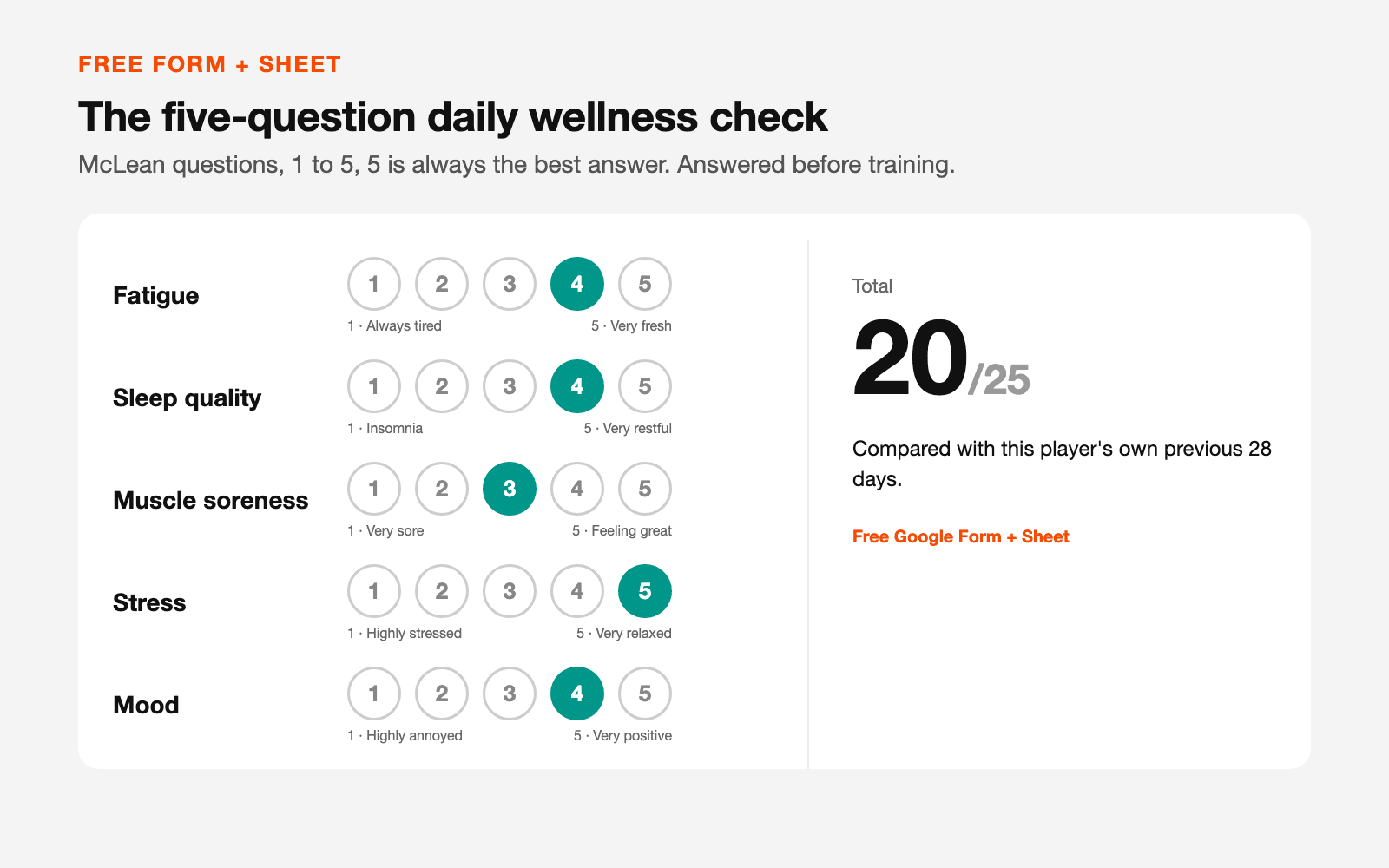
Wellness questionnaire
The short answer
Five questions, one scale, and a comparison with the player's own normal.
Quick answer
The questions
1. The McLean questionnaire: five questions, and 5 is the best answer on every one
The McLean questionnaire, with all 25 answers in text.
| Question | What the player is asked | Answers, from 5 (best) to 1 |
|---|---|---|
| Fatigue | How fresh do you feel? | 5 Very fresh · 4 Fresh · 3 Normal · 2 More tired than normal · 1 Always tired |
| Sleep quality | How did you sleep last night? | 5 Very restful · 4 Good · 3 Difficulty falling asleep · 2 Restless sleep · 1 Insomnia |
| General muscle soreness | How do your muscles feel? | 5 Feeling great · 4 Feeling good · 3 Normal · 2 Increase in soreness/tightness · 1 Very sore |
| Stress | How stressed do you feel? | 5 Very relaxed · 4 Relaxed · 3 Normal · 2 Feeling stressed · 1 Highly stressed |
| Mood | How is your mood? | 5 Very positive mood · 4 A generally good mood · 3 Less interested in others and/or activities than usual · 2 Snappiness at teammates, family and co-workers · 1 Highly annoyed/irritable/down |
How much to trust five questions
Hooper index
2. McLean questionnaire or Hooper index: pick one, and never mix their scores
The two questionnaires run in opposite directions.
| McLean questionnaire | Hooper index | |
|---|---|---|
| Questions | Fatigue, sleep quality, muscle soreness, stress, mood | Sleep, stress, fatigue, muscle soreness |
| Answers per question | 5 (1 to 5) | 7 (1 to 7) |
| Best answer | 5, on every question | Usually 1, but some papers flip sleep so that 7 is best |
| Total | 5 to 25, higher is better | 4 to 28, usually lower is better |
| Origin | McLean et al. 2010, professional rugby league | Hooper et al. 1995, elite swimmers |
Scoring
3. Score each player against their own normal
A total out of 25 means little until you know what that player usually reports.
- 1
Add the five answers
That gives a total from 5 to 25 for each check.
- 2
Work out the player's normal
Take their average total over the previous 28 days, today not included, and the standard deviation (how much it usually moves).
- 3
See how far today sits from it
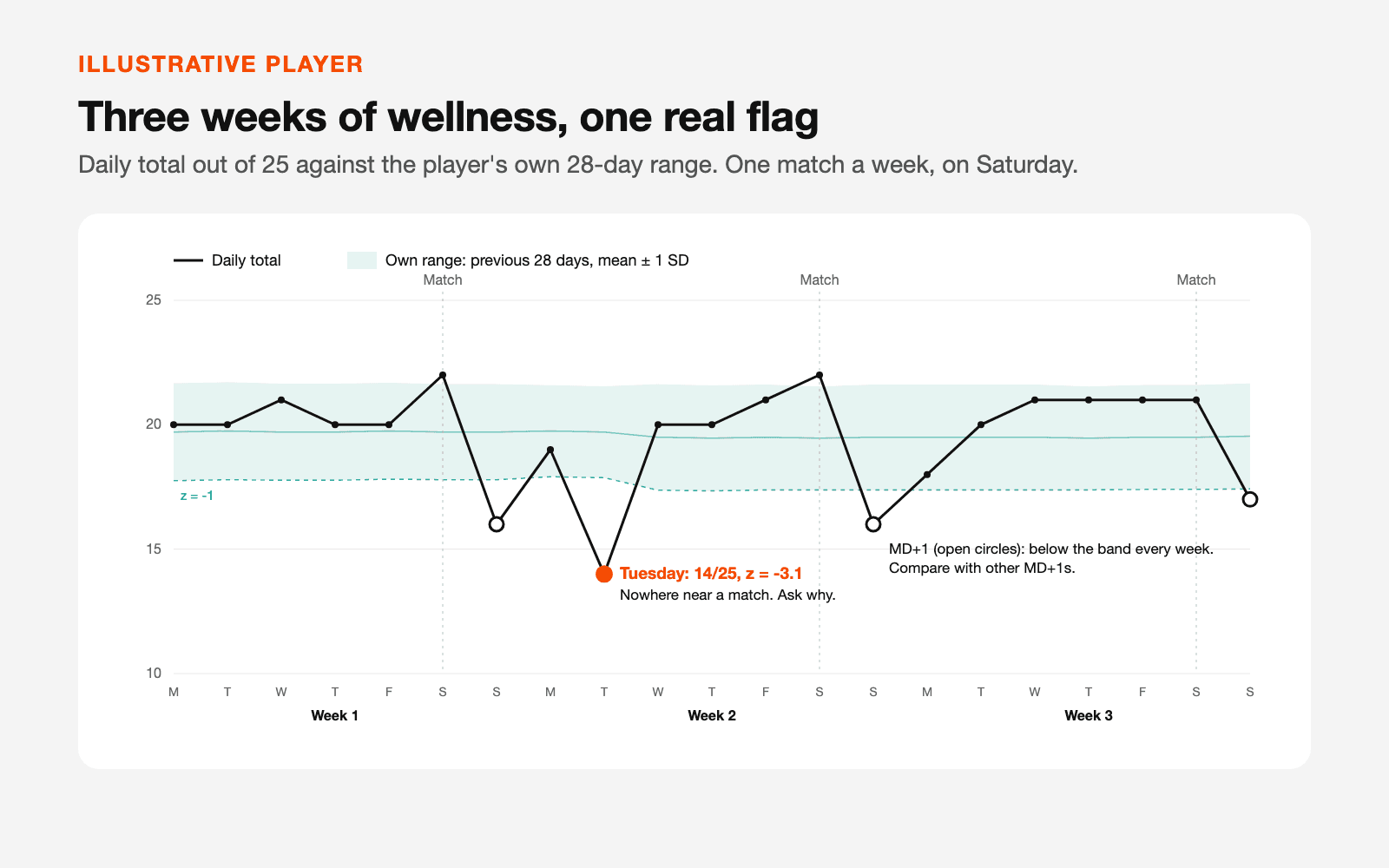
The z-score is today's total minus the average, divided by the standard deviation. 0 is a normal morning for that player; -1 is clearly worse than usual.
- 4
Check the single answers too
A 1 or 2 on any question is worth a word with the player even when the total looks fine. A total can hide one very sore hamstring.
- 5
Read it against the week
Before acting, ask what day it is in the match week. Section 4 covers why.
z = -1
Wellness score one standard deviation below the player's normal
In Australian football players, this came with 4.9 ± 3.1% lower training load (PlayerLoad) that day (Gallo et al. 2016). That is an association; no study has tested -1 as a cut-off.
Match week
4. Expect the day after a match to look bad
Compare a player's MD+1 with their other MD+1s.
Routine
5. Ask before training, and show players what you did with it
Answers come in when staff use them and players can see it.
84% vs 8%
Average completion: team athletes with coach support, against team athletes left to do it themselves
Saw, Main and Gastin 2015, 131 athletes. Self-directed individual athletes averaged 28%.
Keeping the check honest
- Ask at the same time every day, before the first session.
- Tell the squad what the answers are for, and who sees them.
- Act on a low answer with a conversation first. A player who reports a bad night and gets dropped will report a good one next time.
- Show the squad something back every week, even a single team chart.
- With youth players, agree with parents and the club who can see health answers before you start.
Free template
6. Free Google Form and Sheet for a daily wellness questionnaire
The five McLean questions as a form players answer on their phone, and a Sheet that scores each check against the player's last 28 days.
- 1
Make a copy of both
Each link asks you to sign in to Google and makes a copy in your own Drive. Google can take a little while to build the copy, so leave the tab open until it loads. Nothing is shared with us.
- 2
Add your squad
In your copy of the Form, edit the Name question and replace Player 1, Player 2 and Player 3 with your players.
- 3
Link the Form to the Sheet
In the Form, open Responses, click Link to Sheets, choose Select existing spreadsheet and pick your copy of the Sheet. Google adds a tab called Form Responses 1. If your Google account is in another language, rename that tab to Form Responses 1.
- 4
Send players the link
They answer before training. The Scores tab fills in on its own, and the Today tab lists today's checks with the lowest z-score first.
What the free version won't do
- It doesn't remind anyone. You send the link, and you chase the players who didn't answer.
- Anyone with the link can answer as any player. Keep the link in the squad group.
- Two answers on one day both count. Delete the extra row in Form Responses 1.
- The Scores tab reads columns by position. Keep the questions in order and leave email collection off.
- It shows wellness on its own. Training load lives somewhere else.
Form or app
7. What app can my players use for a daily wellness questionnaire on their phone?
A free form works. An app saves the coach's time, mostly in chasing and reading.
Signs the form has become the job
- You message the same players every morning to get answers in.
- You scroll the Sheet to find who is low, then open another file to see their load.
- You run more than one squad, and each has its own Form and Sheet.
- Staff ask for the numbers and you send screenshots.
In Fractall
The same five questions in Fractall
Players answer in the app, and the coach sees wellness next to training load.
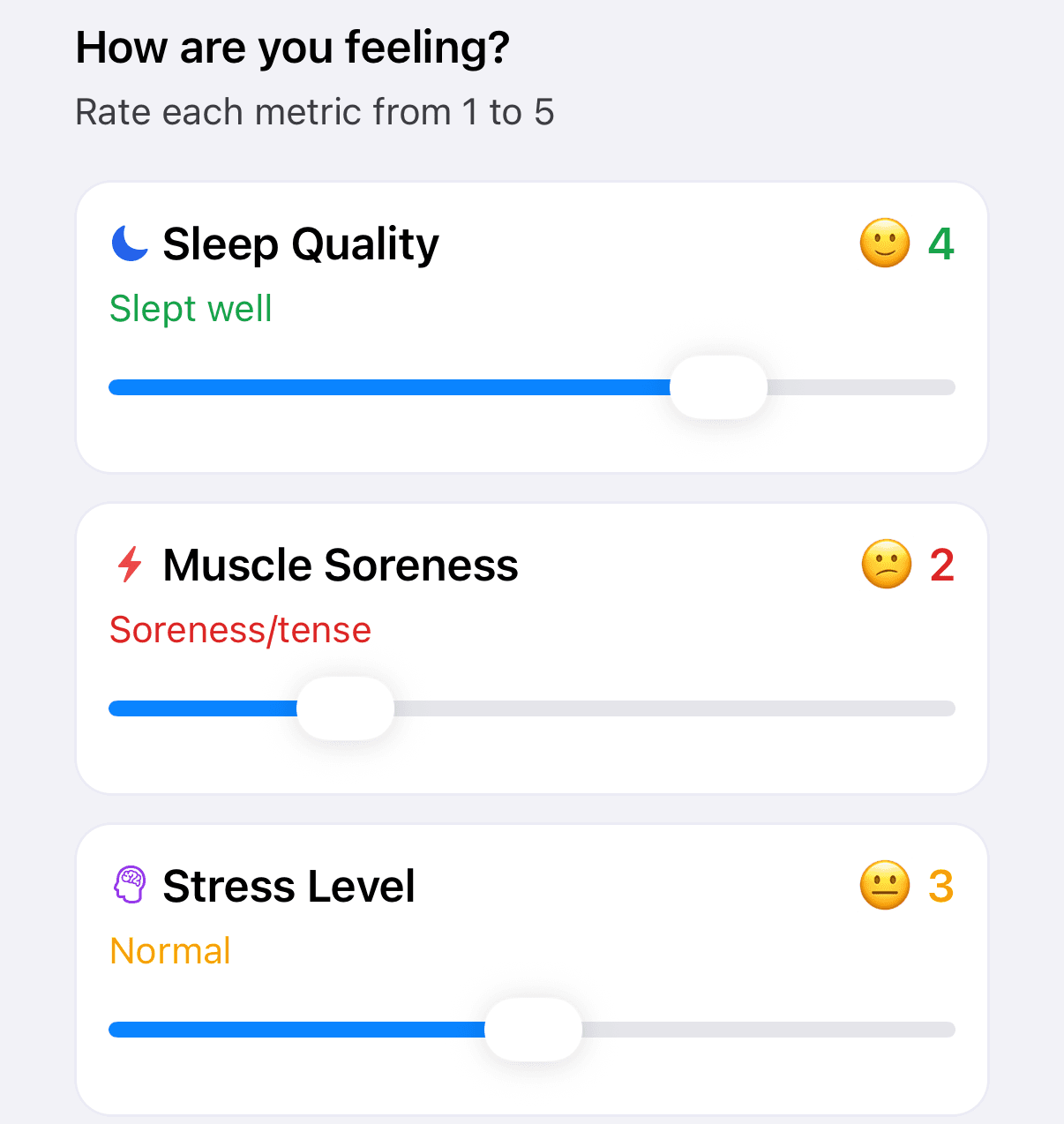
A daily wellness check in Fractall
Set the reminder time for the team. By default players get a reminder at 08:00 and a follow-up an hour later, on their own phone.
Players answer the five questions, and can mark sore spots on a body map, add a note, and, for female athletes, record menstruation.
In response monitoring, see who hasn't answered and send them a reminder with one click.
Read the team's wellness next to session RPE and training load, with any answer below 3 flagged.
Enter answers for a player yourself when someone fills it in on paper or tells you in person.
What Fractall doesn't do yet
- The questions are fixed. You can't add, remove or reword them, and there is no Hooper option.
- The total is shown in fixed bands (20 and above, 16 to 19, 12 to 15, below 12), and single answers below 3 are flagged. It doesn't compare a player with their own normal the way the free Sheet does. Export to CSV to run that comparison yourself.
- Flags show on the dashboard. Fractall doesn't send the coach an alert when a score drops.
- Submitting needs a connection. A player without signal answers once back online.
- Each answer starts at a set value, so a player who submits without moving a slider records an answer they didn't pick. Ask players to set every slider.
- There is one check per player per day. Answering again replaces the first one.
- You can't import answers from a Google Form, so the baseline starts again when you move over.
Put wellness next to training load
Players answer the same five questions in the app, you see who hasn't answered, and wellness sits beside session RPE and load. The first month is free.
Limits
What this guide can't tell you
Small studies, unvalidated questions, and an example player who doesn't exist.
FAQs
Frequently asked questions
What coaches ask before they start a daily wellness check.
What questions should a football wellness questionnaire include?
How do you score a wellness questionnaire?
What is the Hooper index?
Can I use Google Forms for a wellness questionnaire?
What app can my players use to fill in a daily wellness questionnaire on their phone?
Related guides
Two Games a Week: What Wellness Data Shows Before Match 2
Fractall data on football teams playing two games a week: on match morning, fatigue sits less than half as far above normal. How to read wellness between games.
Winter Break Training Plan for Football S&C Coaches
Winter break training plan for football: what two weeks off costs, the minimum to prescribe at home, and how to log it so January ACWR stays honest.
When Athletes Submit Wellness and RPE: 5,605 Check-Ins
Fractall platform data from 631 athletes at 32 clubs. Wellness peaks at 08:00, sRPE after 17:00, and the median athlete-week holds two check-in days.