

How to Prevent Football Injuries Without GPS
A no-hardware weekly workflow to spot rising injury risk early using sRPE load, ACWR, and wellness check-ins: the two signals elite club medics already rank highest.
Updated first published
The problem
Most non-contact soft-tissue injuries follow a load spike you can see coming
Hamstrings, groins, and calves rarely fail at random. The common thread is a sudden jump in workload that outpaces what the player is currently prepared for, and that jump is measurable without any hardware.
Quick answer
ES 0.77
ACWR above ~1.3
Pooled effect size linking high acute:chronic load to greater injury probability across 22 studies.
2nd
Most-valued tool
Elite club medics rank wellness questionnaires the second most important injury-prevention monitoring tool, and they use no hardware.
The two signals
The two early-warning signals that need no hardware
Both are subjective and athlete-reported, which is why they work for clubs without GPS. Used together, they cover the objective side (how much load) and the human side (how the body is coping).
1. sRPE training load
RPE multiplied by session duration in minutes, summed over time. From this you derive ACWR (this week vs the recent base), monotony (how varied the week is), and strain (load × monotony).
Example: A 75-minute session at RPE 6 = 450 AU. Sum the week, compare to the 21-day base.
2. Daily wellness check-in
A 30-second self-report on sleep, fatigue, soreness, stress, and mood. It captures how the player is coping with load, often before performance or load data shows a problem.
Example: A 3-day slide in sleep and a jump in muscle soreness is a flag, even if load looks normal.
Why both, not one
The system
The weekly no-hardware injury-prevention workflow
This is the routine an S&C coach can run from Monday to matchday with nothing but a phone in each player's hand. The point is consistency: the signals are only as good as the habit behind them.
- 1
Collect daily (athletes, 30 seconds)
Players log sRPE after every session and a short wellness check-in each morning. Consistency matters more than precision: same scale, every day.
- 2
Scan the squad each morning (you, 5 minutes)
Look for two things: load spikes (ACWR drifting above ~1.3, or a sharp rise in strain/monotony) and wellness drops (a 2–3 day slide in sleep, fatigue, or soreness).
- 3
Cross-check flagged players
When load and wellness disagree, open the individual. Has the player changed role, returned from absence, or stacked match minutes? Context decides whether a flag is real.
- 4
Act before matchday
Adjust volume, add recovery, modify a drill, or involve medical staff. The whole value of an early signal is that you still have time to use it.
| Signal pattern | What it usually means | Coach response |
|---|---|---|
| ACWR ~0.8–1.3, wellness stable | Load is close to the recent base and the player is coping. | Continue as planned; keep monitoring. |
| ACWR rising above ~1.3, wellness stable | Workload is spiking faster than the recent base. | Check context, consider capping volume or adding recovery this week. |
| ACWR normal, wellness sliding 2–3 days | Under-recovery the load number hasn't caught yet. | Ask the player, review sleep/soreness, lighten load if it persists. |
| ACWR spiking AND wellness dropping | Highest-priority combination: dose up, response down. | Reduce load, prioritise recovery, flag to medical staff. |
| ACWR below ~0.8 for weeks | Detraining: the base is eroding and future exposure gets riskier. | Rebuild load gradually rather than jumping back to full volume. |
Make the habit stick
- Same RPE scale and the same wellness questions every day.
- Capture load for matches too, not just training.
- Review at a fixed time each morning so flags are acted on, not missed.
- Read every flag against the player's role, history, and minutes.
- Treat thresholds as conversation starters, not automatic decisions.
Players coming back from injury
This group is most exposed to load spikes because their chronic base has dropped. Rebuild gradually and watch ACWR and soreness together, because a normal-looking week can still be a big jump for them.
Honesty
What this approach can and cannot do
No monitoring system prevents injuries by itself. These signals lower risk by catching avoidable load errors early. They do not predict the next hamstring strain.
Mistakes to avoid
- Treating a high ACWR as a guaranteed injury.
- Acting on a single day of poor wellness without a trend.
- Using one universal threshold for every player.
- Ignoring missing data, because gaps quietly break the ratios.
- Replacing coaching judgement with a number.
Fractall workflow
How Fractall runs this workflow without hardware
The hard part of this system is not the theory. It is collecting clean data daily and reading load beside wellness without building another spreadsheet. That is exactly what Fractall automates.
1. Load signals from sRPE
ACWR, monotony, and strain are calculated automatically from sRPE, with no GPS required.
2. Wellness beside load
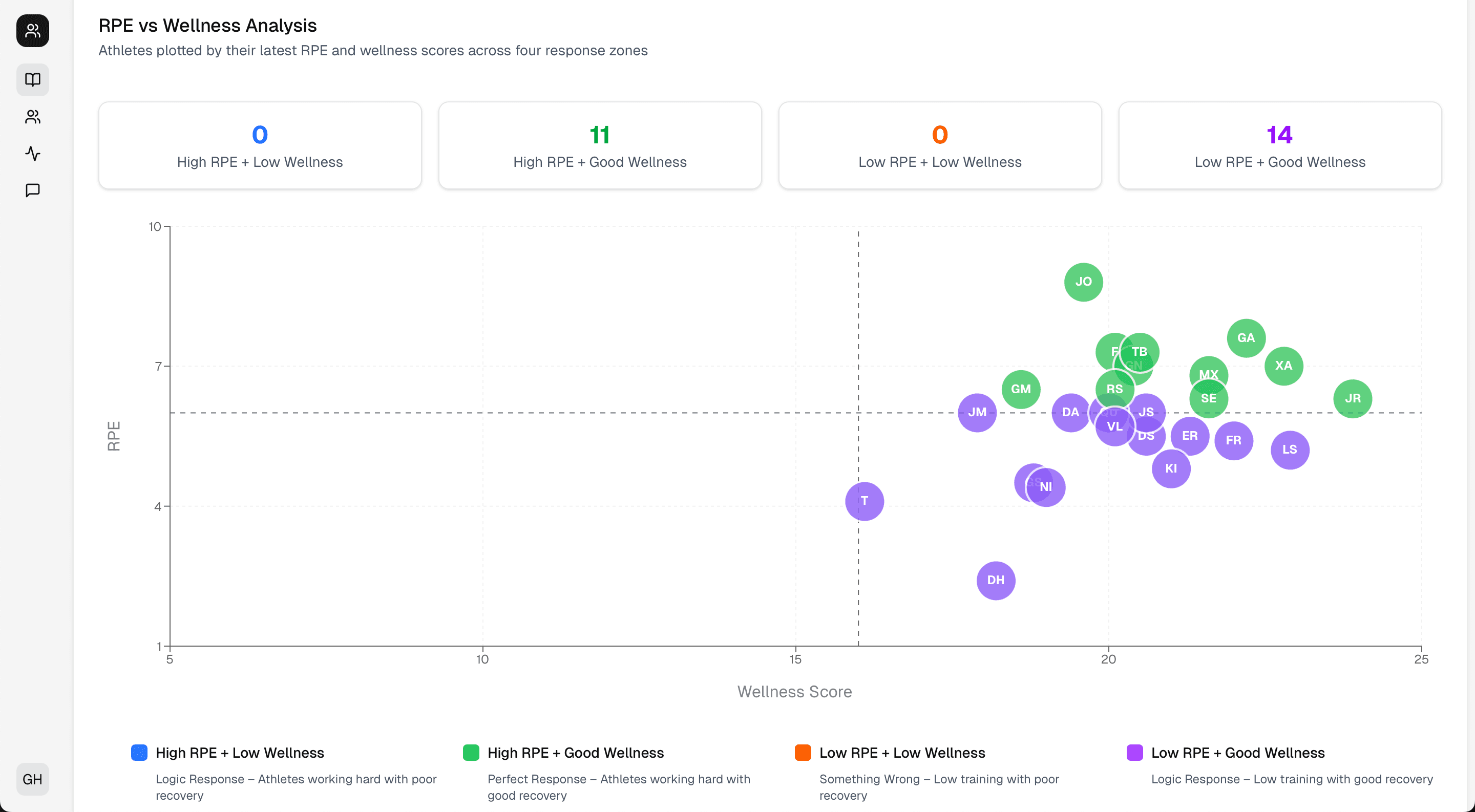
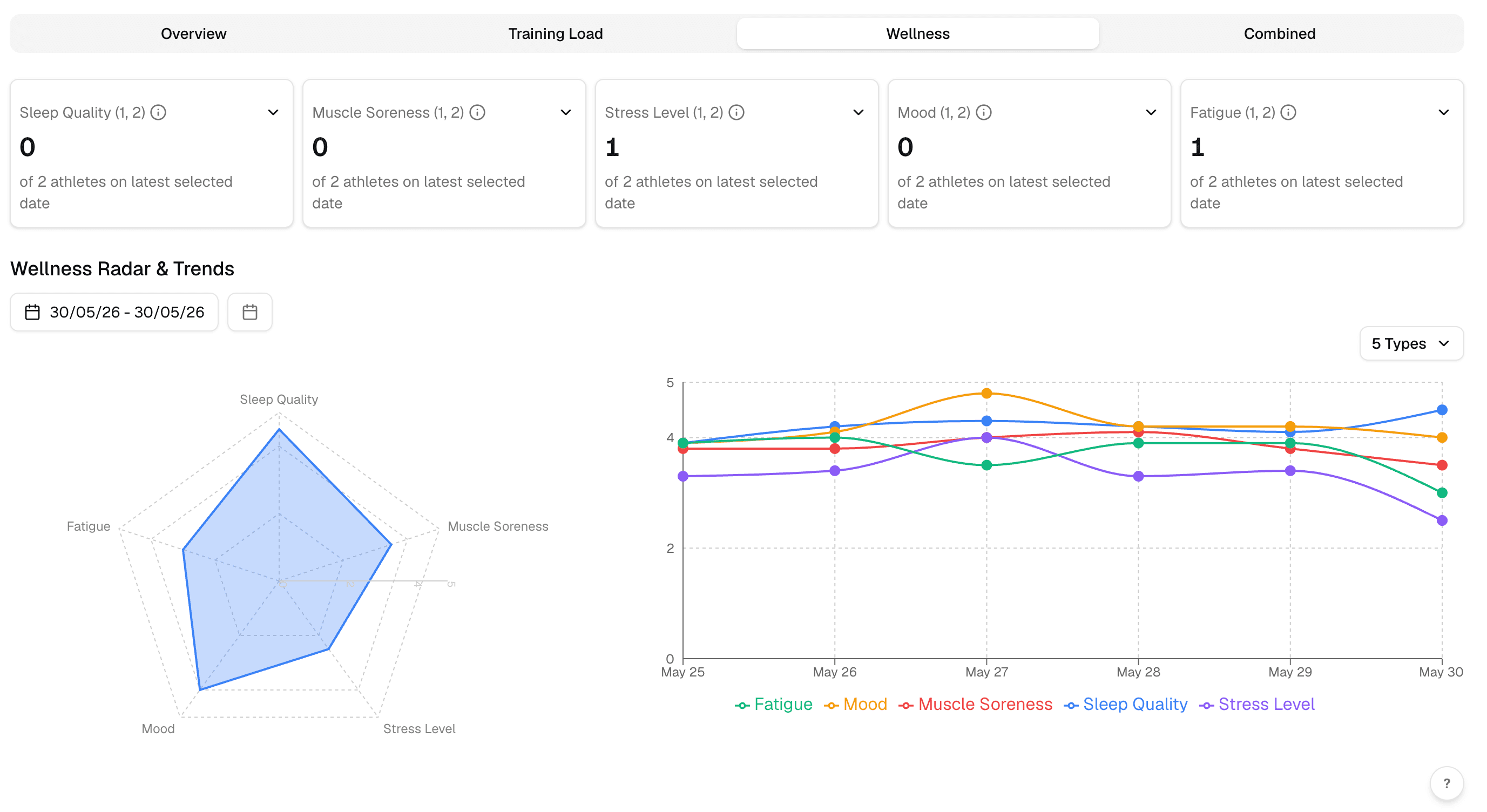
Sleep, fatigue, soreness, and pain sit next to the load chart so flags are read in context.
3. Athlete-level drill-down
Move from the squad scan to the individual players who need a closer conversation.
The same weekly rhythm, automated
Athletes log sRPE and a wellness check-in from their phone.
Fractall computes ACWR, monotony, strain, and wellness trends.
You scan the squad, open the flagged players, and decide before matchday.
Track load and wellness in one place
See how Fractall turns daily sRPE and wellness check-ins into the early-warning signals in this guide. No GPS, no spreadsheet.
FAQs
Injury-prevention questions coaches ask most
Practical guardrails, not universal laws.
Can you prevent injuries without GPS or wearables?
You can meaningfully lower avoidable soft-tissue risk without them. sRPE load and daily wellness check-ins, both hardware-free, are the signals elite club medics rely on most for injury prevention.
Example: GPS adds an external-load layer later, but it is not the starting point.
What ACWR range is considered higher risk?
Research associates ratios outside roughly 0.8–1.3 with higher injury probability, with risk rising above ~1.3. But thresholds are not guarantees, so read them with player context.
Example: A 1.4 spike on a return-to-play athlete matters more than 1.3 on a settled starter.
How is wellness data useful if it's subjective?
Subjectivity is its strength. Self-reported wellness is sensitive to daily load changes and often flags under-recovery before objective markers do, as long as reporting is honest and consistent.
Example: A 3-day slide in sleep and soreness is a flag worth a conversation.
How often should we review the data?
Daily for a quick squad scan, weekly for the bigger load picture. The value is acting on a flag before matchday, which only works if someone looks regularly.
Example: A fixed 5-minute morning scan beats an occasional long review.
Start spotting injury risk earlier
Fractall collects sRPE and wellness, computes ACWR, monotony, and strain, and shows load beside recovery, with no hardware required. Start free for your first month.
Related guides
Two Games a Week: What Wellness Data Shows Before Match 2
Fractall data on football teams playing two games a week: on match morning, fatigue sits less than half as far above normal. How to read wellness between games.
ChatGPT and Claude for Strength and Conditioning Coaches
What an S&C coach can ask ChatGPT or Claude about squad load, wellness and injuries, and the privacy settings to change before any athlete data goes in.
CMJ Test: Protocol, Norms and Why Devices Disagree
The same countermovement jump reads nearly 7 cm apart on a force plate, a phone app and a sensor. Triple the U16 to U18 gap. The protocol and the norms.