

Best Athlete Load Monitoring Tools (2026)
Compare five athlete load monitoring tools by pricing, hardware, and honest pros and cons, and find the right fit for your club's budget.
Published
Quick answer
Before you shortlist
How to compare athlete load monitoring tools
The market spans €16.67/month phone-based tools and six-figure enterprise contracts. Most of the noise comes from comparing tools built for completely different clubs. Score every option against these five questions first.
- 1
1. Hardware or no hardware?
GPS pods and wearables give you external-load data but add cost, charging, and logistics. Internal load (sRPE) and wellness need only a phone. Decide whether you actually need external load before you pay for it.
- 2
2. Is the pricing transparent?
If you cannot see a price without a sales call, assume the tool is sold to bigger budgets than yours. Quote-only pricing is normal at the enterprise end and a real friction point for small clubs.
- 3
3. Can you trial it with your own athletes?
A genuine free trial tells you whether your squad will actually submit data day after day. A demo with a salesperson does not.
- 4
4. Who is it built for?
Enterprise platforms assume a sports-science department and a season of clean data. Small-club tools assume one coach with five minutes. Match the tool to the club you run, not the club you watch on TV.
- 5
5. Are the metrics evidence-backed?
sRPE, ACWR, monotony, and strain are established, research-grounded methods. Be wary of bespoke 'scores' you cannot interpret or trust.
1. Best for small & medium clubs
Fractall
No-hardware sports intelligence built specifically for small-to-medium clubs, with the only transparent pricing in this list.
Works well for
- Transparent pricing from €16.67/month per team, the only published price in this list
- No hardware: training load, ACWR, and wellness from a phone
- Imports GPS files from Catapult, STATSports, Oliver Sports, WIMU and Vert
- 1-month free trial, no credit card, so you test it with your real squad
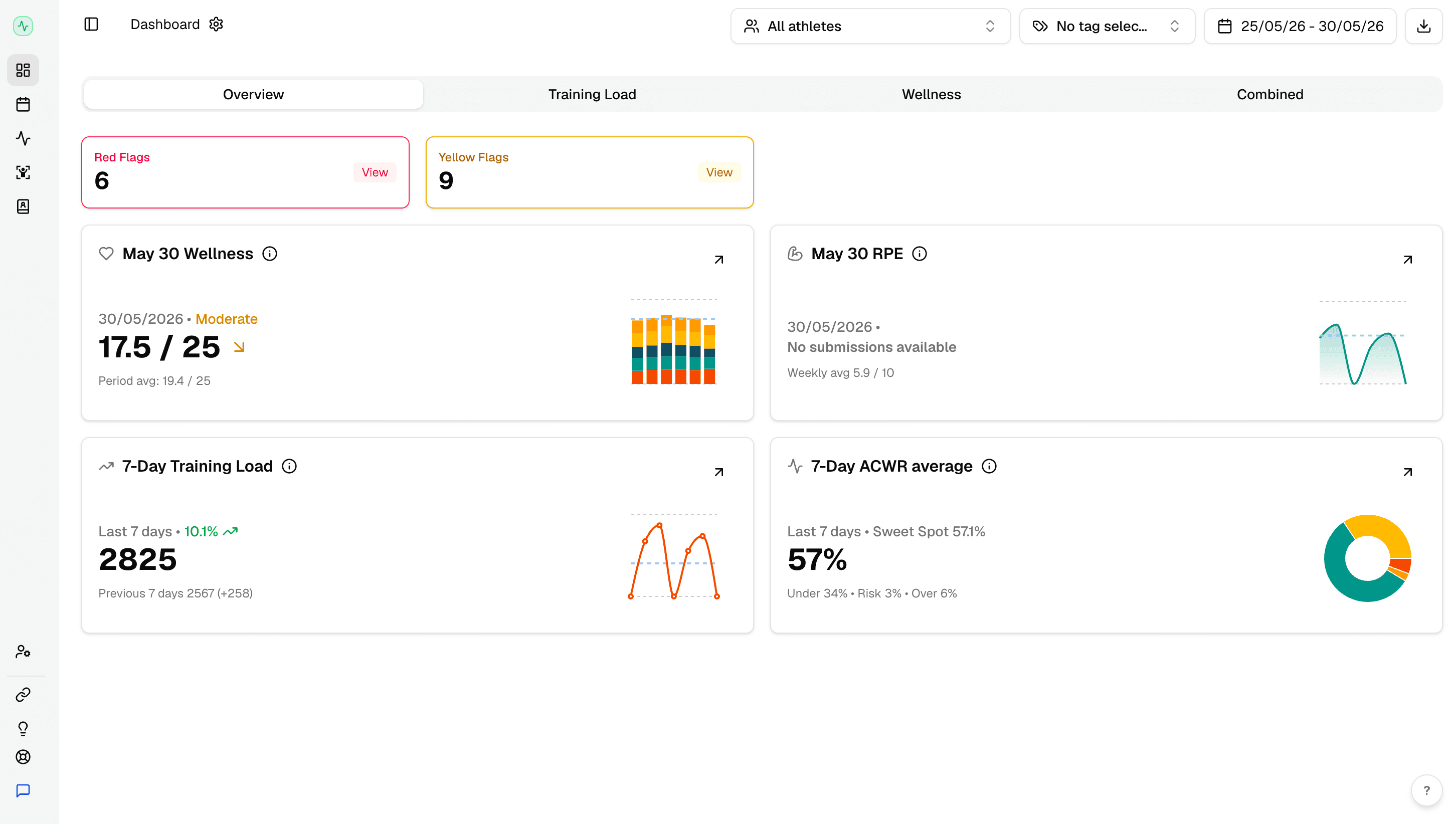
- Setup in minutes; dashboards a coach can read in under five minutes
- Evidence-backed metrics: sRPE, ACWR, monotony, strain
Watch out for
- Newer and smaller than the established enterprise names
- Doesn't sell GPS hardware; external load comes from importing your own vests' files, not a live feed
- Focused on load and wellness, not deep medical/EHR records
- Fewer third-party integrations than enterprise platforms
From zero to a monitored squad in three steps
Create a team, invite your athletes, and schedule your first session, self-serve, the same day.
Athletes submit sRPE after sessions and a daily wellness check-in from the mobile app.
You read auto-calculated load, ACWR, and wellness on the dashboard, and export a PDF report for staff.
2. Simple wellness & readiness
Metrifit
A no-hardware athlete monitoring system focused on daily wellbeing, sRPE, and a readiness-to-perform score.
Works well for
- No hardware: phone questionnaire plus sRPE
- Simple, well-developed mobile experience for athletes
- Covers wellness, sRPE load, ACWR, and a readiness score
- 14-day free trial available
- Positions itself for budget-conscious schools and clubs
Watch out for
- Pricing is quote-only, with no public team price
- Smaller, less visible product with little independent review coverage
- Wearable/GPS integrations are not publicly documented
3. Full sports-medicine AMS
AthleteMonitoring
A broad athlete management system from FITSTATS Technologies, strong on sports medicine, injury surveillance, and customization.
Works well for
- No hardware required; can optionally import wearable/GPS data
- Covers a lot: wellness, load, injury and medical records, testing
- Highly customizable forms, metrics, and interface
- Strong sports-medicine and injury-surveillance depth
Watch out for
- Quote-only pricing with no advertised self-serve free trial
- Breadth brings complexity, and can be overkill for a coaching-only setup
- Thin independent review footprint to validate against
4. Enterprise intelligence platform
Kitman Labs
An enterprise performance-intelligence platform that unifies performance, medical, and operations data for elite organizations.
Works well for
- Unifies performance, medical, and operations data in one platform
- No proprietary hardware; 150+ third-party integrations
- Machine-learning injury-risk model trained on your own data
- Trusted by elite clubs, leagues, and federations
Watch out for
- Enterprise quote-only pricing, annual contracts, and paid onboarding
- Needs data maturity: roughly a season of structured data to add value
- Overkill and out of budget for most small and medium clubs
- Some users report rigidity and limited customization
5. Elite GPS hardware
Catapult
The gold standard for GPS/wearable external-load data, and the only tool here that requires you to buy hardware.
Works well for
- Gold-standard, validated GPS/wearable external-load data
- Live in-session tracking during training and matches
- Integrates video analysis with physical metrics
- Used by thousands of elite teams across 40+ sports
Watch out for
- Requires buying and managing hardware: pods, docks, receivers
- Elite tier is quote-only and expensive for a small budget
- Steep learning curve and complex UI reported by users
- Focused on external/physical load, not subjective wellness or sRPE
Side by side
Athlete load monitoring tools compared
The same category, very different buyers. Map your situation to the right row before you shortlist.
| Tool | Pricing & trial | Hardware & best fit |
|---|---|---|
| Fractall | From €16.67/month per team; 1-month free trial | No hardware. Small & medium clubs |
| Metrifit | Quote-only; 14-day free trial | No hardware. Schools & budget clubs |
| AthleteMonitoring | Quote-only; demo, no self-serve trial | No hardware. Elite & sports-medicine orgs |
| Kitman Labs | Enterprise quote; annual contract | No hardware (150+ integrations). Pro clubs & federations |
| Catapult | Quote-only (elite); ~$179/yr consumer tier | GPS hardware required. Elite & pro teams |
FAQs
Common questions about athlete load monitoring tools
What is the best athlete load monitoring tool?
Do I need GPS hardware to monitor training load?
Which athlete monitoring tools publish their pricing?
What is the cheapest athlete load monitoring tool?
Is ACWR enough to prevent injuries?
See your squad's load and wellness in one dashboard
Start a 1-month free trial. No hardware, no credit card, set up in minutes. Put your own athletes' data into Fractall and decide from there.
Hear from coaches already using Fractall
Coaches, physios, and players describe how Fractall changed the way they manage load, recovery, and injury risk.
Related guides
Two Games a Week: What Wellness Data Shows Before Match 2
Fractall data on football teams playing two games a week: on match morning, fatigue sits less than half as far above normal. How to read wellness between games.
ChatGPT and Claude for Strength and Conditioning Coaches
What an S&C coach can ask ChatGPT or Claude about squad load, wellness and injuries, and the privacy settings to change before any athlete data goes in.
CMJ Test: Protocol, Norms and Why Devices Disagree
The same countermovement jump reads nearly 7 cm apart on a force plate, a phone app and a sensor. Triple the U16 to U18 gap. The protocol and the norms.