

Athlete Monitoring Software for Small Clubs (2026 Guide)
Choosing athlete monitoring software for a small club? The six criteria that matter — no hardware, fair pricing, fast setup — and how to shortlist with confidence.
Published
Quick answer
Why this is hard
Small clubs keep getting sold tools built for someone else
The athlete monitoring market was built around elite clubs: hardware bundles, GPS units, enterprise contracts, and onboarding calls. If you run a small or medium club, that model fights you on price, setup, and complexity.
€200–500
Typical monthly cost of enterprise tools
Most are quote-based, so the real number only appears after a sales call.
0
Hardware a small club should need to start
Internal load (sRPE) and wellness require no GPS units or wearables.
<5 min
How long a coach should spend reading a dashboard
If a tool needs an analyst to interpret it, it is built for the wrong club.
The test that matters
The shortlist filter
What to look for in athlete monitoring software for a small club
Score every tool you consider against these six criteria. They are ordered by how often they decide whether a club keeps using the software after month one.
- 1
1. No hardware required to start
You should be able to monitor training load and wellness from a phone, with no GPS units or wearables to buy, charge, or manage. Hardware is where small-club budgets and adoption go to die.
- 2
2. Transparent, club-sized pricing
If you cannot see the price without a sales call, assume it is not built for you. Look for a clear per-team monthly price you can defend to a board.
- 3
3. Setup in minutes, not onboarding projects
You should be able to create a team, invite athletes, and schedule a session the same day — without a paid implementation call.
- 4
4. Dashboards a coach can read in under five minutes
The output has to be legible to a head coach, not just an analyst. Clear load, wellness, and risk views beat a dense data lake nobody opens.
- 5
5. Evidence-backed metrics, not vanity numbers
sRPE, internal load, ACWR, monotony, and strain are established, research-grounded methods. Be wary of bespoke 'scores' you cannot interpret or trust.
- 6
6. A real trial before you commit
You need to see your own athletes' data in the tool before paying. A genuine free trial — ideally without a credit card — tells you whether your squad will actually submit data.
Internal vs external load
External load is what the athlete does (distance, sprints) and usually needs GPS. Internal load is how the body responds (effort, fatigue) and can be captured with sRPE — no hardware.
Example: A small club can monitor internal load and ACWR from sRPE alone, then add GPS later if budget allows.
Side by side
Small-club needs vs. enterprise athlete monitoring tools
The same category, two different buyers. Map your situation to the right column before you shortlist.
| Decision factor | Enterprise assumption | What a small club needs |
|---|---|---|
| Hardware | GPS units / wearables per athlete | Phone-based sRPE + wellness, no hardware |
| Pricing | Quote-based, €200–500/month | Transparent per-team price |
| Setup | Implementation project + training | Self-serve, live the same day |
| Staffing | Dedicated sports scientist/analyst | One coach, dashboards under 5 min |
| Metrics | Large external-load datasets | sRPE, ACWR, wellness, monotony, strain |
| Trial | Paid pilot or annual contract | Free trial, no credit card |
Red flags that a tool is not built for your club
- No price listed anywhere on the site
- A mandatory hardware purchase to get any data
- A required onboarding or implementation fee
- Dashboards that need an analyst to explain them
- No way to trial it with your own athletes first
A worked example
How Fractall maps to the six criteria
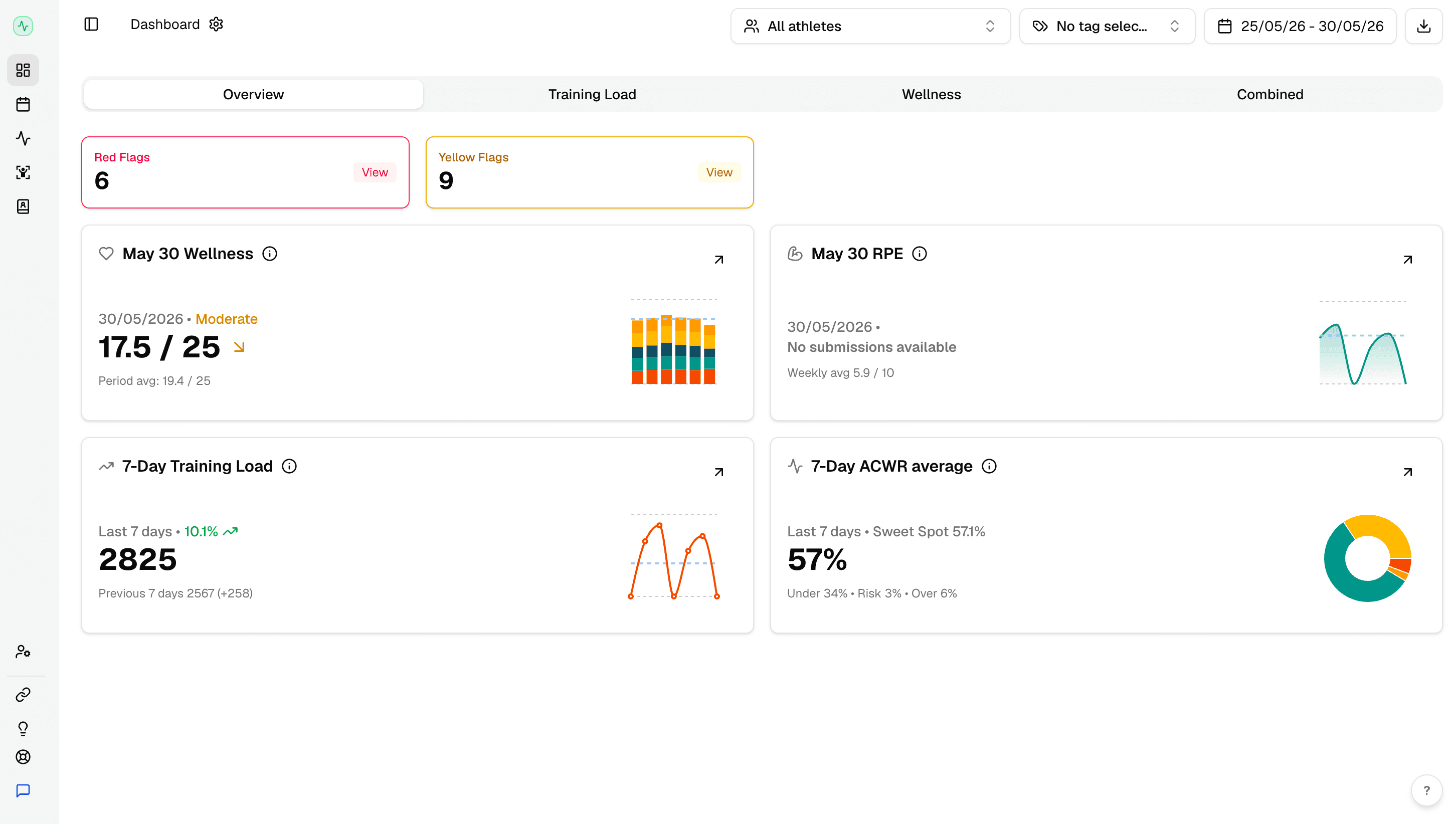
Fractall was built specifically for the small-and-medium-club buyer, so it is a useful reference for what each criterion looks like in practice.
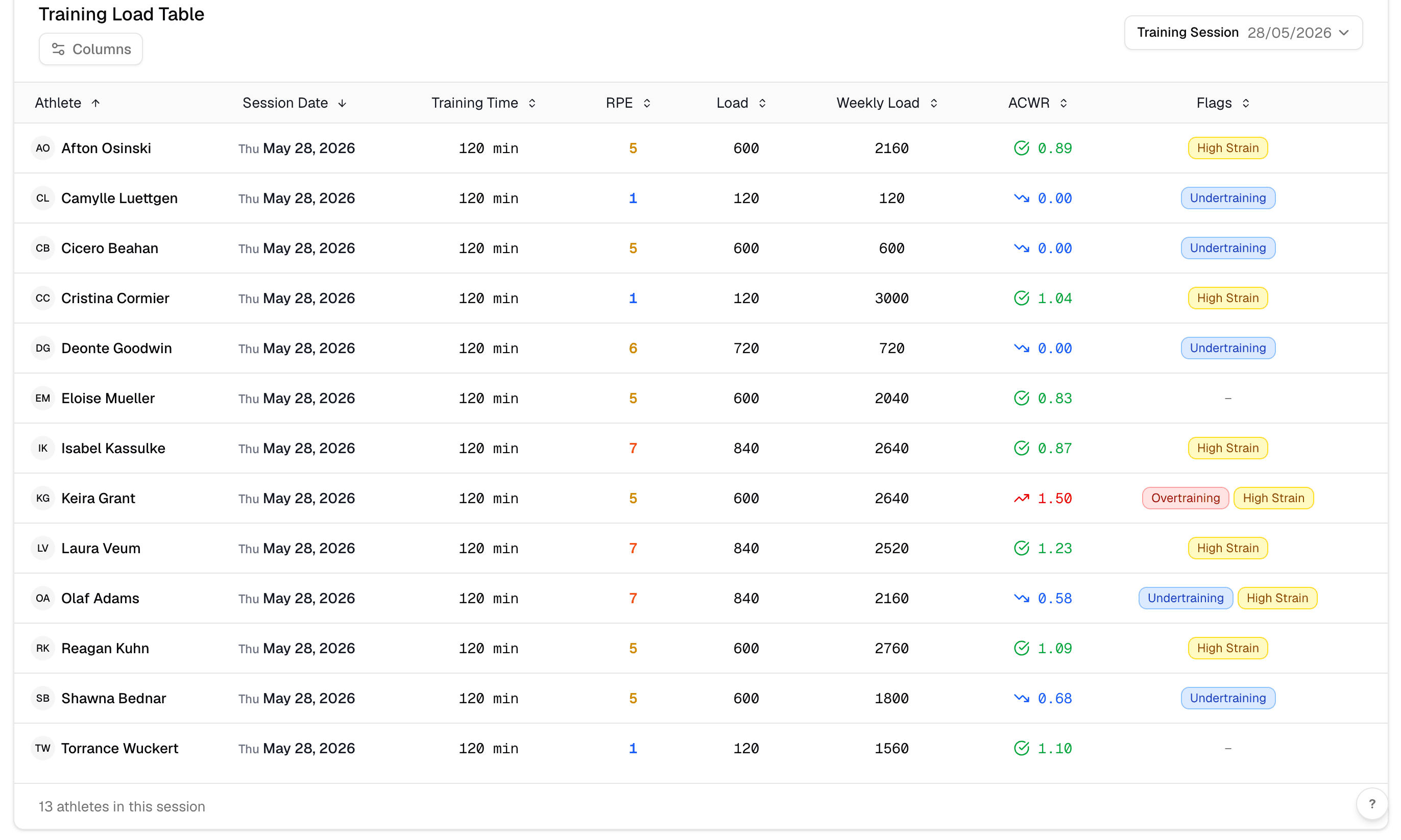
1. No hardware in the loop
Every number here is derived from athletes submitting sRPE on their phones — no GPS units required.
2. Readable at a glance
Load, ACWR, monotony, and strain sit in one table a coach can scan in under five minutes.
3. Evidence-backed metrics
ACWR, monotony, and strain are established internal-load methods — monitoring aids that support, not replace, coaching judgement.
From zero to a monitored squad in three steps
Create a team, invite your athletes, and schedule your first session — self-serve, the same day.
Athletes submit sRPE after sessions and a daily wellness check-in from the mobile app.
You read auto-calculated load, ACWR, and wellness on the dashboard, and export a PDF report for staff.
FAQs
Common questions when choosing monitoring software
Do I need GPS or wearables to monitor my athletes?
No. You can monitor internal training load, ACWR, and wellness using sRPE and daily check-ins from a phone. GPS adds external-load detail but is optional, and is usually the most expensive part of a setup.
How much should athlete monitoring software cost a small club?
Enterprise tools commonly run €200–500/month and are often quote-based. Small-club-focused tools are far cheaper — Fractall, for example, starts at €16.67/month per team with transparent pricing.
Will my coaches and athletes actually use it?
Adoption depends on simplicity: phone-based data entry for athletes and dashboards a coach can read in minutes. This is why a genuine free trial matters — you find out whether your squad submits data before you pay.
Is ACWR enough to prevent injuries?
ACWR is a monitoring aid, not an injury predictor. It helps you spot spikes in load relative to what an athlete is prepared for, so you can ask better questions — the coaching decision stays with you.
See your squad's load and wellness in one dashboard
Start a 1-month free trial — no hardware, no credit card, set up in minutes. Put your own athletes' data into Fractall and decide from there.
Related guides
Winter Break Training Plan for Football S&C Coaches
Winter break training plan for football: what two weeks off costs, the minimum to prescribe at home, and how to log it so January ACWR stays honest.
Two Games a Week: What Wellness Data Shows Before Match 2
Fractall data on football teams playing two games a week: on match morning, fatigue sits less than half as far above normal. How to read wellness between games.
ChatGPT and Claude for Strength and Conditioning Coaches
What an S&C coach can ask ChatGPT or Claude about squad load, wellness and injuries, and the privacy settings to change before any athlete data goes in.