

Cheapest Training Load Monitoring Software Without GPS
Compare the cheapest ways to monitor training load without buying GPS hardware: spreadsheets, sRPE software, broader S&C tools, quote-only platforms, and GPS-device contrast.
Updated first published
Quick answer
Budget reality
What counts as cheap training load monitoring software?
Cheap can mean free cash cost, low monthly software cost, or low total admin cost. Those are different answers.
| Route | Public price anchor | Cost and UX caveat |
|---|---|---|
| Spreadsheet + form | EUR0/month for the core spreadsheet and form workflow | Free in cash, but you pay in reminders, formula checks, reporting time, and coach fatigue |
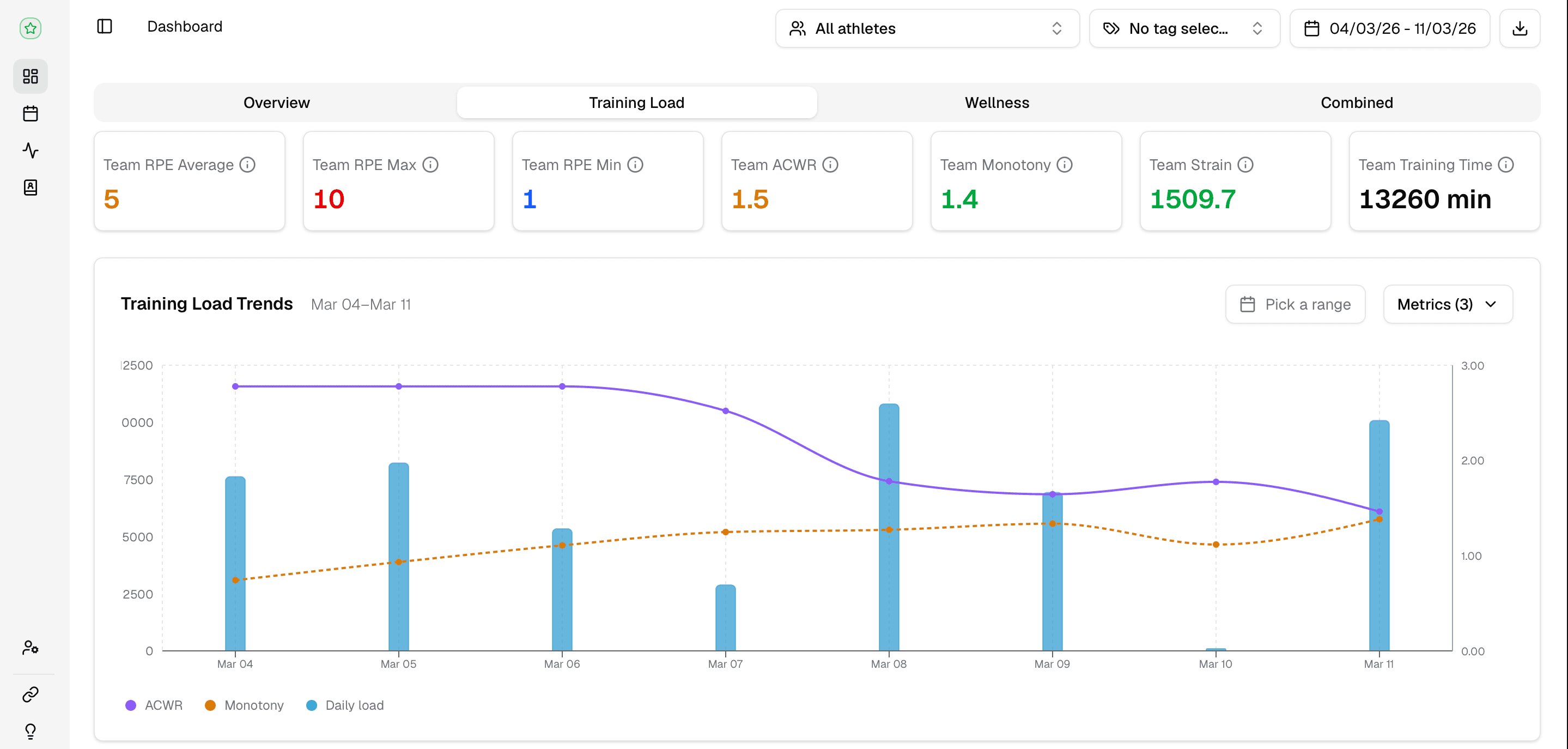
| Fractall.fit | EUR20/team/month monthly, or EUR16.67/team/month billed annually; 1-month free trial | Easiest coach workflow in this group: mobile sRPE, wellness, compliance, ACWR, monotony, strain, reports, and GPS import dashboards in one place |
| sRPE calculators and spreadsheet templates | Often EUR0/month or low-cost | Good for learning the method, but not a complete squad workflow with reminders, compliance, roles, and reports |
| CoachMePlus Strength | $1,000/year public entry plan | Broader S&C platform; useful check-ins, but heavier UI/setup if your main job is simple load monitoring |
| TeamBuildr Strength + AMS | $90/month starting Strength plan; AMS add-on listed at $50/month | Strong S&C category fit, but verify the load-monitoring dashboard flow and how many steps coaches need each week |
| Quote-only AMS platforms | No public number; request a quote | Cannot be ranked as cheapest from public information alone, and enterprise UX can be too broad for a small coach workflow |
| GPS device systems | Catapult One Team listed at $180/player/year with a 2-year commitment | Useful external-load collection, but this is a hardware route, not the cheapest no-new-hardware answer |
1. Lowest cash cost
Spreadsheet plus sRPE is the cheapest starting point
If the only constraint is cash, Excel or Google Sheets wins. The question is how long it stays cheap once the season starts.
Works well for
- Lowest cash cost
- Easy to understand and customize
- Good way to teach staff the basics of internal load
Watch out for
- Athlete compliance is manual to chase
- ACWR, monotony, strain, and reports depend on fragile formulas
- Harder to manage multiple teams, roles, and date ranges
- Mobile athlete submission is usually patched together with forms
- You become the UX: reminders, cleanup, charts, and staff reports all depend on you
2. Cheapest credible software route
Fractall.fit: low-cost load software with public pricing
Fractall.fit is the budget step up from spreadsheets when you want automation without buying new GPS hardware.
- 1
1. Use phones for sRPE and wellness
Athletes submit sRPE and wellness from the mobile app. No pods, vests, docks, charging, or GPS setup is needed for internal load.
- 2
2. Let the software calculate the workload
Fractall.fit calculates session load, weekly load, ACWR, monotony, and strain automatically.
- 3
3. Keep the coach workflow simple
The coach dashboard shows compliance, load, wellness, red flags, and reports without asking staff to rebuild charts every week.
- 4
4. Import GPS when you already have it
If GPS data already exists, Fractall.fit can help you visualize and analyze it instead of pushing that work back into Excel or Power BI.
3. Harder to compare
Quote-only platforms may be good, but they are not easy to call cheap
AthleteMonitoring, Kitman Labs, APEX Coach AI, and other platforms can fit real clubs. The problem is that hidden pricing makes a cheapest-page comparison less precise.
| Tool type | Why it may fit | Budget and UX caveat |
|---|---|---|
| AthleteMonitoring-style AMS | Broad workload, wellness, readiness, and health management | Likely more system and setup than a small club needs for only sRPE, wellness, and ACWR |
| Kitman-style enterprise platforms | Large-org intelligence across many data streams | Not a cheapest-first buying path for most small clubs, and the workflow is built for larger organizations |
| APEX-style data platforms | Unified data, AI reporting, and advanced performance workflows | Useful when you have many data streams, but public pricing and simple small-club UX should be verified |
4. Useful contrast
GPS is valuable, but it is not the cheapest no-new-hardware answer
Catapult and other GPS systems solve a different problem: device-based external-load collection.
Decision
When should you leave spreadsheets for software?
The cheapest option changes once admin time, compliance, and reporting start costing you decisions.
- 1
Stay with a spreadsheet if you have one team and strong compliance
Manual tracking is fine when the dataset is small, you own every step, and reports are occasional.
- 2
Move to software when athletes stop submitting consistently
Automated mobile collection and response tracking are often worth more than another spreadsheet formula.
- 3
Move to software when ACWR and reports become weekly work
If you are rebuilding load charts every week, software is no longer just a cost. It is a time-saving tool.
- 4
Move to software when the workflow feels tiring
Ease of use matters. The cheapest tool is not cheap if staff avoid it or you spend the week explaining the system.
FAQs
Common questions about cheap training load monitoring
Can I monitor training load without GPS?
Is Excel enough for training load monitoring?
What is the cheapest training load monitoring software with public pricing?
Why not just choose a quote-only platform?
Try load monitoring without buying GPS hardware
Start a 1-month Fractall.fit trial and collect sRPE, wellness, ACWR, monotony, strain, reports, and GPS imports when relevant without spreadsheet work.
Related guides
Two Games a Week: What Wellness Data Shows Before Match 2
Fractall data on football teams playing two games a week: on match morning, fatigue sits less than half as far above normal. How to read wellness between games.
ChatGPT and Claude for Strength and Conditioning Coaches
What an S&C coach can ask ChatGPT or Claude about squad load, wellness and injuries, and the privacy settings to change before any athlete data goes in.
CMJ Test: Protocol, Norms and Why Devices Disagree
The same countermovement jump reads nearly 7 cm apart on a force plate, a phone app and a sensor. Triple the U16 to U18 gap. The protocol and the norms.