

4 Weeks Free Access (cancel anytime)
Interactive GuideInjury trackingRecord keepingWellness

Injury Tracking: What to Record When a Player Gets Injured

Injury tracking that still answers questions a season later: how to define the return-to-play date, classify a recurrence, and log the week before it happened.

Published
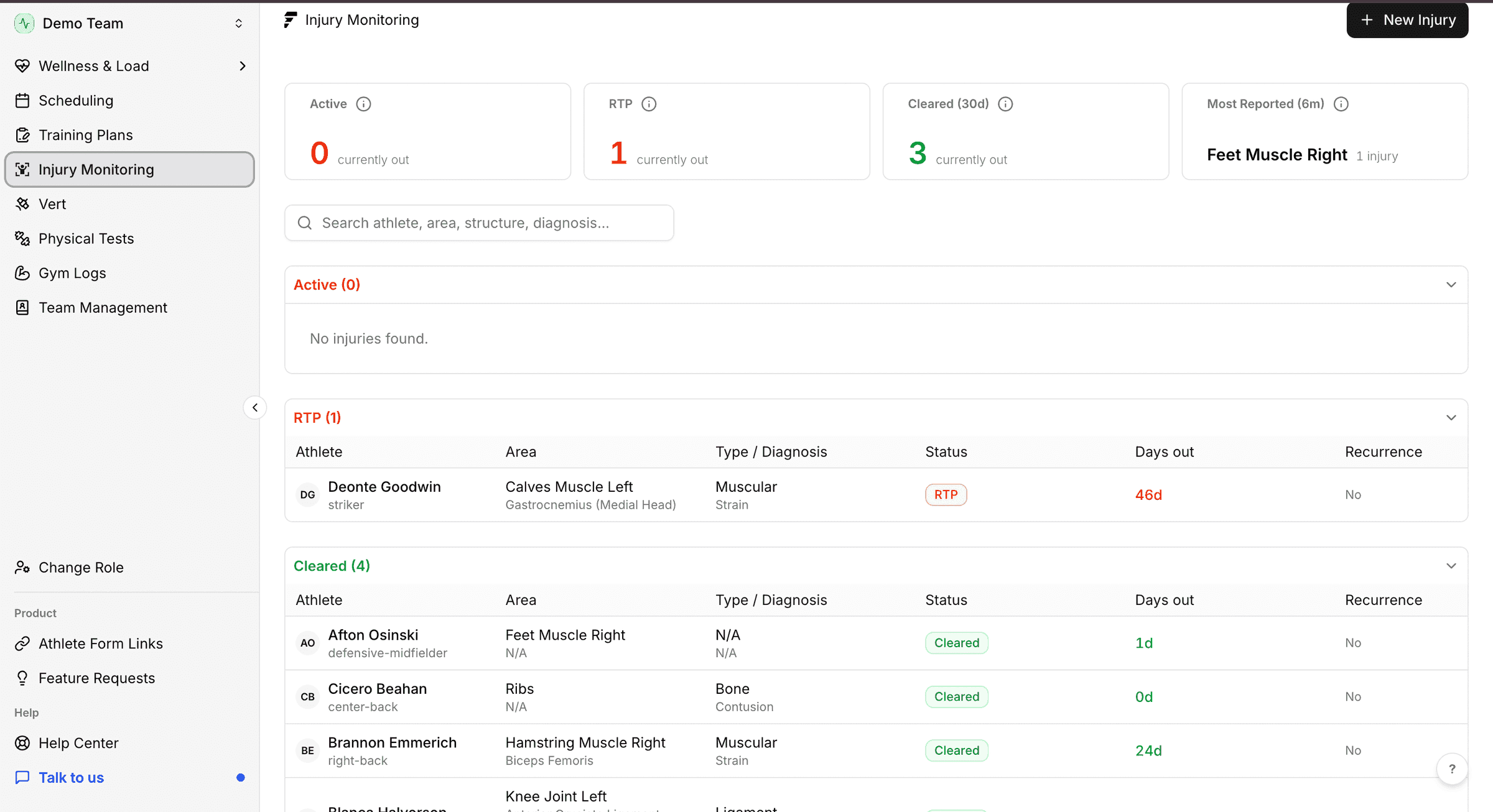
Fractall injury monitoring overview grouping injuries into active, return-to-play and cleared, with columns for athlete, body area, type and diagnosis, status, days out and recurrence

Injury tracking

What an injury record has to answer

Injury tracking works when the record answers the five questions it gets asked months later. Most logs are missing three of them.

Quick answer

An injury record earns its keep when it can answer five questions a season later. That takes five things: the date of onset, the body area, the date the player returned to full unrestricted team training, how this injury relates to any previous one at the same site, and the load and wellness data from the week before it happened. The 2023 football extension of the IOC consensus defines that return date precisely, which is what makes days lost comparable between two players, two seasons, or two clubs.
It's May. Your sporting director asks how many days the squad lost to hamstring injuries this season, and whether the one in February was the same problem as the one in November. You open the log. There's a date, the word “hamstring”, and a note that says back in training.
You can't answer either question. Not because you did the job badly, but because the record was built to note that something happened rather than to be read later. This guide works through the five questions an injury record gets asked months afterwards, and the field that answers each one. The definitions come from the IOC consensus on recording injury and illness data and its football-specific extension, translated for a club where the medical staff is one or two people who also have a day job.

Question one

How many days did we lose?

Days lost is the only severity measure most clubs can produce, and it is only reliable if both ends of the count are defined.

The start is straightforward: the date of onset, counted as day 0. The end is where records fall apart, because “back in training” covers everything from a light run to a full session. The football extension of the IOC consensus settles it.

Return to football

The date the injured player returns to full unrestricted team training, without modifications in duration and/or activities. If the player takes part in partial or full match play before returning to full team training, the date of that match is recorded instead. In periods without training or matches, use the date the player is considered medically cleared and available for full team training.

Example: A midfielder trains with modifications for eight days, then plays 20 minutes of a friendly before his first unrestricted session. The friendly date is his return date.

That definition does real work. Two physios with the same squad will produce the same number, which is the whole point of recording it. Group the results into the bins the football extension recommends: 0 days, 1 to 3, 4 to 7, 8 to 28, 29 to 90, 91 to 180, and over 180. They're deliberately finer than the general IOC bands, because a 45-day absence and a 200-day absence are not the same conversation with a head coach. And report the median with quartiles rather than the mean. Time-loss data is right-skewed, so one ACL turns a mean into a number that describes nobody.

The rule most clubs miss

Rehabilitation sessions don't count as training exposure. They're part of the injury's duration, not part of the training the player was available for. The football extension puts rehabilitation and pre-rehabilitation transition sessions outside training exposure for exactly this reason.

Record three dates, not one

  • Date of onset, counted as day 0 of the absence
  • Date of return to full unrestricted team training, with no modification to duration or activities
  • Date of any match played before that return, which replaces the return date if it comes first
Return-to-football definition and severity time bins: Waldén M, Mountjoy M, McCall A, et al. Football-specific extension of the IOC consensus statement: methods for recording and reporting of epidemiological data on injury and illness in sport 2020. British Journal of Sports Medicine 2023;57:1341–1350.

Question two

What did we lose them to?

Body area, tissue type and diagnosis, recorded at the level of detail the person filling in the form can actually support.

The IOC consensus makes a point here that saves small clubs a lot of bad data. When an injury is logged by an athlete, a coach, or anyone without clinical training, the record should be limited to body area. Reporting of tissue type and abnormality by non-clinicians isn't reliable enough to use. So the split writes itself. Whoever is there logs the date and the body area, and the physio completes tissue, diagnosis and mechanism afterwards.
For football, the extension separates hip and groin instead of treating them as one region. That matters, because adductor-related groin pain and iliopsoas injuries behave differently and get managed differently.
Then there's mechanism, and this is the field most logs skip. Record two things. Mode of onset, sudden or gradual. And what the player was doing at the moment a sudden-onset injury happened, from the extension's list: running, change of direction, kicking, heading, tackling or being tackled, landing, falling, controlling the ball, hit by the ball, collision, other, or unknown.

Why mechanism is worth the extra ten seconds

It's the only field on the form that can change what you do on the training pitch. Six hamstring injuries in a season is a number. Five of them in a sprint during the last twenty minutes of a session is a training design problem.
If you want a coding system rather than free text, OSIICS is free, maintained, and what the football extension recommends. Most clubs won't need it. A consistent body-area list and a mechanism field will carry you a long way before coding becomes the limiting factor.

Question three

Was this the same injury again?

This is the question a yes-or-no recurrence box cannot answer, and it is the one that tells you whether your rehab process is working.

The consensus splits it four ways, and each branch means something different for the club.

Re-injury

Same site, same type or diagnosis, and the player had fully recovered and returned to football before it happened again.

Example: Your rehab finished and the tissue failed anyway. Look at the return criteria.

Exacerbation

Same site, same type, but the player had not yet fully recovered. This is the same episode getting worse, not a new one.

Example: Counting it as a new injury inflates your season totals.

Subsequent local injury

Same site, different type or diagnosis.

Example: A knee ligament injury after patellar tendinopathy is not a recurrence of the tendinopathy.

Subsequent new injury

A different site entirely.

Example: Counts as its own index injury, with its own history.

The distinction between the first two is the useful one. A re-injury after a clean return points at the rehab endpoint or the return criteria. An exacerbation points at the player training through something that hadn't settled. Same body part, same diagnosis, two completely different problems to fix. Record the gap in days rather than sorting it into early, late or delayed buckets. Days keep the detail, and you can always bucket them later.

18%

Of hamstring injuries were recurrences

UEFA Elite Club Injury Study, 21 seasons, 54 teams, 14,057 injuries.

69%

Of those recurrences came within two months

Measured from the player's return to play, which is why the return date has to be defined.

24%

Of all injuries were hamstring injuries in 2021/22

Up from 12% in 2001/02, and 19% across the full 21-season period.

If your tool only offers a checkbox

Write the classification into the notes field as one word: reinjury, exacerbation, subsequent-local, or subsequent-new. It costs nothing at the time, and it's the difference between a countable field and a paragraph you have to reread in eight months. This works in any system, including a spreadsheet.
Recurrence figures: Ekstrand J, Bengtsson H, Waldén M, et al. Hamstring injury rates have increased during recent seasons and now constitute 24% of all injuries in men's professional football: the UEFA Elite Club Injury Study from 2001/02 to 2021/22. British Journal of Sports Medicine 2023;57(5):292–298. Subsequent-injury classification: Waldén et al. 2023, table 3.

Question four

What was the player carrying beforehand?

The week before an injury is data you already collect and almost certainly do not attach to the injury record.

If you're running session RPE and daily wellness check-ins, then at the moment a player gets injured you already have their ACWR, their weekly load in arbitrary units, their last few session RPEs, their fatigue, soreness, sleep quality, stress and mood scores, and any body-pain areas they flagged. All of it sits in a different tab from the injury, and by the time anyone thinks to look, the week has scrolled off the screen.
Attach it at the point of recording. A snapshot of the seven days before onset, stored with the injury.

What this does and does not give you

One injury with a high ACWR in the preceding week establishes nothing. Injuries are multifactorial, and a single case is a story rather than evidence. What the snapshot gives you is a defensible answer when someone asks what the player's week looked like, and across a season and thirty injuries, a pattern worth investigating.
It also catches the thing time-loss records structurally miss. A player who reports soreness in the same area for three weeks and never misses a session doesn't exist in a time-loss log at all. Overuse problems get under-counted by any system that only records absence, which is why the Oslo Sports Trauma Research Centre built a questionnaire that asks all athletes about complaints rather than waiting for someone to drop out. If you already run daily wellness and body-pain reporting, you're capturing that signal. Attaching it to the injury record is what makes it retrievable. There's more on the load side of this in our guide to reducing soft tissue injuries without hardware.

Question five

What can you actually compute at a small club?

Days lost, counts and proportions. Not incidence per 1000 hours.

Incidence rates need exact per-player exposure minutes for every training session and every match, separated into football-specific training, warm-up, strength and conditioning, and other, with rehabilitation excluded. That's the standard the consensus sets for research, and it's realistic for a club with a full-time analyst. For most clubs, attempting it produces estimates dressed up as measurements.
Days lost, injury counts by body area, and the proportion that were recurrences are all computable from a well-kept log, and they're enough to run a season review. Report absolute numbers alongside percentages, since a percentage of a small squad moves a lot on one injury.
What the consensus recommendsSmall-club minimumWhy the minimum still works
Anonymised unique identifier linking a player's records across seasonsA player ID that persists after they leaveThe recurrence question is unanswerable without it.
Exact date of onsetSameDay 0 of the count. Everything else hangs off it.
Return date, precisely definedSame, using the full-unrestricted-team-training definitionMakes days lost comparable between staff and between seasons.
Mode of onset, sudden or gradualSameTwo words, and it separates traumatic from overuse.
Full contact classification, including football-specific contact categoriesNon-contact, contact or unknown, plus the player action at onsetPlayer action is the field that can change training design.
Body region, tissue type and diagnosis, OSIICS-codedBody area for whoever logs it first, tissue and diagnosis added by the physioFollows the consensus rule on non-clinician reporting.
Four-way subsequent-injury classificationOne word in the record: reinjury, exacerbation, subsequent-local, subsequent-newCountable, and it takes three seconds at the time.
Days between return and recurrenceSamePoints at rehab endpoints and return criteria.
Exact per-player exposure minutes by session categorySkip itEstimated exposure produces false precision. Use days lost and counts.
Severity bins, and median with quartilesSameOne ACL ruins a mean.
Consensus column: IOC consensus statement on methods for recording and reporting epidemiological data on injury and illness in sport 2020 (Bahr R, Clarsen B, Derman W, et al.), and its football-specific extension (Waldén M, et al. British Journal of Sports Medicine 2023;57:1341–1350). The small-club column is Fractall's editorial judgement about what a one or two person medical staff can maintain, not a consensus recommendation.

In the product

How Fractall records this

Injury monitoring sits inside the wellness feature group, alongside the daily check-in, the body pain map and the cycle tracker.

The overview groups the squad into active, return-to-play and cleared, with days out and recurrence as columns rather than something you work out later. Each injury carries a status that moves from active through return-to-play to cleared, with the onset, return-to-play and cleared dates recorded separately and days out calculated from them. Body area is selected on a body map down to the specific anatomical structure, with laterality. Injury type covers eleven tissue categories, and diagnosis, episode, signs and symptoms are recorded alongside a free-text mechanism description. Medical files attach to the record, including imaging in DICOM format, so a scan and its report live with the injury rather than in someone's inbox.

The pre-injury context card

1

Open any injury record and the seven days before onset are already assembled: ACWR at injury, session RPE average, weekly RPE load, and the last three session RPEs.

2

Alongside them sit the wellness averages for that week (fatigue, soreness, sleep quality, stress and mood), the wellness trend across the seven days, and the body-pain areas the athlete flagged.

3

Per-athlete injury history sits on the same screen, so the re-injury or exacerbation question is answerable while the record is still open.
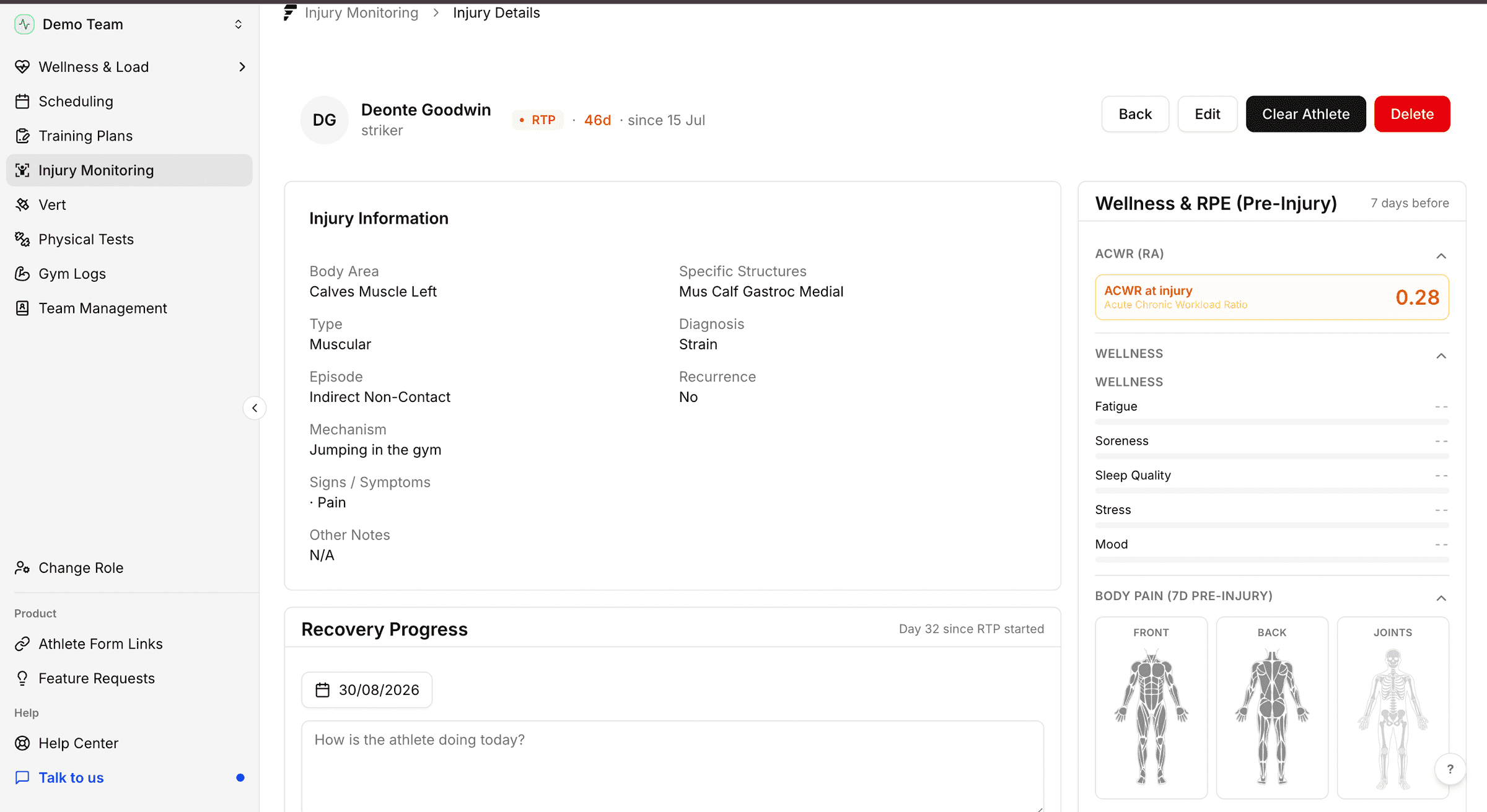
Fractall injury details view for a return-to-play case, showing body area, specific structures, type, diagnosis, episode, mechanism and recurrence alongside a pre-injury panel with ACWR at injury, wellness metrics and a seven-day body pain map
The injury details view. On the left, the structured record: body area down to the specific structure, type, diagnosis, episode and the mechanism in the physio's own words. On the right, the seven days that preceded it.
It's assembled from data the squad was already submitting through daily wellness tracking. Nobody enters anything twice.

Keep injury records that answer questions later

Fractall records the injury, the week that preceded it, and the athlete's full history on one screen. No hardware, set up in minutes, free for 4 weeks.

Start free trial

FAQs

Frequently asked questions

Short answers to the questions that come up when a club rebuilds its injury log.

What date counts as return to play in an injury record?

The date the player returns to full unrestricted team training, with no modification to duration or activities. If they play in a match before returning to full team training, record the match date instead. During periods without training or matches, use the date they were medically cleared and available for full team training.

What is the difference between a re-injury and an exacerbation?

Both affect the same site with the same diagnosis. It is a re-injury if the player had fully recovered and returned to football first, and an exacerbation if they had not recovered yet. A re-injury points at the rehab endpoint or the return criteria. An exacerbation points at a player training through something unresolved.

Should a coach record the diagnosis if there is no physio available?

No. The IOC consensus recommends that reporting by athletes and non-medical staff is limited to body area, because non-clinician reporting of tissue type and abnormality is not reliable. Log the date and the body area, and leave tissue and diagnosis for the physio to complete.

Should we log problems that do not cost any training time?

Yes, if you can. A time-loss record misses everything a player trains through, which is most overuse problems. Daily wellness and body-pain reporting captures those complaints without a separate process, and attaching that history to the injury record is what makes it usable later.

Can a small club calculate injury incidence per 1000 hours?

Realistically, no. It requires exact per-player exposure minutes for every session and match, split by session type, with rehabilitation excluded. Days lost, injury counts by body area, and the proportion that were recurrences are computable from a well-kept log and are enough for a season review.

Related guides