4 Weeks Free Access (cancel anytime)
Sport-specific guideFutsalRPETraining load

Session RPE for Futsal: A Practical Guide

A futsal-specific guide to session-RPE: what the evidence shows, why rolling substitutions change how you log it, and how to read a congested tournament week.

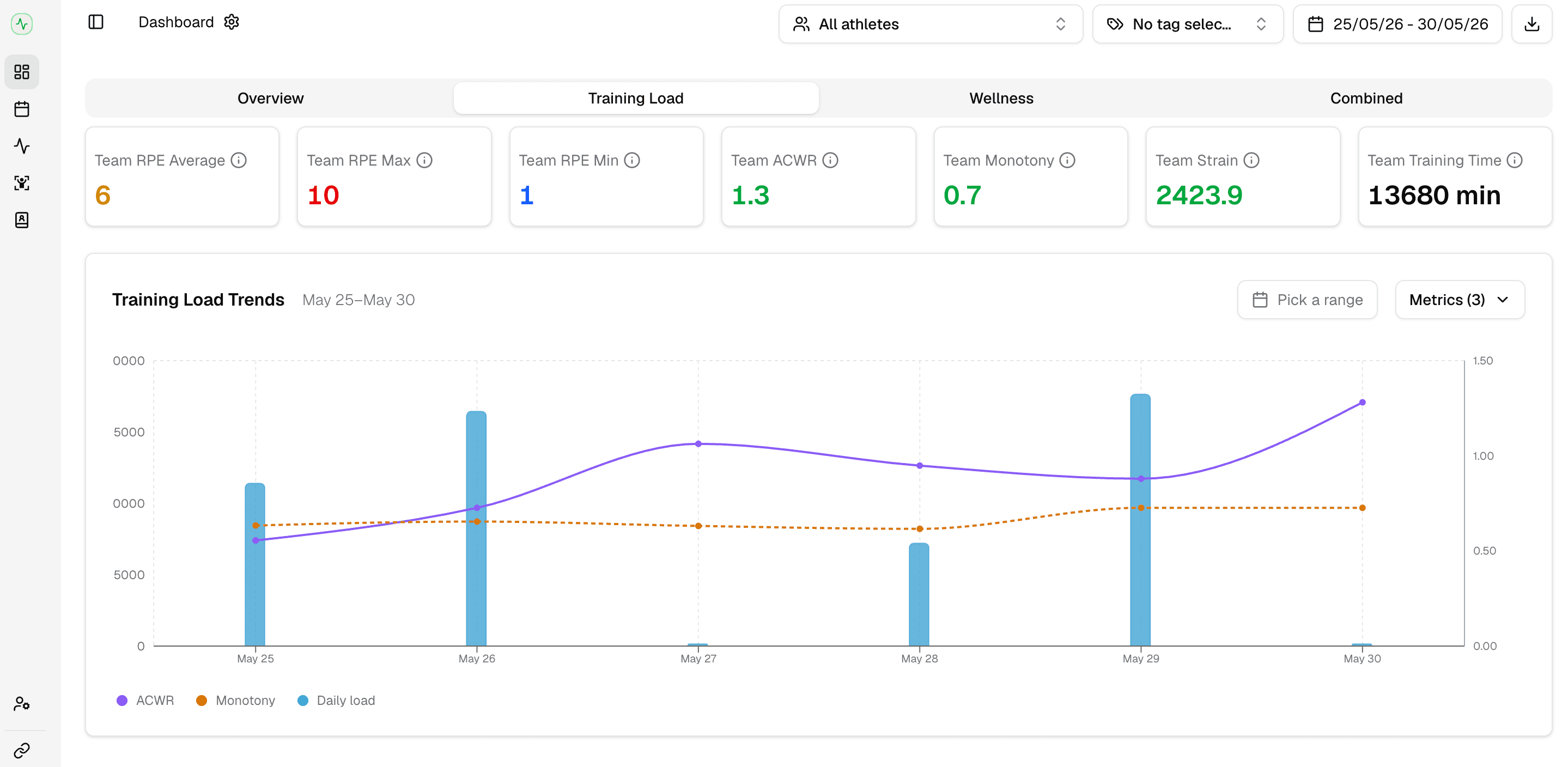
Fractall training load dashboard showing session RPE and ACWR trends for a squad.

Quick answer

Session RPE works in futsal the same way it does in any team sport: multiply a player’s 0–10 perceived-exertion score by session duration in minutes. A two-team study of 28 professional futsal players (Teixeira et al., 2018) found accumulated sRPE load tracked real sprint-performance changes across a preseason, and Rabelo et al.’s single-team case study found coaches consistently overestimate how hard a session felt compared to what players actually report. No futsal-specific ACWR threshold is confirmed in the literature, so treat the ratio as a trend to watch rather than a target number to hit, even a range borrowed from a sport like basketball that has one proposed.

The real futsal problem

Why futsal's monitoring problem isn't the RPE scale

The scale is solved. What decides whether your squad stays healthy is how you read load across a tournament schedule that compresses fast.

Futsal’s injury profile is skewed hard toward match play. Ruiz-Pérez et al. (2021) pooled six studies covering elite male and female futsal and found match injury incidence running well above the overall rate, driven by the short-shift, high-intensity, small -court demands that don’t show up the same way in training.
The calendar adds to it. Recent congested-schedule research on futsal tournaments and training camps links back-to-back match weeks to residual fatigue and added physiological strain. That’s the actual coaching problem: not whether sRPE is useful for futsal, but whether you’re watching load closely enough during the weeks it matters most.

44.9 / 1,000h

Match injury incidence, elite futsal

Ruiz-Pérez et al. (2021) meta-analysis pooling six studies, elite male cohorts, versus an overall (training + match) rate of 6.8 per 1,000 hours.

n = 28

Professional futsal players in a two-team sRPE training-load study

Teixeira et al. (2018): accumulated session-RPE load correlated with 5m sprint-time changes at r = -0.61 across a preseason.

Does sRPE work for futsal?

Is session-RPE actually useful in futsal, or is it a football method relabeled?

It's been applied directly in professional futsal squads, and the load it produces tracks real changes in players, not just how they say they feel.

Teixeira and colleagues (2018) followed 28 elite players across two professional Brazilian futsal teams through a five-week preseason. Every player logged a 0–10 session rating 15–30 minutes after training and friendly matches, multiplied by duration, the standard sRPE method. The team that accumulated more load saw its sprint-time changes track that load: 5m sprint change correlated with total sRPE load at r = -0.61, 15m at r = -0.56.
That’s not a lab study testing sRPE against a heart-rate method head-to-head, it’s a real two-team applied monitoring study, so treat it as evidence the number moves with real physical change in a squad rather than proof of concurrent validity. Either way, it’s a larger and more representative sample than a single small squad, and it points the same direction: the number reflects something real.
You don’t need GPS on an indoor court to know how hard a session hit your squad, and GPS doesn’t work well there anyway. A 0–10 rating collected 20–30 minutes after the session gets you a number that reflects real load. For the general mechanics of the method, our session-RPE basics guide covers scale selection and collection habits in more depth.
Teixeira, A. S., Nunes, R. F. H., Yanci, J., Izzicupo, P., Flores, L. J. F., Romano, J. C., Guglielmo, L. G. A., & Nakamura, F. Y. (2018). Different Pathways Leading up to the Same Futsal Competition: Individual and Inter-Team Variability in Loading Patterns and Preseason Training Adaptations. Sports, 7(1), 7. PMC6358978.

The method

How to collect session-RPE from a futsal squad

Futsal's rolling substitutions mean session duration and playing time aren't the same thing. Build the habit around that.

  1. 1

    1. Pick one 0-10 scale and stick to it

    Define what a 3 feels like versus a 9, and keep the anchors consistent across training, scrimmages, and official matches so the numbers stay comparable.

  2. 2

    2. Collect 20-30 minutes after every session type

    Training, small-sided games, scrimmages, and matches all get a score. Treat matches like any other session; they carry the highest load and the highest injury stakes.

  3. 3

    3. Log playing time per athlete, not just session duration

    Futsal's rolling substitutions mean a squad can share the same session while individual players are on the court for very different amounts of time. Duration for the sRPE calculation should reflect what each player actually played, not the total session length.

  4. 4

    4. Educate players on the scale early

    A few minutes explaining what a 7 feels like versus a 9 avoids flat, uninformative scores, and matters more in a sport where conditioning varies widely between starters and rotation players.

  5. 5

    5. Review weekly, not session by session

    A single number is noise. The pattern across a full week, especially a congested one, is where the signal actually is.

Don't guess the number

Why the coach's estimate of training load isn't good enough

The data has to come from the players, not from what the session was supposed to feel like.

Rabelo et al. (2016) followed 18 Brazilian professional futsal players across a full 45-week season, comparing each player’s submitted RPE against the coach’s intended exertion rating for the same session. The coach’s estimate ran higher than what players actually reported across nearly all intensity zones and every period of the season, preseason through both competitive blocks.
That matters for anyone tempted to skip collection and just plan off what a session was designed to feel like. Intended load and perceived load aren’t the same thing, and the gap between them is exactly what session RPE is built to catch. Collect it from every player, every session, or the number you’re working from isn’t real. It’s a single professional team, so treat the size of the gap as suggestive rather than universal, but the underlying point holds regardless of sample: an outside guess at effort is not the same thing as what a player actually felt.
Rabelo, F. N., Pasquarelli, B. N., Gonçalves, B., Matzenbacher, F., Campos, F. A. D., Sampaio, J., & Nakamura, F. Y. (2016). Monitoring the Intended and Perceived Training Load of a Professional Futsal Team Over 45 Weeks: A Case Study. Journal of Strength and Conditioning Research. PubMed 26200197.

Reading load in-season

Using session RPE through a congested tournament week

This is where futsal load monitoring earns its keep, and where you have to be honest about what the evidence does and doesn't say.

Once you’re collecting sRPE consistently, the useful number is weekly load and how this week compares to the last four, what the acute:chronic workload ratio (ACWR) measures. Unlike basketball, where a 2024 review offered a practitioner range of 0.8–1.3, no futsal-specific ACWR threshold has been confirmed in the literature we reviewed. Don’t borrow a number from another sport and present it as futsal evidence. Track the trend, watch for sharp week-to-week jumps, and treat ACWR as a monitoring aid rather than a target to hit.
What the congestion research does support: tournament and league schedules in futsal regularly compress into back-to-back match weeks, and that pattern is linked to residual fatigue building across the week rather than clearing between games. In practice, that means watching your highest-minutes players specifically during a congested stretch, not just the squad average. Our guide to training monotony and strain covers the companion metric for spotting a week that looks fine on average but is grinding one or two players down. If you coach both futsal and basketball, our basketball sRPE guide covers the equivalent congestion problem for that sport.

How Fractall handles futsal's session variety

1

Schedule training, scrimmages, and matches as distinct sessions, so each one gets its own RPE submission from every player who took the court.

2

Players submit RPE and their own playing time from their phone after every session, no GPS or wearables required.

3

ACWR, monotony, and strain calculate automatically, so a congested tournament week shows up on the dashboard before it becomes an injury.

FAQs

Common questions about session RPE in futsal

Does session-RPE actually work for futsal, or is it built for outdoor team sports?

It’s been applied directly in professional futsal squads. Teixeira et al. (2018) found accumulated sRPE load tracked real sprint-performance changes across 28 players on two teams, and Rabelo et al. (2016) tracked it across a full 45-week professional season.

How is futsal load monitoring different from other team sports?

The scale and the math are identical: RPE times minutes played. What’s different is that rolling substitutions mean session duration and individual playing time diverge, so you need to log minutes per player, not just per session.

What ACWR range should futsal players target?

No futsal-specific threshold is confirmed in the literature. Treat ACWR as a trend to watch rather than a number to hit, and don’t apply a range validated in a different sport.

How often should futsal players submit RPE?

After every distinct session type: training, small-sided games, scrimmages, and matches, collected 20–30 minutes post-session so the rating reflects the whole effort.

Do I need GPS to monitor futsal training load?

No. Futsal is played indoors on a small court, where GPS is largely impractical anyway. Session RPE requires no hardware, just a 0–10 rating submitted from a phone.

Monitor your futsal squad through the congested weeks

Fractall tracks session RPE, ACWR, monotony, and strain for futsal the same way it does for football and basketball: no hardware, unlimited athletes and coaches. Flat €20/team/month (€16.67/month billed annually), 4-week free trial.

Start free trial

Related guides

Session RPE for Futsal: A Practical Guide | Fractall