

Session RPE for Basketball: A Practical Guide
A basketball-specific guide to session-RPE: handle congested fixture weeks and read ACWR using basketball research, not football numbers relabeled.
Published
Quick answer
The real basketball problem
Why basketball's monitoring problem isn't the RPE scale
The scale is solved. What decides whether your players stay healthy is how you read load across a week with two or three games in it.
11 of 14
Studies linking basketball load to injury risk
Chan, Yung & Mok (2024) found at least partially significant results in 79% of the studies their review covered.
0.8-1.3
Recommended ACWR range for basketball
A practitioner recommendation from the same review, not a guaranteed predictor. Evidence on ACWR itself is mixed.
0.95
Session-RPE reliability in basketball (ICC)
Manzi et al. (2010) validated the method directly in basketball players across 200 sessions.
Does sRPE work for basketball?
Is session-RPE actually valid for basketball's stop-start demands?
Yes. The evidence behind that answer comes from basketball players, not a borrowed football citation with the sport swapped.
The method
How to collect session-RPE from a basketball squad
Basketball sessions aren't uniform the way a football training day often is. Build the habit around that.
- 1
1. Pick one 0-10 scale and stick to it
Define what a 3 feels like versus a 9, and keep the anchors consistent across practice, conditioning, and game day so the numbers stay comparable.
- 2
2. Collect 20-30 minutes after every session type
Technical practice, conditioning blocks, scrimmages, and games all get a score. Treat games like any other session; they carry the highest load and the highest injury stakes.
- 3
3. Record duration separately from RPE
Session load is RPE multiplied by minutes, so duration has to be logged accurately, including reduced minutes for players coming off the bench or returning from injury.
- 4
4. Educate players on the scale early
A few minutes explaining what a 7 feels like versus a 9 avoids the flat, uninformative scores you get without calibration.
- 5
5. Review weekly, not session by session
A single number is noise. The pattern across a full week, especially a congested one, is where the signal actually is.
Reading load in-season
Using session RPE through a congested fixture week
This is where basketball load monitoring earns its keep.
How Fractall handles basketball's session variety
Schedule practices, conditioning blocks, scrimmages, and games as distinct sessions, so each one gets its own RPE submission.
Players submit RPE and duration from their phone after every session, no GPS or wearables required.
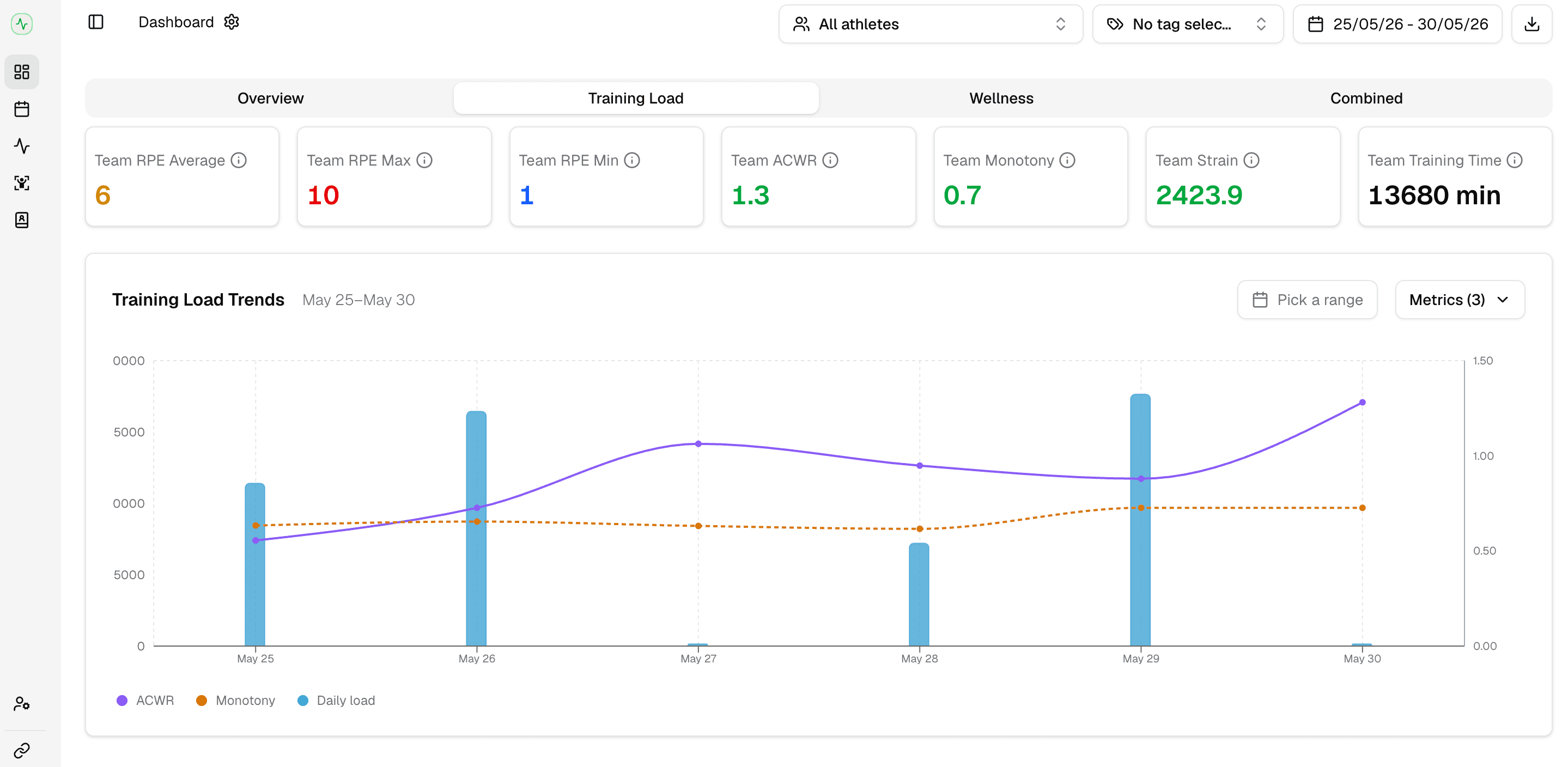
ACWR, monotony, and strain calculate automatically, so a three-game week shows up on the dashboard before it becomes an injury.
FAQs
Common questions about session RPE in basketball
Does session-RPE actually work for basketball, or is it built for running sports?
How is basketball load monitoring different from football?
What ACWR range should basketball players target?
How often should basketball players submit RPE?
Do I need GPS to monitor basketball training load?
Monitor your basketball squad through the congested weeks
Fractall tracks session RPE, ACWR, monotony, and strain for basketball the same way it does for football: no hardware, unlimited athletes and coaches. Flat €20/team/month (€16.67/month billed annually), 1-month free trial.
Related guides
Winter Break Training Plan for Football S&C Coaches
Winter break training plan for football: what two weeks off costs, the minimum to prescribe at home, and how to log it so January ACWR stays honest.
Two Games a Week: What Wellness Data Shows Before Match 2
Fractall data on football teams playing two games a week: on match morning, fatigue sits less than half as far above normal. How to read wellness between games.
ChatGPT and Claude for Strength and Conditioning Coaches
What an S&C coach can ask ChatGPT or Claude about squad load, wellness and injuries, and the privacy settings to change before any athlete data goes in.