

Centralising Player Data in Football: The Cost of Silos
Centralising player data in football: what data silos cost in staff hours, blind decisions, and lost history, plus how to audit your own club.
Updated first published
Quick answer
Scattered data is the norm, and it still costs you
Centralising player data means one record per athlete that every authorised staff member reads from, instead of six tools that each hold part of the story.
The short version
The cost
What does fragmented player data actually cost a club?
Four costs, in rough order of how easy they are to see. The first one shows up on a timesheet. The last three don't show up anywhere, which is why they persist.
73%
run more than one storage system
Of 206 football practitioners surveyed across all six FIFA confederations, most combined cloud storage with local or in-house storage, or with an analytics company's service.
76%
still analyse in spreadsheets
Spreadsheets were the most common tool for aggregating and analysing data, ahead of databases and coding software. A further 62% used them for reporting.
54%
of lower-tier clubs use live data
Against 76–79% at first and second tier and in national teams. The gap tracks resources, not ambition.
Estimate what the shuffling costs you
Enter your own numbers. Count anyone who touches athlete data: performance staff, physio, analyst, team manager.
Staff hours spent moving data each season
360 hours
Roughly 9.6 full working weeks. Multiply by your own loaded staff cost to price it.
This is an estimate built from the three numbers you entered, not a research finding. The starting values are illustrative placeholders, not an industry benchmark. Time an actual week before you take a figure to a board.
The audit
Where is your club's player data actually stored?
Before costing the fix, map the current state. Most directors find between five and eight separate locations, and at least one they didn't know existed.
| Data stream | Where it usually lives | What it costs you there |
|---|---|---|
| Daily wellness | WhatsApp group, paper form, or a survey tool | Nobody aggregates it, so a downward trend is only visible once the athlete breaks down |
| Session RPE | Spreadsheet on one coach's laptop | Only that coach can read it, and it never gets checked against wellness |
| GPS and external load | The GPS vendor's own portal | Sits in a separate dashboard and rarely gets compared to internal load |
| Injuries and body pain | The physio's notes | Medical and performance staff work from different pictures of the same athlete |
| Physical test results | One file per test day | No trend line per athlete, so each test is an island instead of a progression |
| Session plans | Calendar, whiteboard, or a photo of one | Load can't be tied back to what was actually planned, so nothing gets learned |
Run this audit in one meeting
- List every place athlete data is entered, including paper and messaging apps
- For each one, name the single person who can retrieve it
- Mark any stream that exists in two places, and find out which copy staff actually trust
- Note which streams can currently be read on the same timeline as training load
- Ask what would happen to each stream if that named person left tomorrow
- Time one real week of moving data between systems rather than estimating it
The standard
What does centralising player data actually mean?
One login is not centralisation. A shared drive is not centralisation. Here's the bar a system has to clear.
Centralised player data
One record per athlete, holding every stream on a shared timeline, readable by any staff member whose role allows it, and owned by the club rather than by an individual.
Example: A physio opens an athlete and sees the same load history the S&C coach sees, without asking anyone to send a file.
What a centralised system has to do
- Hold one record per athlete that persists across seasons, not one folder per season
- Let any two streams be read against each other on the same timeline
- Capture data at source, so athletes submit directly instead of a coach transcribing
- Control access by role, so the physio and the S&C coach see one record with appropriate permissions
- Keep the history when staff change, without depending on anyone's personal file
- Let you export your own data without asking the vendor for it
Continuity
What happens to your data when a coach leaves?
The cost no club budgets for, and the one that lands hardest on smaller clubs.
The baseline walks out with the laptop
In Fractall
How Fractall centralises player data
One athlete record covering load, wellness, injuries, physical tests, and session planning, with no hardware to buy and setup measured in minutes.
From scattered streams to one record
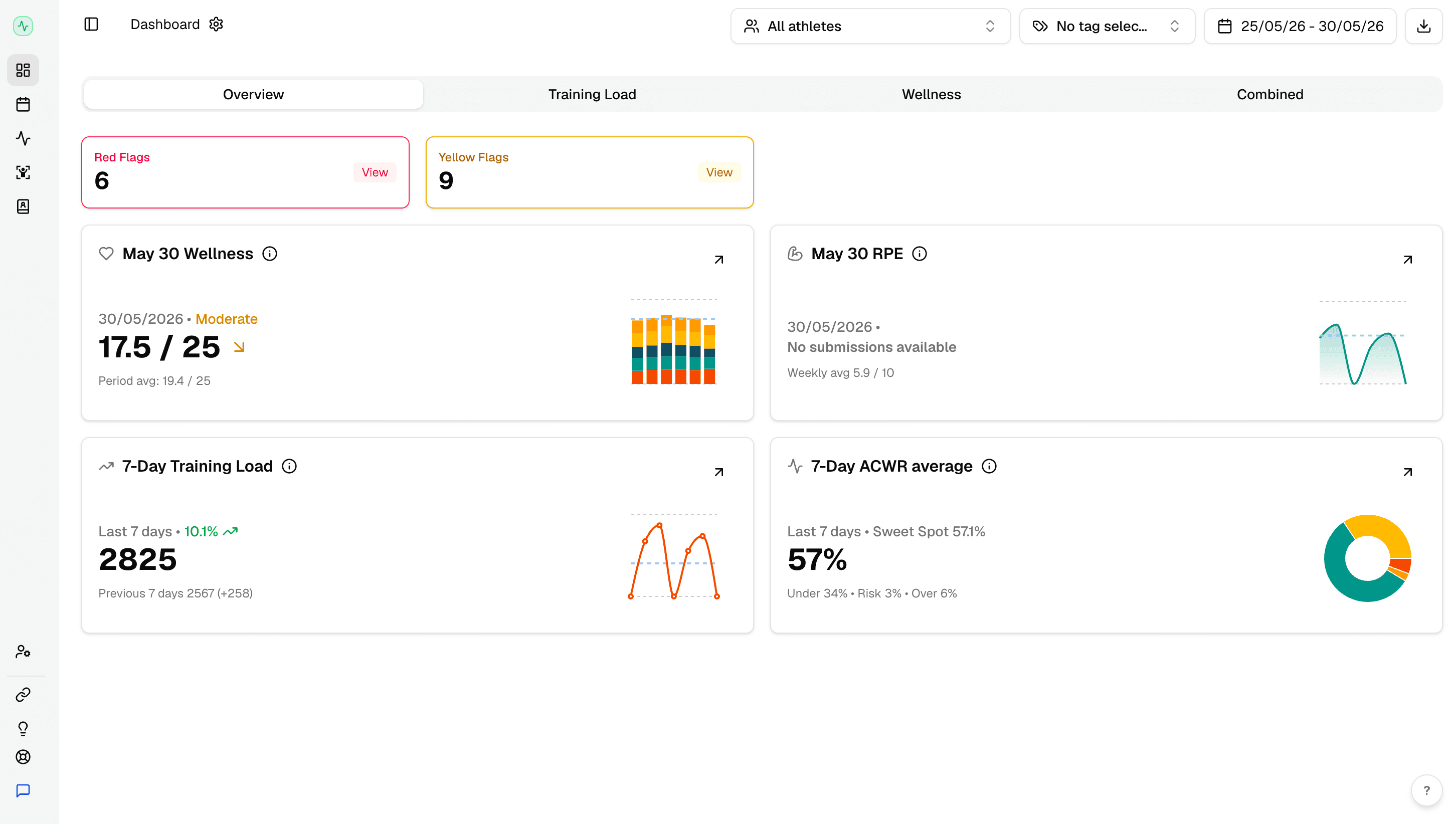
Athletes submit daily wellness and post-session RPE from their phone, so data lands in the club's record without anyone retyping it.
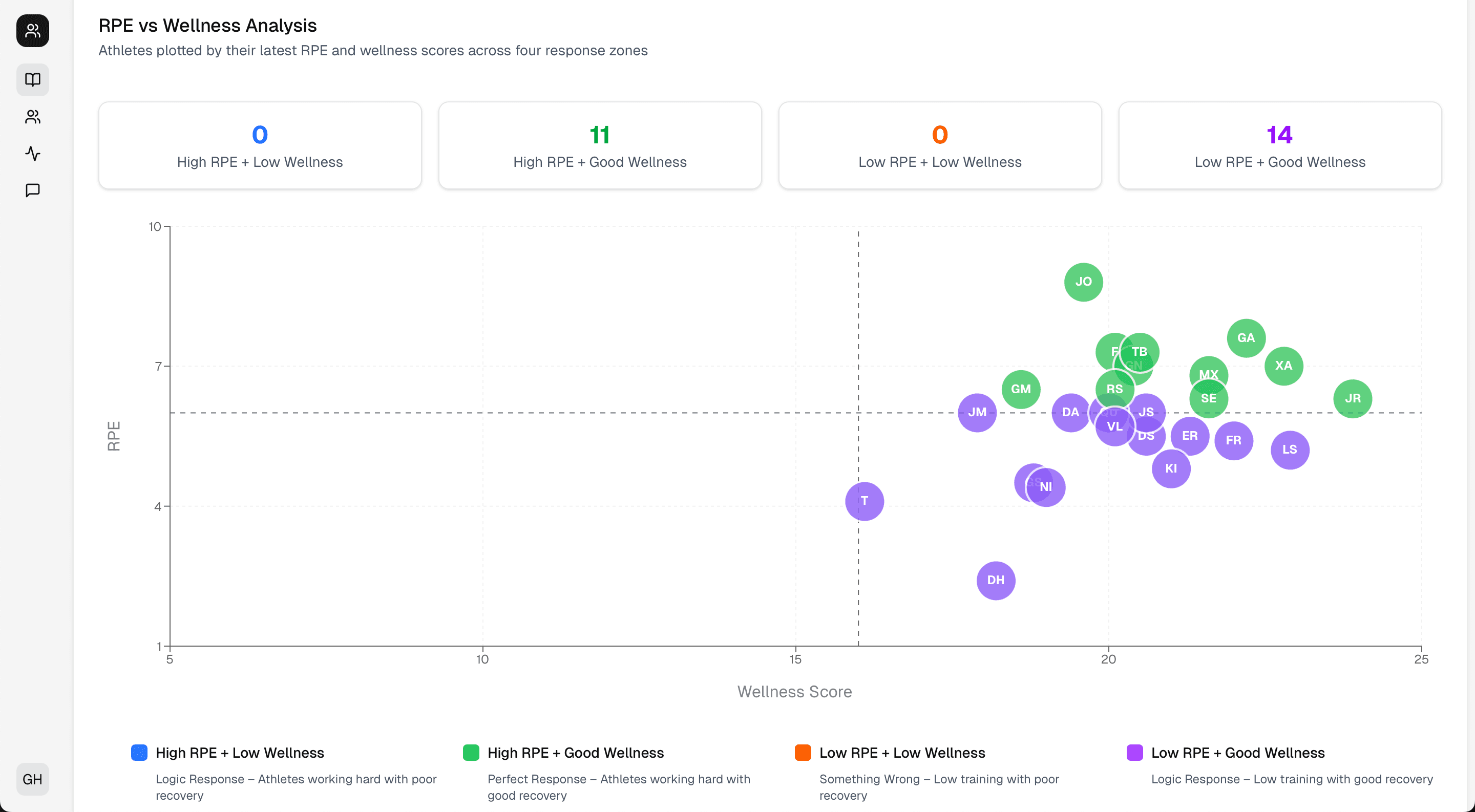
Load, wellness, body pain, injuries, and physical test results sit against one athlete profile on a shared timeline, with ACWR, monotony, and strain calculated for you.
Coaches export a PDF report from that same record, so staff and board review one version instead of three spreadsheets.
FAQs
Common questions about centralising player data
Short answers to what club directors ask before committing to a change.
Put every stream in one athlete record
Fractall brings load, wellness, injuries, physical tests, and session planning into one record per athlete. No hardware, setup in minutes, one-month free trial with no credit card.
Related guides
Two Games a Week: What Wellness Data Shows Before Match 2
Fractall data on football teams playing two games a week: on match morning, fatigue sits less than half as far above normal. How to read wellness between games.
ChatGPT and Claude for Strength and Conditioning Coaches
What an S&C coach can ask ChatGPT or Claude about squad load, wellness and injuries, and the privacy settings to change before any athlete data goes in.
CMJ Test: Protocol, Norms and Why Devices Disagree
The same countermovement jump reads nearly 7 cm apart on a force plate, a phone app and a sensor. Triple the U16 to U18 gap. The protocol and the norms.