4 Weeks Free Access (cancel anytime)
Coach guideAthlete monitoringAthlete complianceSmall clubs

Why Centralise Athlete Data: Benefits for Coaches

Why centralise athlete data: the benefits coaches get from one athlete record, and what a system has to do before it earns the word centralised.

Published

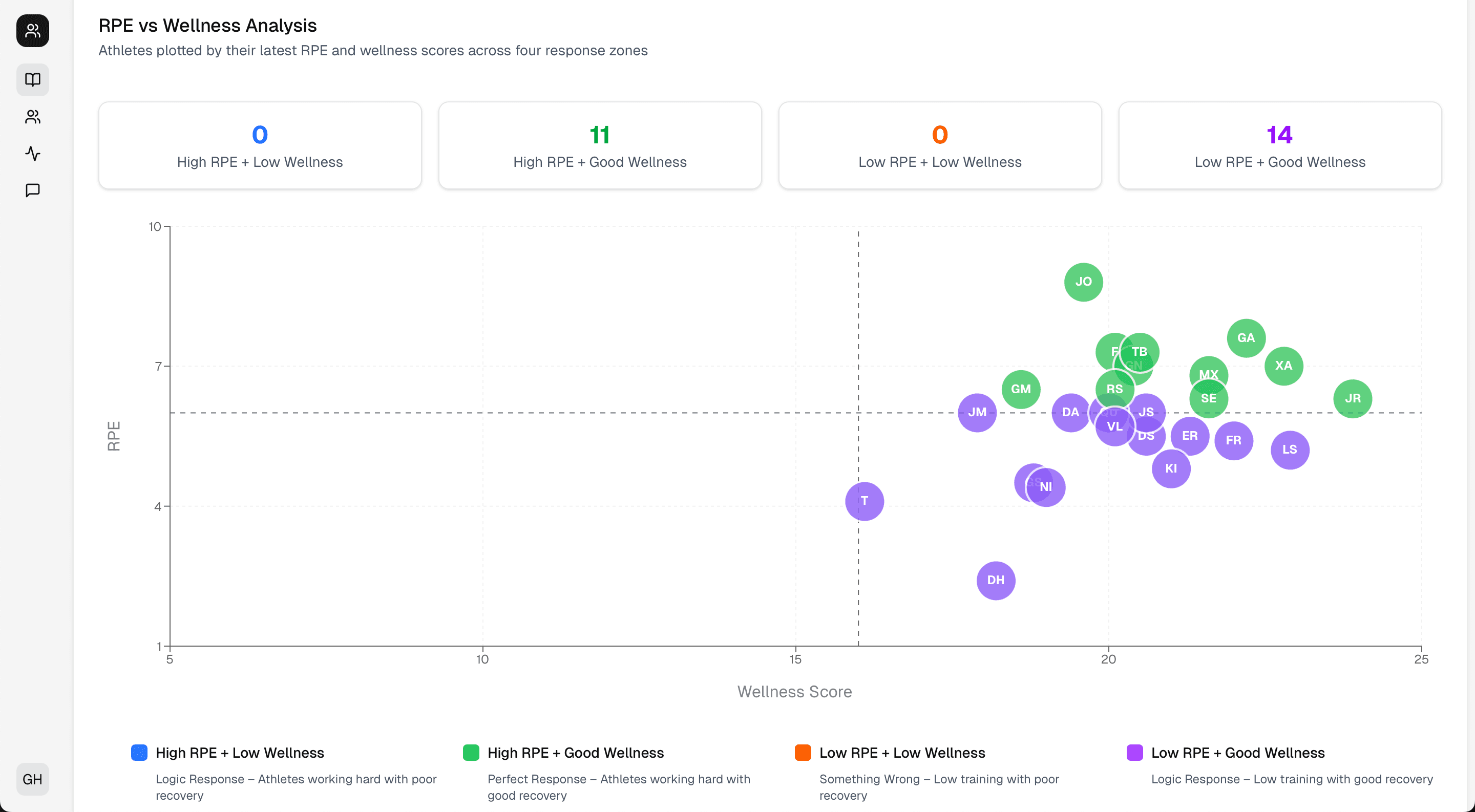
Fractall combined dashboard plotting every athlete's session RPE against their wellness score across four response zones.

Quick answer

One record per athlete, and why it changes what you can see

The benefits of centralising athlete data, and the things it won't fix.

The short version

To centralise athlete data is to have every stream you collect (daily wellness, session RPE, injuries, physical tests, GPS if you use it) land on one record per athlete that any authorised staff member can read. The benefit that changes the most is context: a training load number only means something next to how the athlete is coping with it. In a 2025 survey of 206 football practitioners worldwide, 73% were running more than one storage system and 76% still did their analysis in spreadsheets (Dello Iacono et al., 2025), so most coaches are reading those two things in separate places, if they read them together at all.
This guide is written for the coach who collects the data, not the director who signs for the software. If you need the spend argument to take upstairs, our guide to what fragmented player data costs a club makes that case with the staff-hours and continuity numbers. What follows is what you get back day to day, and where centralising stops helping.

The problem

Why does scattered athlete data hold coaches back?

Not because anything is missing. Because the pieces never meet, so the questions worth asking can't be answered from any one of them.

Most clubs already collect more than they use. Wellness comes in on a form, RPE goes into a spreadsheet, the physio keeps injuries in their own notes, and test results live in whatever file was open on testing day. Every stream is fine on its own. Nearly every question worth asking spans two of them.
Take the most common one. An athlete's acute load has jumped this week. Is that a problem? You can't answer it from the load file. You need to know whether they slept, whether they're carrying soreness from the weekend, and whether they've just come back from three weeks out. Those answers sit in three places, and by the time you've gathered them the session you were deciding about has already happened.
This is why acute:chronic workload ratio numbers get misread so often. The ratio is calculated from load alone, so it looks equally trustworthy whether or not the athlete has been reporting poor sleep all week. The number isn't wrong. It's just half an answer being treated as a whole one.

The benefits

What are the benefits of centralising athlete data?

Five things you get back once the streams sit on one record.

1. You read load and coping in the same place. An ACWR of 1.4 means one thing when wellness is steady and something different when the athlete has reported poor sleep four days running. Same ratio, different decision. When session RPE and daily wellness sit in separate systems, nobody reads them together, so the ratio gets treated as the answer rather than as half of it.
2. Compliance becomes something you can hold. You can see who submitted and who didn't on the day, rather than discovering a month later that four athletes stopped in week three. That matters more than it sounds, because compliance tracks coach attention closely.

84% vs 8%

compliance, supported versus self-directed

Team-sport athletes supported by their coach or programme averaged 84 ± 21% compliance over 16 weeks. Team-sport athletes left to self-direct averaged 8 ± 18%.

35%

signed up and never used it

46 of 131 athletes created an account and then never attempted a single entry. Registration numbers looked healthy while the system was already failing.

73%

run more than one storage system

Of 206 football practitioners surveyed worldwide, most combined cloud storage with local storage or an analytics company's service. 76% still analysed in spreadsheets.

Compliance figures from Saw, A. E., Main, L. C., & Gastin, P. B. (2015). Impact of Sport Context and Support on the Use of a Self-Report Measure for Athlete Monitoring. Journal of Sports Science and Medicine, 14(4), 732–739. A single 16-week study across mixed sports at an Australian institute with a self-selected sample, and the low groups carry wide standard deviations, so read them as direction rather than precise rates. Storage figures from Dello Iacono, A., Datson, N., Clubb, J., Lacome, M., Sullivan, A., & Shushan, T. (2025). Science and Medicine in Football, a convenience sample weighted toward top-tier professional football.
3. Weekly reporting stops being an assembly job. When the streams already sit together, a report is a view of data you already have rather than a document somebody builds by copying from four places every Monday. The version that gets built by hand is also the version that quietly stops appearing in a busy month.
4. The record outlives whoever set it up. Staff turnover is normal in club sport. When the monitoring history lives in one coach's spreadsheet, the baseline leaves with them, and the next person starts from zero on athletes who have been at the club for years. A club-owned record means the incoming coach reads the history instead of rebuilding it.
5. You can see an athlete against their own baseline. Squad averages hide individuals. The useful comparison is almost always an athlete against their own normal, and that only works when enough history sits in one place to establish what their normal is. This is a monitoring aid rather than a warning system, and it's worth being clear about the difference. If you want to go deeper on getting the submissions consistent enough to trust, our guide to athlete compliance with monitoring data covers it.

Honest limits

What centralising athlete data won't fix

The case is strong enough without overstating it, and knowing the limits is what stops a rollout from being sold on promises it can't keep.

Works well for

  • Clubs already collecting wellness or RPE in some form who can't read the streams against each other
  • Squads of 20 or more, where individual detail disappears into a squad average
  • Clubs where more than one person needs the same picture: coach, physio, analyst
  • Any club that has lost its monitoring history when a staff member left

Watch out for

  • It won't rescue a programme nobody acts on. One record makes data visible, not useful.
  • It won't make ACWR predictive. The ratio is a monitoring aid wherever it's stored.
  • It won't create compliance on its own. Athletes submit when a coach visibly uses what they send.
  • It can pull attention toward the dashboard and away from the athlete in front of you.
That last one is worth taking seriously rather than treating as a disclaimer. A 2024 scoping review of 42 studies found that alongside the familiar barriers of time, expertise, and money, practitioners raised over-reliance on data as a risk that distances coaches from athletes. Centralising makes more data visible at once, which makes that risk larger, not smaller. The screen is a prompt to go and ask someone how they're feeling, not a substitute for it.
Timmerman, W. P., Abbiss, C. R., Lawler, N. G., Stanley, M., & Raynor, A. J. (2024). Athlete monitoring perspectives of sports coaches and support staff: A scoping review. International Journal of Sports Science & Coaching, 19(4). Barriers reported across the 42 included studies covered lack of time, expertise, and resources, resistance to the time and effort required, difficulty securing commitment, misinterpretation of data without context, and over-reliance on data potentially distancing coaches from athletes.

In Fractall

How Fractall centralises athlete data

What the single record looks like in practice, and which parts of the benefits above it actually delivers.

From separate streams to one athlete record

1

Athletes submit a daily wellness check-in and post-session RPE from the mobile app, so collection is centralised rather than retyped by a coach.

2

Every submission attaches to the same athlete on the same date, alongside injuries, physical tests, and session plans.

3

Load and wellness render on the same dashboard, with ACWR, monotony, and strain calculated from internal load automatically.

4

Response monitoring shows which athletes have submitted and which haven't, so gaps are visible the day they appear.

5

Reports export as PDF for staff who need the summary without logging in.

The part that does most of the work is that collection happens on the athlete's phone. If a coach still has to retype what athletes submitted somewhere else, the fragmentation hasn't gone, it has just moved. Everything lands on one athlete record rather than in separate modules. Clubs running GPS can bring Catapult exports into that record through file-based import, and clubs without GPS still get a complete internal load picture from RPE and session duration, which needs no hardware at all. Pricing is a flat rate per team with every module included, and the trial runs four weeks.

FAQs

Common questions about centralising athlete data

What coaches ask before committing to the change.

What does it mean to centralise athlete data? It means every stream you collect lands on one record per athlete that any authorised staff member can read, instead of living in separate files and tools. Daily wellness, session RPE, injuries, physical tests, and GPS if you use it, all attached to the same athlete on the same date. The test is whether you can answer a question that spans two streams without opening a second system.
What are the main benefits of centralising athlete data? You read training load next to how the athlete is coping with it, you can see who is submitting and who isn't, weekly reporting stops being a manual assembly job, the record survives staff turnover, and you can compare an athlete against their own baseline rather than a squad average.
Does centralising athlete data improve compliance? Not by itself, but it removes the main obstacle. Compliance is driven by whether a coach visibly supports the process: in a 16-week study of a newly introduced self-report measure, team-sport athletes supported by their coach or programme averaged 84% compliance against 8% for those left to self-direct (Saw et al., 2015). One record makes that support practical, because you can see who has submitted on the day rather than at the end of the month.
Does centralising athlete data reduce injuries? No, and you should be wary of anyone claiming it does. Centralising improves what you can see, and monitoring metrics like ACWR are aids to a coaching decision rather than predictors of injury. The honest benefit is that decisions get made with the full picture instead of a quarter of it, and that context is missing when load and wellness sit in different systems.
Do you need an athlete management system, or will a spreadsheet do? A spreadsheet centralises storage but not collection, so someone still retypes what athletes submitted somewhere else. That manual step is where the fragmentation returns, and it is also the step that stops when the person doing it gets busy. A spreadsheet works while one person owns every stream and the squad is small. It stops working when more than one staff member needs the same picture. Our comparison of the best Excel alternatives for athlete monitoring goes through the options.

See every stream on one athlete record

Fractall brings load, wellness, injuries, physical tests, and session planning onto one record per athlete, and shows you who has submitted and who hasn't. No hardware, setup in minutes, four-week free trial with no credit card.

Start your free trial

Related guides