

Athlete Compliance: How to Get Better Monitoring Data
Learn how athlete compliance in sRPE and wellness monitoring affects coaching decisions, and how to build a system athletes actually use.
Updated first published
Quick answer
Aim for 80% squad compliance, and watch week four
Quick answer
Data quality
Compliance is the foundation of every monitoring system
A coach's analysis is only as good as the athlete data behind it. Compliance means athletes submit consistently, honestly, and on time.
Submission is not enough
Improvement process
Improve compliance by designing around the athlete routine
The most reliable compliance gains come from reducing friction and proving that the data changes coaching decisions.
- 1
Reduce submission friction
Keep sRPE and wellness inputs short enough that athletes can complete them quickly after training or during the daily routine.
- 2
Set expectations at onboarding
Explain what each input is used for, how staff read it, and what happens when data is missing.
- 3
Time reminders around training
Reminders work best when they match squad routines rather than generic clock times.
- 4
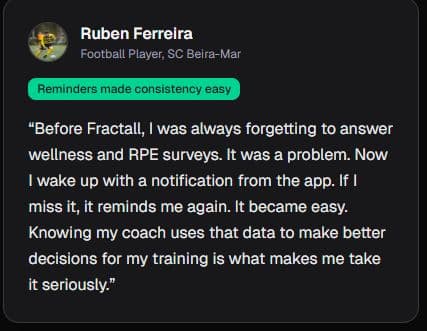
Close the feedback loop
Show athletes when wellness, sRPE, or pain data changes a session, recovery plan, or conversation.
- 5
Track compliance itself
Review submission rate and response variance so staff can distinguish missing data from stable readiness.
Useful compliance signals
- Squad submission rate by week.
- Athletes below the team average.
- Repeated missing sRPE after key sessions.
- Flat wellness scores with no variance.
- Drop-offs after novelty wears off.
Applied example
Compliance drops when athletes stop seeing the point
A monitoring process may start strong in pre-season and still fade if staff do not reinforce why the data matters.
Week 1
Week 4
The fix
Common mistakes
Most compliance problems are experience problems
Before adding pressure or incentives, audit the collection process from the athlete's perspective.
The submission path has too many steps
Every extra tap, login, or context switch lowers the chance that athletes submit on time across a full season.
Fractall workflow
Make compliance visible before trusting the dashboard
Fractall helps coaches collect wellness, sRPE, and pain inputs, then review the training-load signals that depend on consistent athlete responses.
| Input | Why compliance matters | Coach response |
|---|---|---|
| sRPE | Missing sRPE weakens weekly load and ACWR. | Follow up after key sessions and explain how load is used. |
| Wellness | Low completion hides readiness trends. | Keep surveys short and reference trends in planning. |
| Pain | Underreporting delays useful conversations. | Normalize pain reporting as context, not punishment. |
Compliance-aware monitoring
Athletes submit wellness, sRPE, and pain through Fractall's athlete flows.
Coaches review dashboards that rely on consistent submissions.
Staff use missing data and response patterns as prompts for follow-up.
Build a monitoring system athletes can sustain
Use Fractall to collect athlete inputs, review load and wellness trends, and reduce spreadsheet friction for staff.
FAQs
Athlete compliance questions
Short answers for coaches improving the quality of wellness and sRPE monitoring data.
What is a good compliance rate?
Why do athletes stop submitting?
How many wellness questions should we ask?
How does compliance affect ACWR?
Coach checklist
- Track compliance rate weekly.
- Simplify the submission experience before adding reminders.
- Show athletes how their data affects decisions.
- Keep daily surveys short.
- Match reminder timing to athlete routines.
- Check response variance, not only submission count.
Related guides
Winter Break Training Plan for Football S&C Coaches
Winter break training plan for football: what two weeks off costs, the minimum to prescribe at home, and how to log it so January ACWR stays honest.
Two Games a Week: What Wellness Data Shows Before Match 2
Fractall data on football teams playing two games a week: on match morning, fatigue sits less than half as far above normal. How to read wellness between games.
ChatGPT and Claude for Strength and Conditioning Coaches
What an S&C coach can ask ChatGPT or Claude about squad load, wellness and injuries, and the privacy settings to change before any athlete data goes in.