

1 Month Free Access (cancel anytime)
Physical testsAerobic testingTest norms

Cooper Test: Protocol, VO2max Formula and Score Tables

How to run the 12-minute Cooper test with a squad, the VO2max formula and how far off it can be, and where the score table everyone copies comes from.

Published
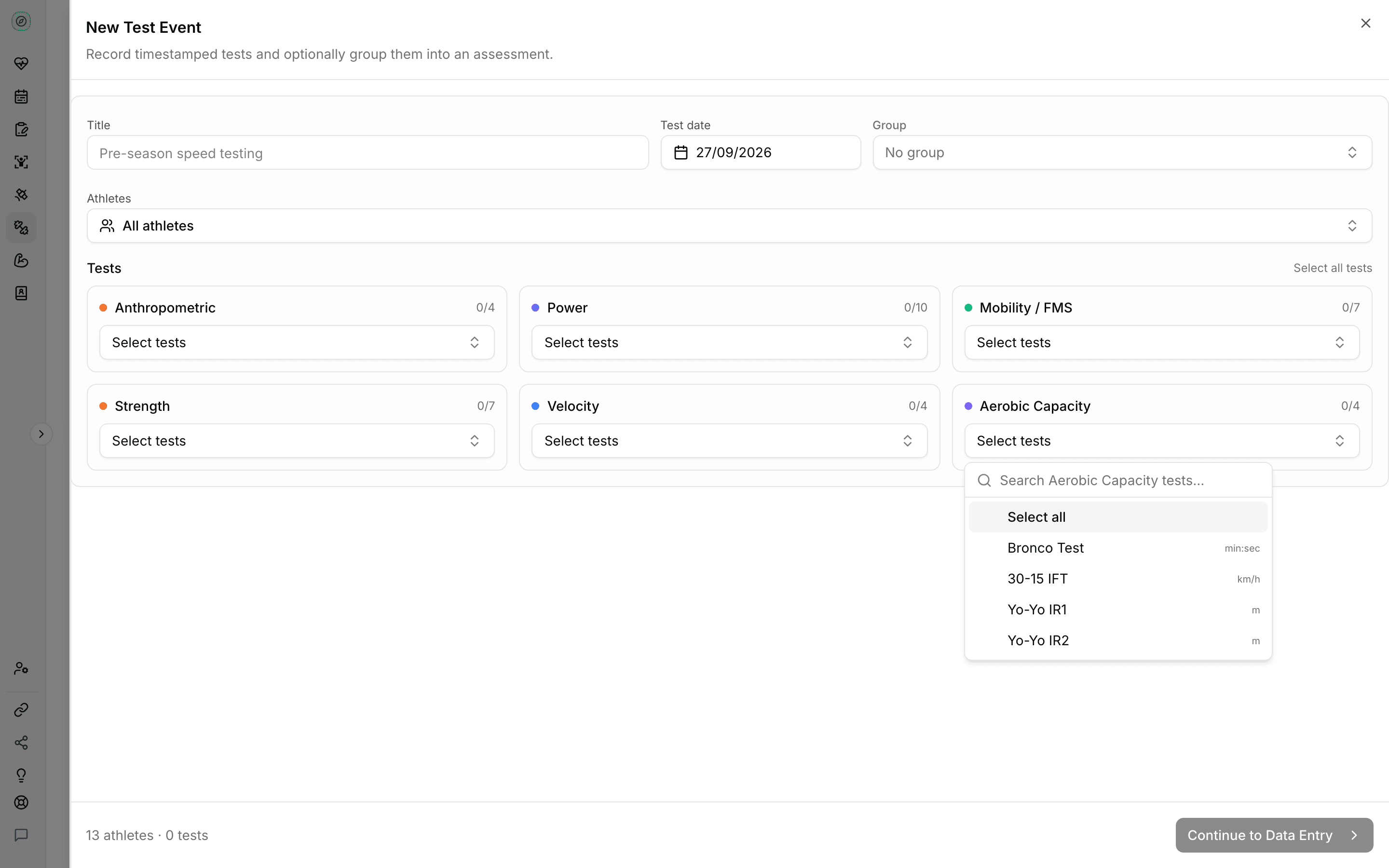
Fractall physical tests: the aerobic test catalogue, where the Cooper test sits next to the Bronco, 30-15 IFT and Yo-Yo IR1.

Cooper test

What the Cooper test is

A 12-minute run for distance, scored in metres, with a VO2max estimate worked out from the distance.

Quick answer

The Cooper test is a 12-minute run: each player covers as much distance as possible in 12 minutes, usually on a 400 m track, and you record the metres. The common VO2max estimate is (metres minus 504.9) divided by 44.73, so 2,800 m gives about 51 ml/kg/min. In team-sport athletes that estimate read 6 ml/kg/min low on average. The score table copied across the web is credited to Cooper's 1968 paper, which tested only men, so its women's bands cannot come from it. A change smaller than about 50 m between two tests is within the test's own noise.
Below: how to run it with a whole squad, the VO2max formula and how far off it can be, the score table and where it comes from, what footballers and referees actually run, and how big a change has to be before it means anything.

Cooper test

A field test of aerobic fitness: the distance a person covers in 12 minutes of running, used on its own or to estimate VO2max.

Example: Kenneth Cooper tested 115 US Air Force men in 1968. Their 12-minute distance correlated 0.897 with VO2max measured on a treadmill.

Cooper built it for large groups with almost no equipment, which is still the reason clubs use it: a track, a stopwatch and someone counting laps. The 1968 abstract calls it "readily adaptable to large groups" with "minimum equipment", and a better indicator than the 600-yard run it was compared with.
Cooper KH, JAMA, 1968, PMID 5694044 (abstract read; full text paywalled). The Cooper Institute, "50 Years of the Cooper 12-Minute Run", 2018.

Protocol

How to run the Cooper test with a squad

The Cooper Institute protocol, plus what a club needs when 20 players run at once.

  1. 1

    Use a measured surface

    A standard 400 m track is what the Cooper Institute describes. A measured loop on a pitch works if you know its exact length.

  2. 2

    Warm up for at least 5 minutes

    Then start everyone in lane 1, or on the inside of the loop.

  3. 3

    Run for 12 minutes

    As far as possible, at a steady pace the player can hold for the whole 12 minutes.

  4. 4

    Count laps to the nearest quarter

    One counter per three or four players, with a sheet ready, so nobody is guessing at the end.

  5. 5

    Cool down by walking

    5 to 10 minutes.

The protocol steps come from the Cooper Institute. The counting advice is ours, from practice, not from a study. With a squad the weak point is the lap count, so write each player's laps down as they pass, and at the whistle mark where each one stopped.
The test needs a track or an accurately measured loop. A 2011 review of FIFA's referee tests noted that a running track "is not always available", which is one practical reason clubs pick a shuttle test instead, such as the Yo-Yo IR1 or the Bronco.

VO2max

The VO2max formula, and how far off it can be

VO2max = (metres minus 504.9) / 44.73. Good for ranking a squad, wide for any one player.

The equation used by almost every calculator is VO2max (ml/kg/min) = (distance in metres minus 504.9) / 44.73. In miles it is 35.98 times the distance, minus 11.29. It is widely credited to Cooper 1968; we could not open the full paper to confirm it is printed there, so we call it the equation most commonly used.
12-minute distanceEstimated VO2maxNote
2,400 m42.4 ml/kg/minOur arithmetic with the common equation
2,800 m51.3 ml/kg/minOur arithmetic with the common equation
3,000 m55.8 ml/kg/minOur arithmetic with the common equation
3,200 m60.3 ml/kg/minOur arithmetic with the common equation

-6.0

ml/kg/min: how far the estimate read below measured VO2max

73 university team-sport athletes (soccer, rugby, futsal, handball), Cooper test and treadmill test 2 to 7 days apart. Limits of agreement -19.8 to +7.9. Soares et al., Int J Exerc Sci, 2026.

The estimate works for ranking a squad and is wide for any one player. In those 73 athletes the average gap was 6 ml/kg/min, and a single player's error ran from about 20 low to 8 high (95% limits). Football and rugby players were 4.5 low on average; futsal and handball players 7.4 low.
The direction of the error depends on who runs. In 21 healthy adults it read low at low fitness and high at high fitness (Penry 2011). In 22 young regular exercisers it matched the treadmill average (Grant 1995). A meta-analysis of 123 walk and run studies pooled the 12-minute run at 0.78 against measured VO2max (Mayorga-Vega 2016), lower than the 0.897 in Cooper's own sample.
Soares et al., Int J Exerc Sci, 2026, PMID 42516264. Penry et al., J Strength Cond Res, 2011, PMID 20647946. Grant et al., Br J Sports Med, 1995, PMID 8800845. Mayorga-Vega et al., PLoS One, 2016, PMID 26987118.

Score tables

The score table everyone copies, and where it comes from

Credited to Cooper 1968, which tested only men. Use it as a rough guide, not a standard.

BandMen 20 to 29Women 20 to 29
ExcellentAbove 2,800 mAbove 2,700 m
Above average2,400 to 2,800 m2,200 to 2,700 m
Average2,200 to 2,399 m1,800 to 2,199 m
Below average1,600 to 2,199 m1,500 to 1,799 m
PoorBelow 1,600 mBelow 1,500 m
This is the table you will find on most sites, for ages 20 to 29. Several of them credit Cooper's 1968 JAMA paper. That paper tested 115 men, so it cannot be the source of the women's bands, and none of the sites names another one. The band edges also overlap: 2,800 m sits in two bands. Other sites publish different tables for the same age group, also without a named source.
A third-party site says the Cooper Institute publishes 12-minute run norms in a 2013 monograph on fitness assessment for adults and law enforcement. We could not open the monograph, so we cannot say whether it matches this table.
Use the table to place a player roughly, and your own squad's results to set targets. A general-population table says little about where a semi-pro midfielder should be.
Table as published by Topend Sports, Brian Mac and Sport Science Insider, opened 16 Nov 2026. Cooper KH, JAMA, 1968, PMID 5694044.

Football

What footballers and referees run, and why FIFA moved on

Elite referees run about 2,900 to 3,050 m. FIFA replaced the 12-minute run in its referee tests from 2007.

Group12-minute distanceSource
FIFA-listed referees, European study3,043 ± 127 mBartha et al., JSCR, 2009
Italian Serie A and B referees (n = 14)3,000 ± 112 mCastagna et al., JSCR, 2005
Hungarian elite referees2,939 ± 136 mBartha et al., JSCR, 2009
Professional footballers, NASL (n = 18), end of season1.86 miles, about 2,990 mRaven et al., Br J Sports Med, 1976 (conversion ours)
Hungarian county III referees2,522 ± 270 mBartha et al., JSCR, 2009
Most published football data on the Cooper test is from referees, because FIFA used it in its referee fitness tests. In 2005 UEFA described the minimum as 2.7 km in 12 minutes. Across 2,459 referees in 18 European countries, the distance separated the levels: FIFA referees ran furthest (Bartha 2009).
Studies on match running told a different story. In Italian referees, the 12-minute run did not separate Serie A and B officials from lower levels; the Yo-Yo IR1 did (Castagna 2005). In Danish top-league referees, the Yo-Yo explained more of high-intensity match running than the 12-minute run, an r² of 0.57 against 0.21 (Krustrup and Bangsbo 2001). FIFA introduced a new battery of 40 m sprints and 150 m intervals from 1 January 2007 (Cerqueira 2011, citing a FIFA newsletter), and Premier League referees were tested on it in 2007-08 (Weston 2009).
For a football squad, the Cooper test measures aerobic fitness cheaply; an intermittent test tells you more about match running. That second point comes from referee studies, not players. No direct comparison of the Cooper test with the 30-15 IFT or the Bronco was found. For how to choose a battery, see the physical tests that matter for a small club.
Bartha et al., J Strength Cond Res, 2009, PMID 19125100. Castagna et al., J Strength Cond Res, 2005, PMID 16287348. Krustrup and Bangsbo, J Sports Sci, 2001, PMID 11695510. Raven et al., Br J Sports Med, 1976, PMID 1009297. Cerqueira et al., Rev Bras Med Esporte, 2011. Weston et al., J Sports Sci, 2009, PMID 19724966. UEFA.com, 1 Feb 2005.

Reliability

How much a Cooper result has to change to be real

About 50 m between two tests, measured in trained runners.

52 m

Typical variation between two Cooper tests

15 male amateur distance runners, retested at 48 hours on a 400 m track: 52.2 m, or 1.7%. ICC 0.99. Alvero-Cruz et al., Rev Andal Med Deporte, 2017.

A player who ran 2,780 m in July and 2,820 m in September has not demonstrably improved. That gap is inside the test's own variation, and it was measured in runners who pace well. Footballers who set off too fast will probably vary more; no retest study in team-sport players was found.

Before you compare two Cooper tests

  • Same surface and the same loop.
  • Same point in the week, never the day after a match.
  • Same warm-up and the same instruction about pacing.
  • Note the temperature and wind if you test outdoors.
  • Treat anything under about 50 m as no change.

In Fractall

Where the Cooper distance goes after test day

The distance, the VO2max estimate and your own bands, on each player's record.

How the Cooper test is recorded in Fractall

1

Enter each player's 12-minute distance. Fractall works out the VO2max estimate with the common equation above.

2

The result is graded Excellent, Good, Average or Poor against cut-offs for the player's sex. The defaults follow the common table, so change them for your squad in Physical Tests settings: the bands are saved per team.

3

Results are saved per testing session, and the team overview compares two sessions. Session RPE load and wellness are tracked in the same app.

The Cooper test is one of the aerobic protocols in Fractall's aerobic testing, next to the Bronco, the 30-15 IFT, the Yo-Yo IR1 and IR2 and the 5-minute run. See how physical tests work in Fractall, and how the same app tracks the session RPE load of the weeks before it.

Test results and load data in one app

Fractall saves every testing session, compares two of them across the squad and grades each result against bands you set. Load and wellness live in the same app. The first month is free.

Start free trial

FAQs

Frequently asked questions

The questions coaches ask about the Cooper test.

What is the Cooper test?

A 12-minute run: each player covers as much distance as possible in 12 minutes, usually on a 400 m track, and you record the metres. Kenneth Cooper published it in 1968 after testing 115 US Air Force men, where the distance correlated 0.897 with treadmill VO2max.

How do you calculate VO2max from the Cooper test?

The equation most often used is VO2max (ml/kg/min) = (distance in metres minus 504.9) divided by 44.73. 2,400 m gives about 42.4, 2,800 m about 51.3 and 3,200 m about 60.3. It is an estimate: in 73 university team-sport athletes it read 6.0 ml/kg/min low on average, with individual errors from about 20 low to 8 high.

What is a good Cooper test score?

The table copied across most websites puts men aged 20 to 29 at excellent above 2,800 m and women above 2,700 m. It is credited to Cooper's 1968 paper, which tested men only, so the women's bands cannot come from it. For football, FIFA referees averaged 3,043 m in a study of referees from 18 European countries, and a 1976 squad of NASL professionals ran about 2,990 m.

Is the Cooper test good for football?

It measures aerobic fitness cheaply and works for a whole squad, but it is a continuous run and football is intermittent. In Italian referees the Yo-Yo IR1 separated top-level officials from lower levels and the 12-minute run did not, and FIFA replaced the run in its referee tests from 2007 (Cerqueira 2011).

How far should you run in 12 minutes?

Using the common table, 2,400 to 2,800 m is above average for men aged 20 to 29 and 2,200 to 2,700 m for women. Elite referees run about 2,900 to 3,050 m. Treat these as rough marks: we could not trace where the table comes from.

How much does a Cooper result need to change to be real?

About 50 m. In 15 trained runners tested 48 hours apart, the within-subject variation was 52.2 m, or 1.7%. Footballers who pace less evenly will probably vary more, and no retest study in team-sport players was found.

Related guides