

4 Weeks Free Access (cancel anytime)
Interactive GuideWearablesTraining loadSession RPE

Garmin, Apple Watch and Polar Training Load for Team Sports

What Garmin, Apple Watch and Polar training load scores actually measure, why they don't compare across a squad, and how to run one team standard with sRPE.

Published
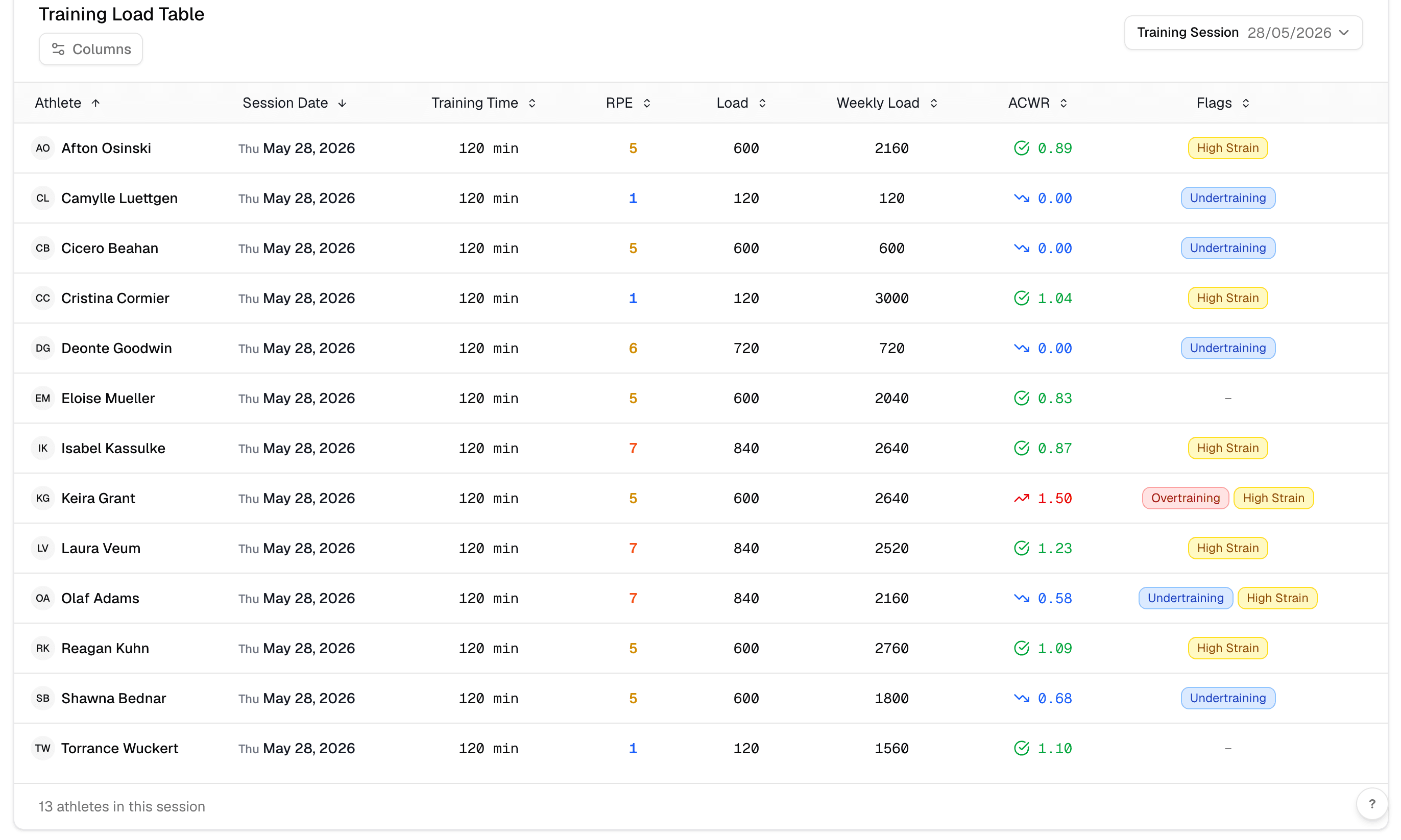
Fractall training load table showing each athlete's RPE, load, weekly load, ACWR, and overtraining or undertraining flags.

Quick answer

Garmin, Apple Watch and Polar: three different numbers

Garmin builds its training load from EPOC, Apple multiplies a 1 to 10 effort rating by duration, and Polar's Cardio Load is TRIMP based. The scores sit on different scales and none of them transfers between brands, so a mixed squad can't be monitored through watches. Session RPE gives you one internal load number per player, and it needs no watch at all.

The question players keep asking

A centre back shows you his watch after training. Load ratio 1.6, the screen says, with an arrow pointing up. He wants to know if he should skip tomorrow's gym block. Whether that number should change anything depends on what it measures, and the honest answer is different for every brand on your squad's wrists.

The watches already agree on the method

Apple asks athletes to rate effort from 1 to 10 and multiplies it by duration. Polar ships a Perceived Load score built the same way. The watch industry has quietly converged on RPE, the method sports science validated for team sports two decades ago, and the one you can run across a whole squad for free.

Garmin

What does Garmin's training load actually measure?

Garmin's training load is an estimate of EPOC, excess post-exercise oxygen consumption, modelled from heart rate during the session. Its load ratio divides short-term load by long-term load.

Oxygen debt, modelled from heart rate

Garmin's own manuals define acute load as "a weighted sum of your excess post-exercise oxygen consumption (EPOC) for the last several days," and load ratio as the ratio of that short-term load to your long-term load. Everything in the score starts from heart rate.

A familiar ratio with a private formula

An acute figure divided by a chronic one is the same idea as ACWR, which most coaches already track from session data. The difference is the input. Garmin's version runs on modelled oxygen debt, and the company doesn't publish the exact day windows behind "the last several days," so you can't reconstruct the number or line it up against a ratio you calculate yourself. For an endurance athlete training alone, that's a reasonable readout. Everything a marathoner does shows up in heart rate. A footballer's week doesn't.
Definitions quoted from the Garmin Forerunner 970 owner's manual, Acute Load section, retrieved August 2026. Garmin does not publish the acute or chronic day windows there, so this article doesn't claim them.

Apple Watch

What does Apple Watch training load measure?

Apple's training load, added in watchOS 11 in 2024, multiplies an effort rating by workout duration, then compares the most recent 7 days against a 28 day weighted average.

An effort rating times minutes

For cardio workouts the watch estimates the 1 to 10 effort automatically from age, height and weight plus GPS, heart rate and elevation data. The athlete can adjust the estimate, and for strength training there's no automatic estimate at all: the athlete enters the rating by hand. The result is labelled from well below to well above the 28 day baseline.

Sounds familiar for a reason

A subjective effort score on a 1 to 10 scale, multiplied by minutes, compared across a rolling month. That's session RPE with an algorithmic starting guess. Apple's design also concedes the point coaches have known for years: when the work is strength, heart rate has nothing useful to say, so the athlete's own rating becomes the measurement.
Feature mechanics from Apple's watchOS 11 announcement (Apple Newsroom, June 2024): automatic effort estimates for cardio workouts, manual entry for strength, and a 28 day weighted average of effort ratings and duration as the baseline.

Polar

What do Polar's Cardio Load and Training Load Pro measure?

Polar splits training load into three scores: a TRIMP based Cardio Load from heart rate, a Muscle Load in kilojoules from power data, and a Perceived Load built from the athlete's own 1 to 10 rating times duration.

Three scores, three signals

Cardio Load is computed from heart rate, with a typical 60 minute session landing between 70 and 130 by Polar's own documentation. Muscle Load counts the mechanical energy in kilojoules produced during running and cycling sessions with power data. Perceived Load multiplies the athlete's own 1 to 10 rating by session duration.

Polar says the quiet part out loud

Polar is direct about why the third score exists. Perceived Load, in their words, "is a useful tool especially in sports where measuring training load based on heart rate alone has its limitations, for example strength training." Two major watch brands now ship a subjective rating beside their sensor data because heart rate misses too much on its own.
Definitions from Polar's Training Load Pro documentation (polar.com support and user manuals, retrieved August 2026).

The squad problem

Why the numbers won't add up across a squad

Garmin, Apple and Polar training load scores can't be combined or compared, because each brand uses its own input signal and formula, reported on its own scale. A Garmin acute load of 300 and a Polar Cardio Load of 130 describe two different quantities in two different units.

SystemBuilt fromComparable across a squad
Garmin training loadEPOC modelled from heart rateNo. Garmin wearers only.
Apple Watch training load1 to 10 effort rating × duration, entered by hand for strengthNo. Apple Watch wearers only.
Polar Training Load ProHeart rate TRIMP, plus Muscle Load and an RPE-based Perceived LoadNo. Polar wearers only.
Session RPEAthlete's 0 to 10 rating × minutes, gym sessions includedYes. Every athlete, no device.

That table is the whole problem in four rows. Even if every score were perfect on its own terms, three practical gaps remain for a coach.

Coverage

The number only exists for players who own that brand of watch and wore it, charged, to training. Squad monitoring can't run on a metric a third of the squad doesn't produce.

Translation

With mixed brands there's no exchange rate. You can't rank load or plan a week from figures that don't share a unit.

Baselines

Each watch compares the athlete against their own recent history, which is exactly right for a consumer product and useless for a squad view. You get eleven private trends and no team picture.

The evidence

Where heart rate based load under-reads team sport work

Heart rate based training load struggles with the stop-start shape of team sport. Intermittent exercise disturbs the heart rate relationships that TRIMP style calculations depend on.

What the research found

Research published in the Journal of Science and Medicine in Sport found that intermittent exercise alters the heart rate to blood lactate relationship that TRIMP calculations depend on, and may underestimate training load in team sport players as a result. A 2018 conceptual review in Frontiers in Physiology makes the underlying point: the linear link between heart rate and work intensity holds during continuous work, and a football session rarely offers any.

The expensive work is the invisible work

Sprints, duels, jumps and gym work are the expensive parts of a team sport week, and they're precisely what a heart rate model reads worst. Short maximal efforts end before heart rate catches up. Resistance training barely registers. This is why both Apple and Polar bolt a subjective rating onto their sensor stack, and it's why the internal load method validated for football doesn't use heart rate at all. The internal versus external load distinction is worth getting straight before choosing any of these tools.

The team standard

Session RPE: one question, every athlete

Session RPE gives every athlete the same load number regardless of what's on their wrist. Each player rates how hard the session was on a 0 to 10 scale, the rating is multiplied by duration in minutes, and the result is comparable across the squad and across the season.

  1. 1

    Collect one rating per player after every session

    Within about 30 minutes of the session ending, gym included. If you're new to the method, start with the basics of session RPE first.

  2. 2

    Multiply rating by minutes for session load

    A 7 out of 10 across a 90 minute session is 630 arbitrary units. The unit doesn't matter; the consistency does.

  3. 3

    Sum the week and watch the change

    Weekly load against the previous week is the first trend worth reading.

  4. 4

    Track acute against chronic load once four weeks exist

    That's ACWR, calculated from data every athlete produces instead of a watch estimate.

  5. 5

    Let the watch stay what it is

    Personal context the athlete brings to a conversation, especially around sleep and recovery.

Validated where it matters for you

The method dates to the late 1990s and costs nothing to run. Impellizzeri and colleagues tested session RPE against heart rate based methods in 19 youth soccer players and concluded it can be considered a good indicator of the global internal load of soccer training. The study is from 2004. The watch industry arrived at the same design in 2024.

The answer for the centre back

So the player with the 1.6 load ratio gets a real answer. Thanks for flagging it. Then you check his sRPE trend and his wellness entry in your own system, against the whole squad, and decide from data that compares.

In Fractall

Running sRPE and ACWR without hardware

Fractall runs this workflow with no devices at all. Athletes submit their RPE from a phone in the seconds after training, and the coach reads one table instead of eleven watch faces.

From session to squad view

1

Athletes rate the session on their phone, prompted automatically.

2

Session load, weekly totals and ACWR are calculated for the whole squad.

3

Flags surface the outliers so the conversation happens before the injury.

The pieces, if you want to read further
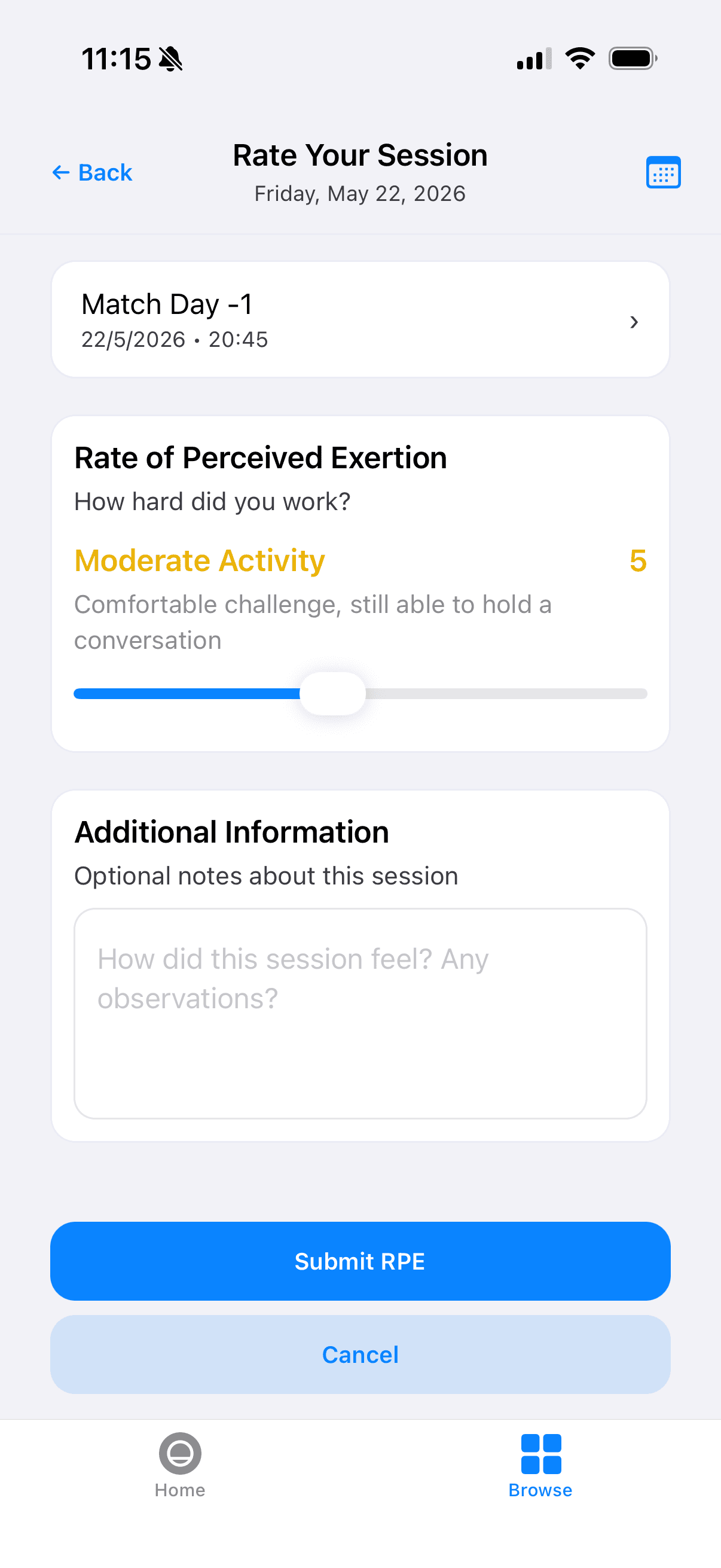
The collection side runs through Fractall's RPE monitoring and the ratio side through the ACWR dashboard. Both work from the same one-question submission.
Fractall mobile app athlete sRPE submission screen with the perceived exertion slider set to 5, Moderate Activity.
The whole ask, from the athlete's side: one slider, a few seconds, any phone.

One load number for the whole squad

Whatever's on their wrists. Try Fractall free for 4 weeks, set up in minutes, no hardware required.

Try Fractall free

FAQs

Wearable training load questions coaches ask

Short answers for staff deciding what to do with the numbers players bring in.

Can I combine Garmin and Apple Watch training load across my squad?

No. Garmin's score is modelled from EPOC, Apple's multiplies an effort rating by duration, and the two sit on unrelated scales. There's no conversion between them, so a squad wearing mixed brands can't be monitored through watch load scores.

Is Garmin's load ratio the same as ACWR?

It's the same idea, an acute load divided by a chronic load, but built from EPOC estimates rather than session data, with day windows Garmin doesn't publish. Treat it as a cousin of ACWR, and don't mix it into an ACWR you calculate from session RPE.

Do athletes need a watch for session RPE?

No. Session RPE needs one rating from the athlete and the session duration, nothing else. That's the point: every athlete produces the same metric whether they wear a Garmin, an Apple Watch, a Polar or nothing.

Should I ask players to stop wearing their watches?

No. The watch is useful personal context, especially for sleep and recovery habits. Just keep squad decisions on a metric every player produces.

Which watch has the most accurate training load?

They measure different things, so there's no single answer. Garmin models oxygen debt, Apple scores perceived effort, Polar offers both plus mechanical work. For squad decisions the accuracy question matters less than the comparability one, and on comparability none of them can beat a method every athlete shares.

Related guides