

4 Weeks Free Access (cancel anytime)
Buyer’s guideInjury trackingBuyer’s guideSoftware pricing

Injury Tracking Software: A Buyer’s Guide for S&C Coaches

What an injury record has to capture, which tools capture it, and what each one costs. Prices read off vendor sites in September 2026.

Published
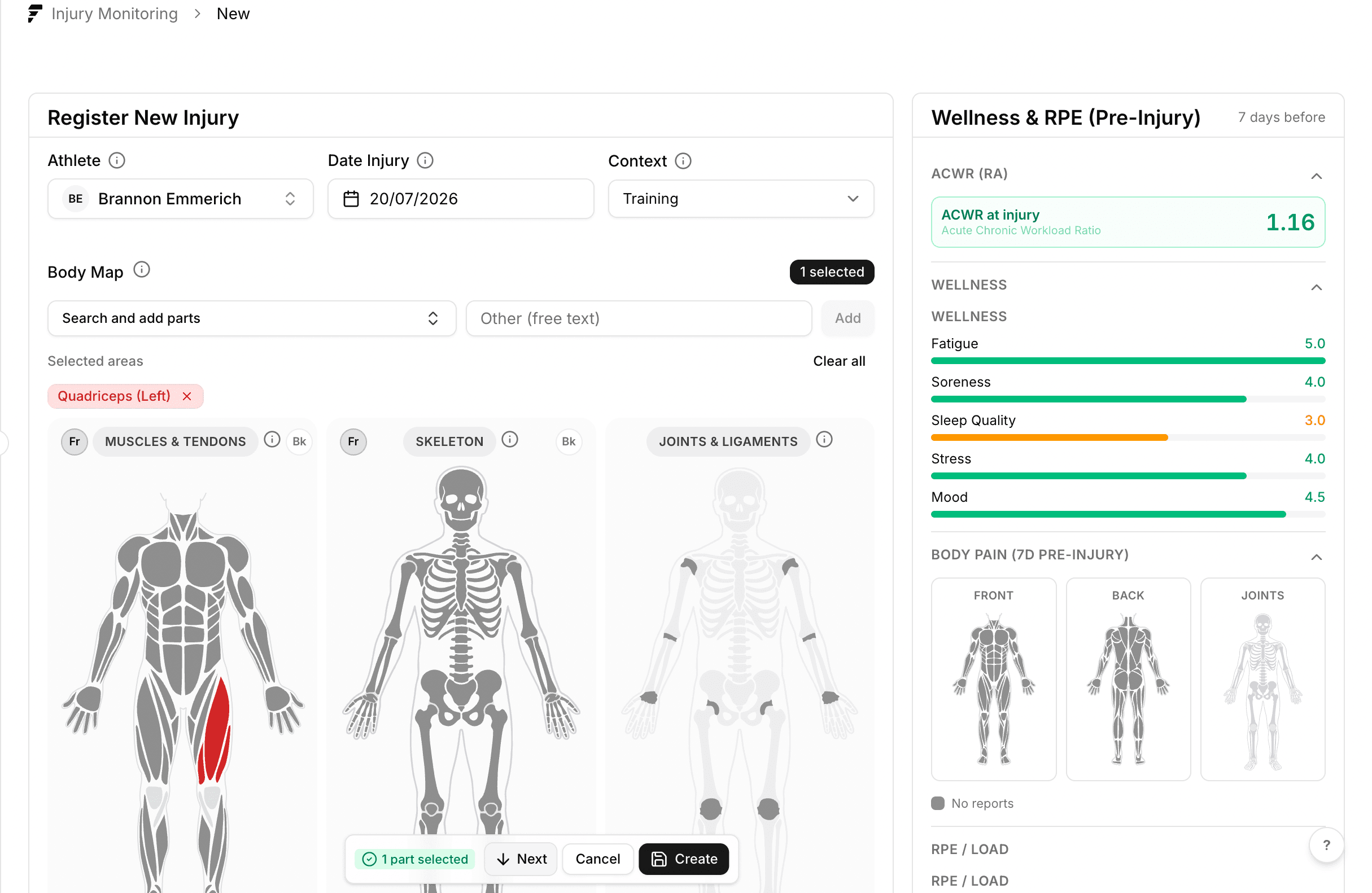
Fractall register new injury form with athlete, date and context fields, a layered body map, and the pre-injury wellness and RPE panel beside it

Quick answer

Judge injury tracking software on whether it holds a record you can read back a season later: body area and structure as separate fields, a status that stays current, a return-to-play date, and a recurrence checked against the athlete’s own history. Most tools in this category won’t publish a price. Of the seven compared here, three do, and one of those three puts injury reporting and return-to-play plans in its top tier at $3,350 per year. Fractall bundles injury monitoring into €20 per team per month with a 4-week trial and no card.

The rubric

What an injury record has to hold

Feature lists in this category are close to useless, because “injury tracking” covers everything from a pain slider to a clinical record. Five checks separate them.

We wrote the long version of this separately, in what to record when a player gets injured, which follows the IOC consensus and the STROBE-SIIS extension for injury surveillance. Here it is compressed into the five things worth checking before you pay for anything.

Five checks to run on any tool

  • Body area and the specific structure are separate fields, so “Quadriceps (Left)” is data rather than a note somebody has to interpret next season.
  • There is a status the tool keeps current, and a return-to-play date, not just an open and closed flag.
  • A recurrence is distinguished from a new injury to the same site, checked against the athlete’s history rather than the coach’s memory.
  • The load and wellness from the days before the injury are attached to the record, not reconstructed afterwards from a form export.
  • A non-clinician can file a usable record without being forced to guess a diagnosis.
The last one gets ignored most often and matters most at a small club. The IOC consensus is explicit that reporting by athletes and non-medical staff should stay limited to body area, because non-clinician reporting of tissue type and abnormality isn’t reliable. If your club has no physio on a Tuesday night, a tool that won’t save a record without a diagnosis field either blocks you or teaches your staff to invent one.

The money

The three tools that publish a price

Read this section with the date attached: every figure below came off the vendor’s own pricing page on 7 September 2026, and this category re-tiers often.

Lumin Sports publishes four annual tiers, priced in USD and scaled by user count. At the up-to-50-users band they are Strength at $1,000, Lite at $600, Core at $2,000 and Pro at $3,350. The interesting part is where the medical features sit. Core buys athlete-reported soreness, athlete availability, body composition and medical testing. Injury reporting, SOAP notes, treatments, medical file storage and rehab and return-to-play plans are all Pro only. So if injury tracking is the reason you’re buying, Lumin starts at $3,350 a year rather than $600. There’s a free 7-day demo with no card.
TeamBuildr publishes its Strength tiers in USD: Silver at $90 a month or $900 a year for 50 athletes, Gold at $150 a month for 250, Platinum at $200 a month for 500, and Platinum Pro at $280 a month for 1,000. Annual billing is ten times the monthly rate, so two months are free. The AMS module, which is where the injury and recovery monitoring lives, is a separate add-on at $50 a month or $500 a year. What that module does is athlete-reported pain location and severity through daily check-ins, surfaced as a body heat map, plus injury status. We could not verify a structured injury record carrying a diagnosis and a return-to-play date, so treat it as a strong soreness and availability picture rather than a clinical record until the vendor shows you otherwise.
Fractall is €20 per team per month, or €16.67 a month billed annually, with every module included and a 4-week free trial that needs no card. Injury monitoring isn’t a tier or an add-on. The detail of what it records is in the injury monitoring page, and there’s a section further down this guide.

Watch the aggregators

While researching this we found a widely-repeated figure putting TeamBuildr’s AMS add-on at $80 a month. The vendor’s own pricing page says $50. We also found a “from $995 a year” price for SportsWare Online that appears on no page CSMi publishes. Directory and comparison sites in this category recycle each other’s numbers, so check the vendor’s page before you build a budget on one.

The rest

The four that quote on request

No published price is not the same as expensive, but it does mean a call before you can compare, which is the part that slows a small club down.

AthleteMonitoring is the most standards-serious tool we looked at. Its injury surveillance implements the IOC consensus and the STROBE-SIIS extension directly, and it carries OSTRC questionnaires and the 2023 IOC consensus on athlete mental health. Pricing is quote-only across four named packages, with a quote emailed inside 24 hours and volume and multi-year discounts mentioned without figures. If your club has clinical staff and a surveillance obligation, it belongs on your shortlist.
Metrifit is quote-only with a 14-day free trial, and covers wellness, load and injury analytics. Kitman Labs publishes no pricing anywhere and sells annual enterprise contracts, which for a small club is a different product category rather than a dear version of the same one. XPS Network includes injury management and publishes no price we could find. SportsWare Online from CSMi is built around athletic trainers in the US school and college system, licensed by concurrent trainer seats with athletes, parents and coaches free, and modules priced separately. No public figure.

Side by side

What tier holds an injury record, and what it costs

One row per tool. The middle column is the one that decides most shortlists.

ToolWhat tier holds an injury recordPrice (verified 7 Sep 2026)
FractallIncluded: body area, structure, type, diagnosis, mechanism, status, return to play€20 per team/month (€16.67 billed annually); 4-week trial, no card
Lumin SportsPro only: injury reporting, SOAP notes, treatments, rehab and RTP plans$3,350/year for Pro at up to 50 users (Lite $600, Core $2,000); 7-day demo
TeamBuildrAMS add-on: pain location and severity, body heat map, injury status$90/month Strength (50 athletes) plus $50/month AMS; free trial, no card
AthleteMonitoringIncluded in its health packages: IOC and STROBE-SIIS surveillance, OSTRCQuote only, four packages, emailed within 24h
MetrifitInjury analytics alongside wellness and loadQuote only; 14-day free trial
Kitman LabsFull medical and performance record, enterprise scopeNo published price; annual enterprise contract
XPS NetworkInjury management inside a wider coaching platformNo published price found
Prices and tier gating read from each vendor’s own pricing page on 7 September 2026: luminsports.com/pricing (rendered in a browser, as the figures are loaded client-side and don’t appear to a plain fetch), teambuildr.com/pricing, athletemonitoring.com/pricing, csmisolutions.com and fractall.fit/pricing. Lumin’s tier assignments come from the medical rows of its own feature comparison table, and its prices are the up-to-50-users band; larger squads price higher. TeamBuildr’s AMS injury depth is described from its product and support pages, and a structured injury record with diagnosis and a return-to-play date was not verified. Injury surveillance definitions follow the IOC consensus statement and the STROBE-SIIS extension. For the wider budget picture beyond injuries, see our cost breakdown for a small club.

Product

How Fractall handles the five checks

Included in the single price rather than gated, and built so the week before the injury is already attached when you open the record.
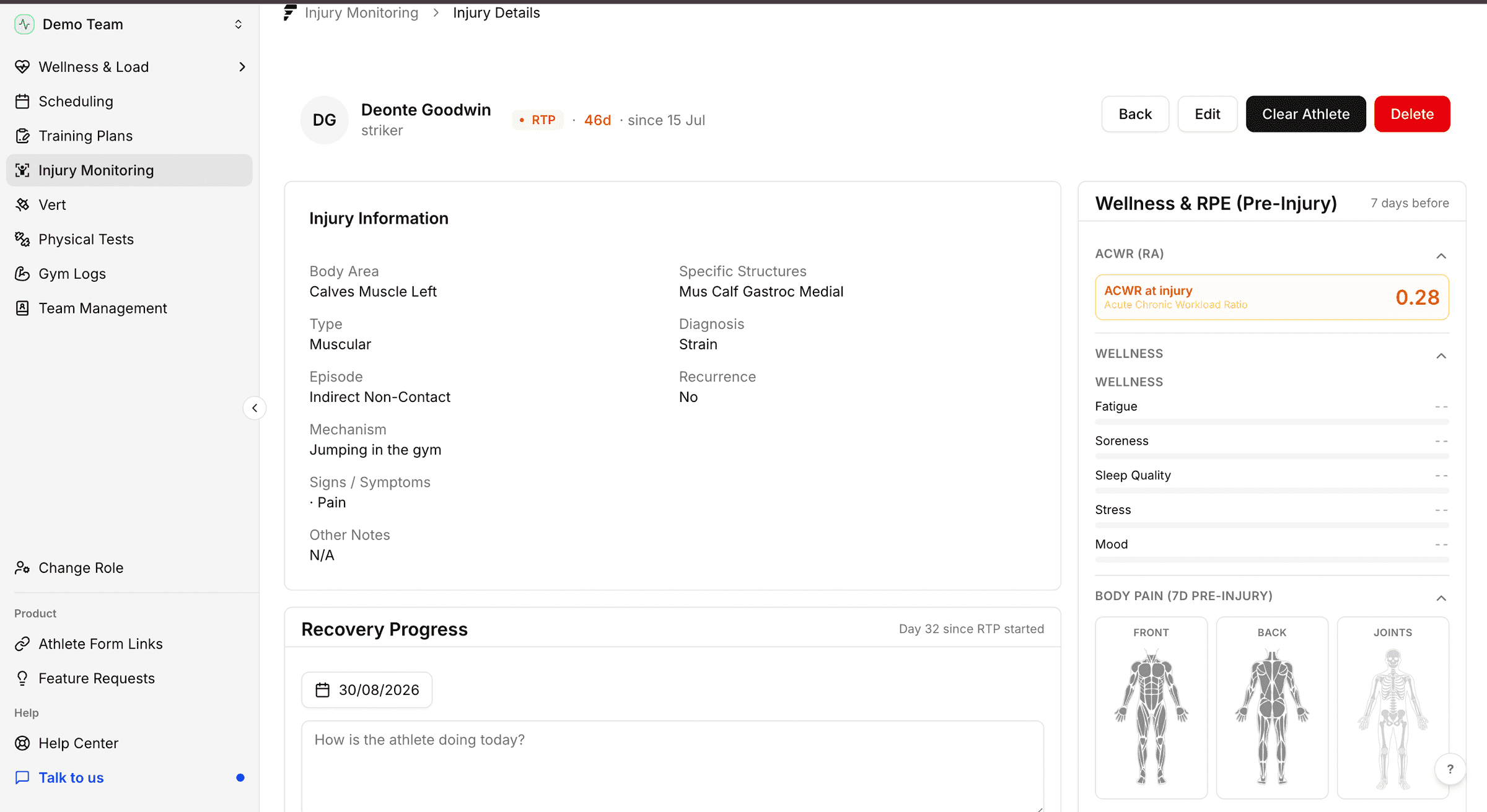
One record per injury carries the body area and the specific structure, the type and diagnosis, the episode and mechanism, the signs and symptoms, and free notes. Each record sits in one of three states, active, return to play, or cleared, and the days out counts itself as the athlete moves between them, so the availability answer stays current without anyone maintaining a sheet.
Recurrence is checked rather than remembered. Fractall looks at the athlete’s history for the same area and structure and flags the row when this one has happened before, which is what turns a third hamstring into the third one instead of a fresh entry. Recovery notes are dated and kept in order across both phases.
Fractall injury detail view with injury information, dated recovery progress entries, and the pre-injury wellness and RPE panel
An injury record with its recovery entries and the week that preceded it on the same screen.
The fourth check is the one that’s hard to bolt on later. Because athletes already submit session RPE and a daily wellness check-in in the same system, opening an injury shows the ACWR at the moment of injury, the fatigue, soreness, sleep, stress and mood scores, the session RPEs from the sessions before it, and where the athlete had been reporting pain. It’s drawn from submissions they had already made, so nobody reconstructs it from memory.

Logging one injury, end to end

1

Pick the athlete and the date, and mark whether it happened in training or a game.

2

Mark the spot on a body map that layers muscle and tendon over the skeleton, front and back, so the structure is recorded rather than described.

3

Read the pre-injury panel that fills in beside the form with the ACWR and wellness from the seven days before.

4

Add dated recovery entries as the athlete progresses, and let the status and days out update themselves through return to play.

What Fractall doesn’t do

It isn’t a clinical EMR. There are no SOAP notes, no prescriptions and no treatment billing, and it won’t replace a physio’s own system at a club that has one. It records injuries, tracks them to cleared, and puts the load and wellness context beside them. If you need clinician-grade charting, AthleteMonitoring or a full EMR is the better answer.

Practical

What to ask the vendors who won’t publish a price

Four of the seven need a call. These are the questions that get you a comparable answer instead of a demo.

Ask on the call

  • What is the annual price for my exact squad size, in writing, including any onboarding or setup fee?
  • Which tier includes the injury record, and what specifically drops out of the tier below it?
  • Can a coach with no clinical qualification file a record without entering a diagnosis?
  • Does the injury record show the athlete’s load and wellness from the week before, without an export?
  • How does the system tell a recurrence apart from a new injury to the same structure?
  • Can I export every injury record if we leave, and in what format?
The last one gets skipped and costs the most later. An injury history is only worth keeping if you can take it with you, and a season of records locked in a platform you’ve left is a season you can’t audit.

FAQs

Common questions about injury tracking software

What should injury tracking software record?

Body area and the specific structure as separate fields, the date, how it happened, a status the tool keeps current, and a return-to-play date. It also has to tell a recurrence apart from a new injury to the same site, which means checking the athlete’s own history rather than asking the coach to remember. Anything that only captures a pain score and a body map is a soreness log, not an injury record.

Is injury tracking usually included or a paid add-on?

More often gated than included. At Lumin Sports, injury reporting, SOAP notes, treatments and rehab and return-to-play plans all sit in the Pro tier at $3,350 per year for up to 50 users, while the $2,000 Core tier gets soreness and availability without an injury record. At TeamBuildr the AMS module is a separate $50 per month on top of a Strength plan starting at $90 per month. Fractall includes injury monitoring in the single €20 per team per month price.

How much does injury tracking software cost?

Most vendors in this category will not tell you without a call. Of the seven tools compared here, three publish a price: Fractall at €20 per team per month, TeamBuildr from $90 per month plus a $50 per month AMS add-on, and Lumin Sports from $600 per year, though its injury features start at the $3,350 Pro tier. Kitman Labs, XPS Network, AthleteMonitoring, Metrifit and SportsWare Online all quote on request.

Should a coach record the diagnosis if there is no physio?

No. The IOC consensus recommends that reporting by athletes and non-medical staff stays limited to body area, because non-clinician reporting of tissue type and abnormality is not reliable. Log the date and the body area and leave tissue and diagnosis for a clinician. A tool that forces a diagnosis before it will save the record works against that.

Do I need separate software for injuries and for training load?

You can run both separately, but then you lose the thing that makes an injury record worth reading later: what the athlete’s load and wellness looked like in the days before it. If the two live in one system, that context attaches itself. If they live apart, joining them means a phone call and an approximate date, usually weeks after the fact.

Put your injury history and your load data in one place

Fractall is €20 per team per month with injury monitoring included, not gated behind a tier. Start a 4-week free trial, no card, and log your first injury today.

Start free trial

Related guides